May 12, 2026
The CLARITY Vote: How Thursday Reshapes Crypto, and Why Circle Already Won
Senate Banking Committee votes Thursday May 14 on the first U.S. crypto market structure bill — the first such committee vote in U.S. history. Three scenarios (60/25/15), Polymarket calibration (62% off the 75% high), what the 309-page bill actually says, why the real trade is Circle (CRCL), and the structure to play it.
The CLARITY Vote: How Thursday Reshapes Crypto, and Why Circle Already Won
Published 2026-05-12. Senate Banking Committee markup vote Thursday May 14, 10:30 AM ET. T-2.
1. Why This Vote Matters
There has never been a Senate committee vote on a U.S. crypto market structure bill. Not ever. Thursday is the first one.
If you’ve been following crypto since 2021, you know the regulatory story has been a six-year fog: the SEC sued exchanges, the CFTC asserted jurisdiction over BTC and ETH, lawsuits dragged on, and a thousand industry op-eds asked Congress to “draw the line.” This Thursday, a single 24-person room in the Russell Senate Office Building draws the line for the first time. Then sends it to the Senate floor in June.
The bill — the Digital Asset Market CLARITY Act — has been ripening for years. The House passed it 294-134 last July. The Senate version dropped at midnight Sunday: 309 pages of jurisdictional bright lines, decentralization tests, DeFi safe harbors, self-custody protections, and one extremely contested compromise on stablecoin yield.
It is the most consequential piece of crypto legislation in U.S. history. It is also already 70% priced in.
This article does three things. First, it walks through what the bill actually does — in plain English, no lawyer-brain. Second, it sets up three scenarios for Thursday and what each does to BTC, ETH, XRP, exchanges, and Circle. Third, it explains why Circle is the cleanest single-name expression of the post-CLARITY world, and how I’d structure that trade today.
The voice is opinionated. The probabilities are subjective. Disclosures at the end.
2. What CLARITY Actually Does
Strip away the 309 pages and there are six moves that matter.
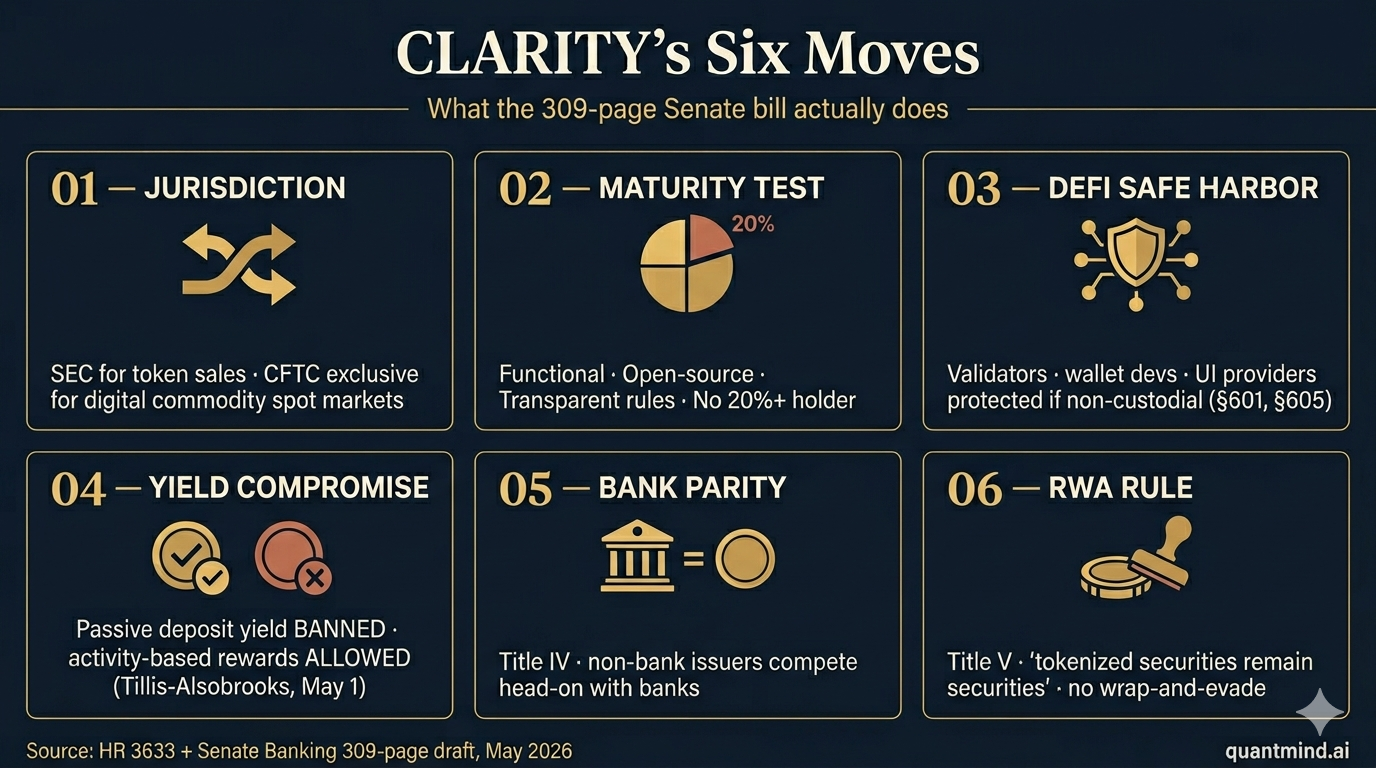
Move 1: SEC vs. CFTC — a bright line
The single biggest source of crypto’s regulatory fog has been the SEC/CFTC turf war. Gensler argued nearly everything was a security. Behnam argued the spot markets needed a federal cop. The Howey test, written for orange-grove investments in 1946, has been the entire judicial framework.
CLARITY ends this. The bill draws a bright line:
- SEC governs token sales/offerings when the token represents an investment contract.
- CFTC governs secondary spot markets in “digital commodities” — including exclusive anti-fraud and anti-manipulation jurisdiction.
New CFTC registration categories appear: digital commodity exchanges, brokers, dealers. They must segregate customer assets, use qualified custody, disclose, and submit to market surveillance. This is what the industry has asked for and what Coinbase has been litigating toward for two years.
Move 2: The “mature blockchain” test
Here’s the clever part. CLARITY doesn’t list which tokens are commodities. It writes a test. A blockchain becomes “mature” — and its native token a digital commodity rather than a security — if it meets four conditions:
- Functional: it can actually execute transactions and run governance.
- Open-source: the code is public.
- Transparent rules: pre-established protocol rules, not arbitrary control.
- Not controlled: no single person or group exercises control — including no token holder above 20% of supply.
This is the decentralization gate. BTC sails through. ETH almost certainly sails through, though staking-concentration lawyers will get rich arguing the edges. XRP gets a clear commodity path — if Ripple’s holdings and escrow are deemed not “control.” SOL, AVAX, ADA all have arguments to make.
The 20% threshold is the most important number in the bill that nobody is talking about.
Move 3: DeFi safe harbor — “regulate control, not code”
CLARITY Section 601 (the new Exchange Act §15H) is the DeFi industry’s victory lap. Blockchain developers, validators, wallet creators, and UI providers get an explicit safe harbor from broker-dealer registration — provided they don’t take custody or exercise control over user funds.
Section 605 (“Keep Your Coins Act”) prohibits federal agencies from restricting self-custody for lawful purposes. The BSA, sanctions enforcement, and anti-fraud powers all survive — but the “Treasury bans non-custodial wallets” nightmare scenario from 2022 is killed by statute.
Protocol developers are not brokers. Uniswap, Aave, Compound, the entire non-custodial stack — they get to operate. This was the condition Coinbase named when it reversed its opposition to the bill in April.
Move 4: The stablecoin yield compromise
This is the one that moved Circle’s stock 40% in a fortnight, and it deserves its own section.
The GENIUS Act, signed into law July 2025, banned issuer-paid yield on stablecoins. That part is settled. The ambiguity was about platform-distributed rewards — like Coinbase’s USDC rewards program, where holding USDC on the platform earned interest-like returns.
The first draft of CLARITY tried to ban all such rewards. Bank lobbyists wrote the language: if you hold dollars and get interest, that should require a bank charter and deposit insurance. End of story.
Circle dropped 20% in a single session — its worst day on record. Then on May 1, Senators Thom Tillis (R-NC) and Angela Alsobrooks (D-MD) struck a bipartisan compromise:
- BANNED: Passive, deposit-like yield. You cannot earn interest just for parking USDC.
- ALLOWED: “Bona fide activities” — rewards tied to transactions, trading volume, payments, platform usage. Joint SEC-CFTC-Treasury rulemaking will define the perimeter.
Circle ripped 20% on the news. Banking lobbyists rejected the compromise on May 9 and are still pushing markup amendments to narrow the carve-out. This is the most important sub-vote inside Thursday’s vote.
Move 5: Bank/non-bank parity (Title IV)
CLARITY does not give traditional banks an exclusive lane on stablecoin distribution. Non-bank issuers like Circle (now an OCC-chartered national trust bank as of December 2025) can compete head-on with JPM, Citi, and the regional bank stablecoin consortia.
This is the banking lobby’s actual loss in the bill, and the reason they are still fighting at the markup-amendment stage.
Move 6: “Tokenized securities remain securities” (Title V)
You cannot wrap a security in a token and escape SEC jurisdiction. RWA tokenization is allowed, encouraged, given a framework — but tokenizing a stock or bond doesn’t change its regulatory class.
This kills the offshore “wrap-and-evade” arbitrage and is, perversely, bullish for compliant RWA platforms: Ondo, BlackRock BUIDL, Franklin Templeton. The legitimate players get a runway; the gray-area players get squeezed out.
What’s NOT in the bill
- No formal retail investor protection regime beyond disclosure.
- No SRO structure.
- No mandatory joint SEC-CFTC rulemaking (à la Dodd-Frank).
- No explicit national bank digital-asset custody pathway.
- No ethics/conflict-of-interest provisions. This is the political fault line.
The Democrats — led by Senators Gillibrand and Schiff — are demanding restrictions barring senior officials from profiting from crypto investments while regulating the industry. The 309-page draft has zero ethics language. Gillibrand has said publicly the bill cannot pass the floor without it. Polling shows 73% voter support for such restrictions.
The Republicans deliberately excluded any language addressing Trump-family crypto ventures (World Liberty Financial, the TRUMP memecoin) to avoid a White House veto threat. This is the bill’s Achilles’ heel.
3. Three Scenarios for Thursday
The committee splits 13 Republicans / 11 Democrats. All 13 Republican votes are needed for party-line passage. Senator John Kennedy (R-LA) is publicly uncommitted — Punchbowl reports his hesitation is not about crypto. Sen. Tillis is firmly yes on the yield compromise he co-authored, but may cross on ethics amendments.
Calibrating with Polymarket
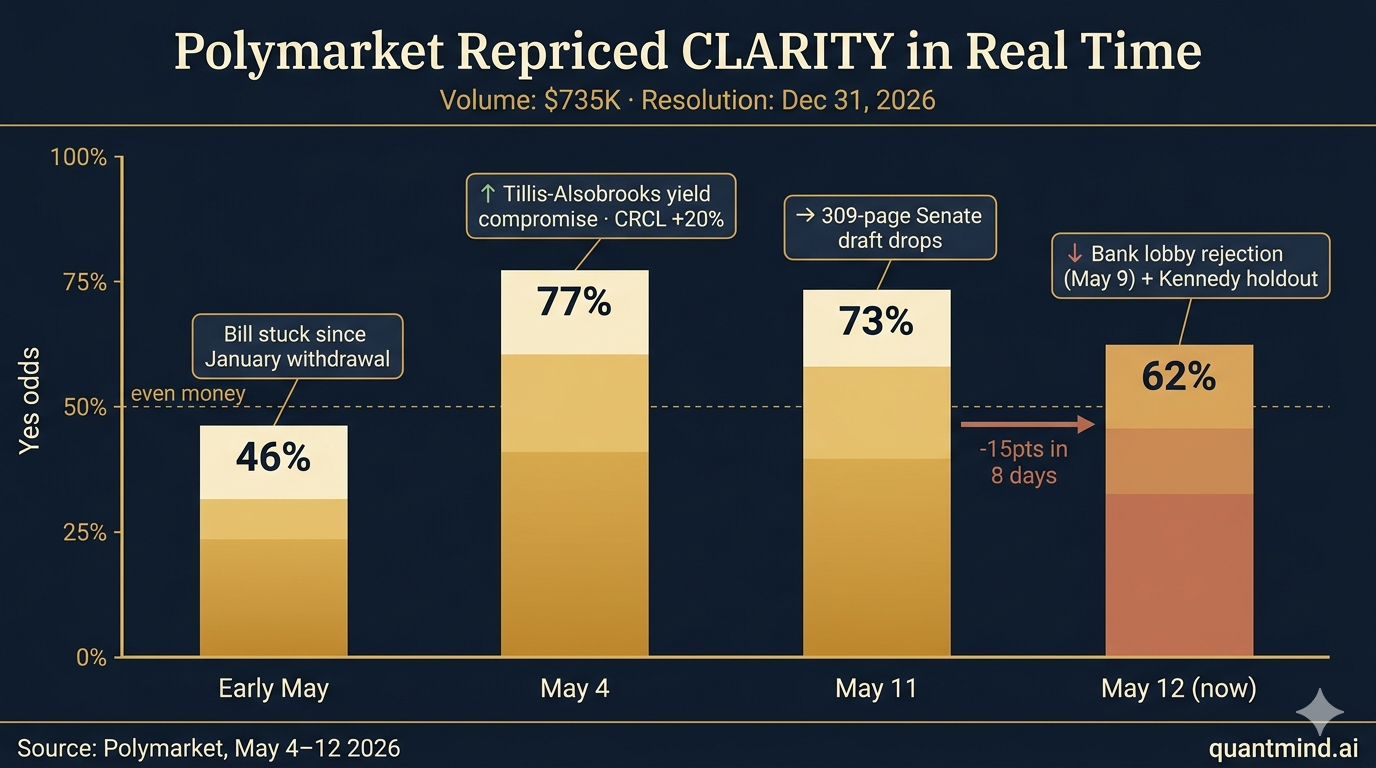
Polymarket has a market on this: “Clarity Act signed into law in 2026?” (resolves Dec 31, 2026). The odds chart over the past two weeks tells its own story:
| Date | Yes | Driver |
|---|---|---|
| Early May | 46% | Bill stuck since January withdrawal |
| May 4 | ~75-80% | Tillis-Alsobrooks compromise; CRCL +20% |
| May 11 | 73% | 309-page draft drops |
| May 12 | 62% | -10pts overnight on bank lobby pushback + Kennedy uncertainty |
The market is pricing the full pipeline — committee + floor + House reconciliation + Trump signature. Decompose:
- Committee pass Thursday: ~75-80% implied
- Senate floor (June target): ~75% conditional on committee pass
- Reconciliation + signing (White House targeted July 4): ~95% conditional on Senate
- Compound: 0.78 × 0.75 × 0.95 ≈ 56% — roughly consistent with the 62% headline
Two things to take from this. First, the market shaved 10-13 points off in 48 hours. That is the real-time pricing of bank-lobby amendment risk and the Kennedy holdout — not a thesis break, but a risk premium being added back. Second, volume is thin ($735K), so the print is movable on light flow. Treat it as a directional signal, not a calibrated probability.
My subjective scenarios below (60/25/15 on a committee-vote basis) imply ~85% committee-pass probability — slightly more optimistic than the market’s implied 75-80%. The justification: the political cost to Republicans of failing the first committee vote on crypto market structure in U.S. history is high enough that Kennedy’s “non-crypto” hesitation likely gets resolved off-camera before Thursday. If you trust the market more than me, shade Scenario C up to 20-25%.
Here is how I read it:
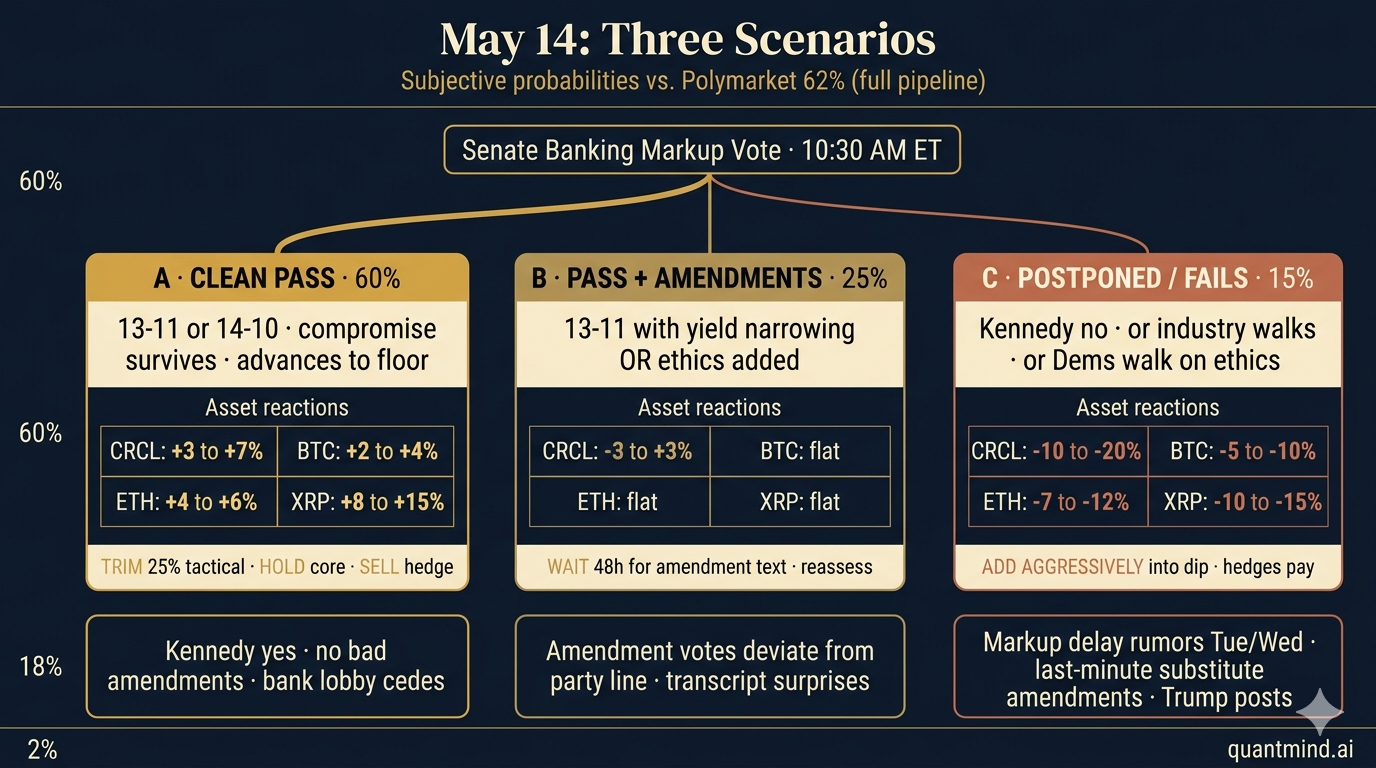
Scenario A — Clean Pass (60%)
The vote is 13-11 or 14-10. Kennedy’s reservations resolve. The Tillis-Alsobrooks compromise survives intact. Bank-lobby amendments to narrow the yield carve-out are tabled or fail. The bill advances to floor.
Market reaction: - CRCL +3 to +7% (most already priced from the May 4 move). - BTC sympathy bid, but $80-90k range likely holds; this isn’t a $100k catalyst by itself. - ETH outperforms BTC on relative terms — staking ambiguity resolves favorably. - XRP biggest single-token mover: clear commodity path opens up the long-anticipated ETF cycle. Up to $8B in projected inflows per industry estimates. - COIN, HOOD: modest bid. Their trading is driven more by volumes than market structure clarity.
Tells (Wed-Thu): Kennedy announces yes. No last-minute amendment surprises. Banking lobby reframes their position as “we lost this round.”
Scenario B — Pass with Significant Amendments (25%)
The bill passes 13-11 but with either: - Bank-friendly yield narrowing (BAD for CRCL/COIN) - Democratic ethics provisions inserted (GOOD for floor passage; neutral for crypto names short-term)
Markup transcripts and amendment vote tallies become the leading indicator. Expect choppy, bidirectional price action while the market digests the amendment text.
Market reaction: CRCL -3% to +3% intraday on uncertainty. Resolution comes in 24-48 hours.
Scenario C — Postponed or Fails (15%)
Kennedy votes no without a replacement. Industry withdraws support over an amendment (as happened in January). Democrats walk out over ethics. Markup gets pushed to June or later.
Market reaction: - CRCL -10 to -20%. (The May 4 +20% move unwinds.) - BTC -5 to -10%. Tests $75k. - ETH -7 to -12%. XRP -10 to -15%. - Equities: COIN, HOOD off 5-8%. Miners largely unaffected.
Tells: Markup delay rumors hit Tue/Wed. Substitute amendments tabled at the last minute. Trump posts criticizing the bill (low probability, but possible if a personal-finance provision sneaks in).
4. The Real Trade: Circle (CRCL)
Here’s the punchline. Of every public name that benefits from CLARITY, Circle is the cleanest expression of the structural shift. Not the best trade for Thursday. The best trade for the decade.
Why CRCL is the asset, not just the stock
Three things matter:
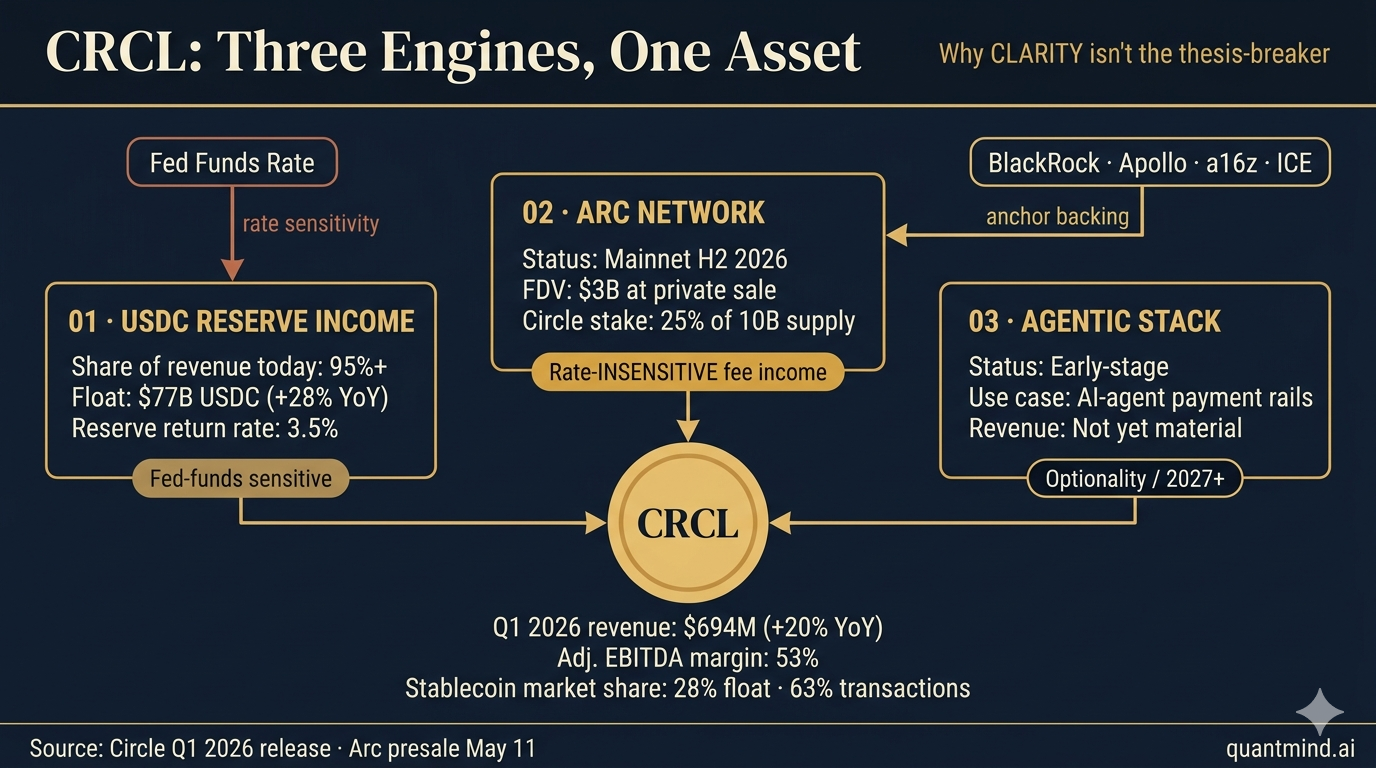
(a) It pays you for dollar float compounding. CRCL is a dollar-stablecoin issuer with $77B in USDC outstanding (up 28% YoY despite a 45% crypto bear market since October). Its core revenue line is reserve income: float × reserve return. Q1 2026 revenue was $694M (+20% YoY) with a 53% adjusted EBITDA margin. This is a high-quality fee-and-float business, not a beta-on-BTC trade.
(b) The compliance moat is the moat. GENIUS Act compliance — 1:1 reserves, monthly attestations, annual audits, ban on issuer-paid yield — is structural. Circle was already there. Tether is not, and the cost of getting there involves submitting to U.S. audits and potentially re-domiciling. The OCC trust bank charter Circle received in December 2025 is the strongest possible signal of where the federal banking architecture is going.
CLARITY’s bank/non-bank parity (Title IV) prevents traditional banks from monopolizing the stablecoin distribution layer. The yield compromise preserves Circle’s distribution partners (Coinbase, fintechs) from losing the activity-based reward programs that drive USDC adoption.
Net: USDC’s market share has the strongest structural tailwind in the stablecoin sector for the rest of 2026.
(c) Arc network is the second engine. On May 11, Circle closed a $222M Arc token presale at a $3B FDV — the first publicly listed company to do a token presale. Investors: a16z crypto ($75M anchor), BlackRock, Apollo, Intercontinental Exchange, SBI Group, ARK Invest, Haun Ventures. Arc is a stablecoin-native L1 with USDC as the gas token, EVM-compatible, mainnet expected H2 2026.
Circle holds 25% of the 10B Arc token supply. The 60% community allocation and 15% reserve are standard. What’s not standard is that this is fee income that isn’t rate-sensitive. The biggest single risk to CRCL’s existing business is Fed cuts compressing reserve return rates. Arc is the explicit hedge — and ICE/BlackRock/Apollo backing it isn’t a vanity round.
What CRCL is worth
At Q1 run-rate of $2.78B revenue and 22% growth, with Arc embedded as optionality, a 12-15× sales multiple gets you to $33-42B equity value, or roughly $140-180/share depending on share count assumptions. Top sell-side targets:
- Mizuho: $135
- Baird: $138
- Needham: $150
- Bull-case (Seeking Alpha): $280
The stock at the time of writing is in the $130s. The 52-week high is $298.99 (June 2025 post-IPO euphoria). The 52-week low is ~$110 (April lows when the yield ban looked total).
Structure I’d Run
Layer 1 — Core long, 2-3 year hold. Add on any pullback into the $120s. No catalyst-driven exit.
Layer 2 — Vote hedge. May 16 weekly puts at the 20-25Δ, sized to cover ~3-5% equity P&L if Scenario C plays out. Roll Friday open if held overnight. Verify pricing on Wednesday; if Kennedy positions positive in pre-vote signaling, this hedge can be deferred or skipped.
Layer 3 — Arc optionality. July or August $170/$200 call spreads. Sized small (10-15bps of portfolio). Pays off on Arc mainnet execution + Tether-share migration. This is the lottery ticket on the structural thesis playing out faster than consensus expects.
The math on Layer 2 specifically: at a $135 reference and the scenario probabilities above, expected value of holding unhedged through May 14 is roughly -0.2% (60% × +5%, 15% × -7%, 10% × +1%, 15% × -15%). The vote itself has poor naked risk/reward. Hedge the tail, let the core ride.
What Breaks the Thesis
Not CLARITY failing — that’s a 15-20% drawdown opportunity, not a thesis-breaker. The actual breakage scenarios:
- Tether successfully US-domiciles with Big Four audit + OCC charter. Eliminates the compliance moat. 30% probability over 2026.
- Fed cuts 100bps faster than priced. Compresses reserve return rate faster than float can grow. 40% medium-term probability.
- Arc mainnet slips to 2027 with a credible competitor capturing stablecoin chain mindshare (Hyperliquid, Berachain). 25% probability.
- A USDC depeg event. <5% probability but existential. Mitigant: GENIUS-mandated 1:1 reserves with attestations.
Monitor monthly. The thesis decays slowly; the trade does not.
5. Crypto Outside CRCL
A short take on the other names CLARITY moves:
BTC: Cleanest commodity status. Vote impact is incremental, not transformational. $80-90k range likely holds through markup. Breakout above $100k needs Fed cuts + ETF inflow continuation, not just CLARITY. Hold core, no tactical adds.
ETH: Bigger relative upside on pass than BTC because PoS/staking treatment was murkier. ETF inflow leverage if mature-blockchain test is read favorably for ETH staking. Buy any selloff into Thursday’s print.
XRP: Biggest single-token catalyst. The clear commodity path opens the long-stalled ETF cycle. Industry estimates project up to $8B in inflows. Upside on a clean ETF approval window: 30-50%. Caveat: ETF approval is its own multi-month process after CLARITY passage. This is more “buy the bill, sell the ETF” than “buy the vote.”
COIN: Beneficiary of clarity, but stock-level moves are dominated by trading volumes. Modest bid on pass. The CRCL/COIN ratio is the more interesting expression — widening favors CRCL as the market differentiates trading exposure from structural-stablecoin exposure.
HOOD: Similar to COIN, with a retail tilt. Equity beneficiary of clarity but volume-driven.
ONDO, BUIDL, Franklin OnChain: Title V’s “tokenized securities remain securities” is bullish for compliant tokenization platforms. The offshore wrap arbitrage dies; the legitimate players get the runway.
Tether: The bill doesn’t ban USDT outright. It makes the US venue cost of non-compliance higher. Watch for either: (a) US sub + audit announcement, or (b) quiet retreat from US-regulated venues. Either way, USDC’s share grows.
6. The Single Trade Matrix
If you read nothing else, read this.
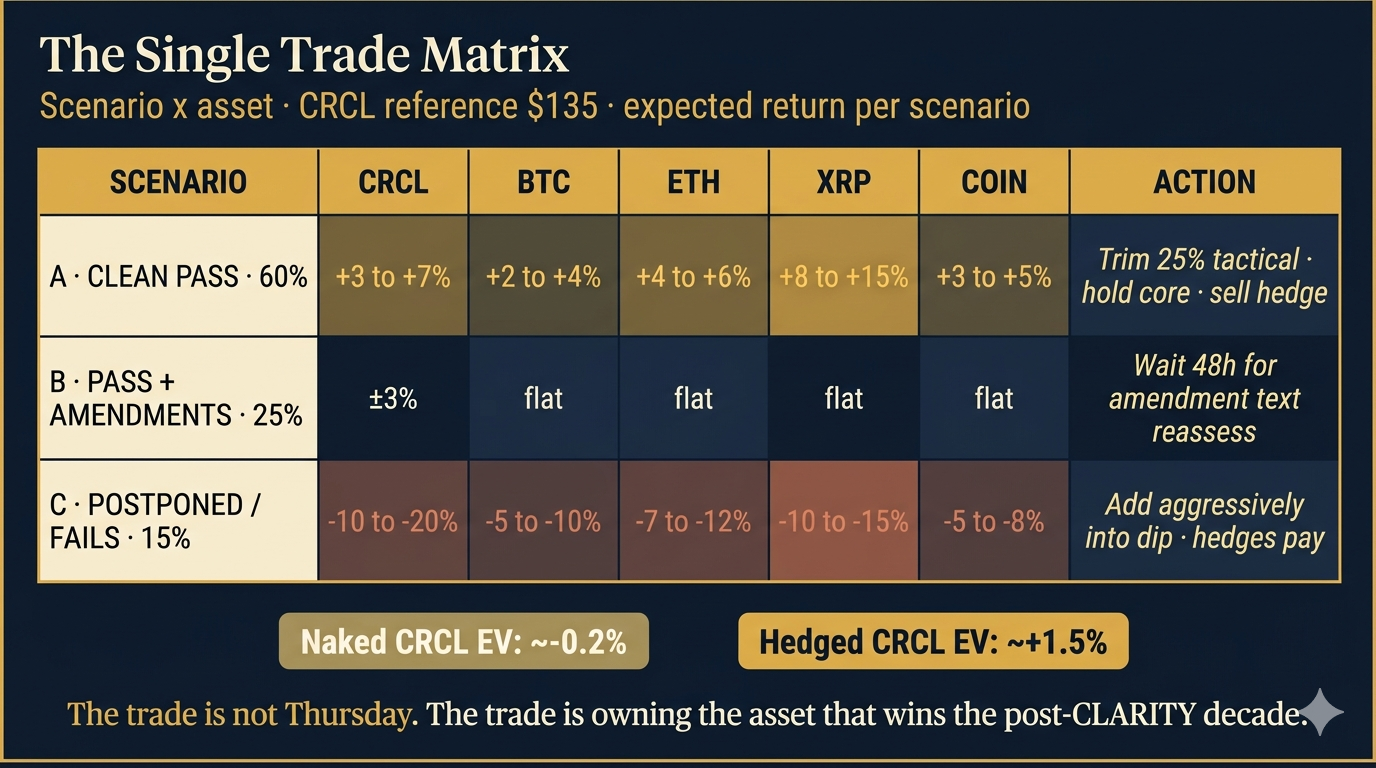
| Scenario | Prob | CRCL | BTC | ETH | XRP | COIN | Action |
|---|---|---|---|---|---|---|---|
| A: Clean Pass | 60% | +3-7% | +2-4% | +4-6% | +8-15% | +3-5% | Trim 25% of tactical, hold core, sell hedge |
| B: Pass + Amendments | 25% | ±3% | flat | flat | flat | flat | Wait 48h for amendment text; reassess |
| C: Postponed/Fails | 15% | -10 to -20% | -5 to -10% | -7 to -12% | -10 to -15% | -5 to -8% | Add aggressively into the dip; hedges pay |
Expected returns (CRCL, naked at $135 ref): roughly -0.2% — vote is poorly priced for asymmetric long. Expected returns (CRCL with Layer 2 hedge): roughly +1.5% — hedge structure pays the risk premium.
The trade is not Thursday. The trade is owning Circle through the decade where every dollar gets a wrapper.
7. What I’m Watching Wed-Thu
- Kennedy’s announced position (highest single signal)
- Last-minute amendments filed by Banking Committee members (especially bank-lobby yield-narrowing language)
- Democratic walkout threat over ethics provisions
- CRCL pre-market grind vs. fade (a sustained grind into Thursday open suggests positive inside-info on the vote tally)
- USDC 7-day net mint/burn (fundamental tell independent of the politics)
- BTC holding $80k through Wed close (broader-market endorsement of pass)
8. Disclosures & Voice
This is opinion, not advice. The probabilities are mine; the bill text is public. I am long CRCL at the time of writing and intend to hold across scenarios. Position structures described are illustrative — sizing depends on your portfolio, conviction, and risk tolerance.
The CLARITY Act is the most consequential piece of crypto legislation in U.S. history. Thursday’s markup is the first time the Senate has voted on it. Whatever happens, the line is being drawn. Position the asset that wins on the right side of the line.
That asset is Circle.
Last updated 2026-05-12. Will be revised post-vote.