May 10, 2026
The Beijing Handshake: Trump-Xi Summit Scenarios & Sector Playbook
Trump visits Beijing May 14-15. Three scenarios (45/40/15), five deep sector dives, master trade matrix, and what to actually do this week.
The Beijing Handshake: Trump-Xi Summit Scenarios & Sector Playbook
Published 2026-05-09. Trump visits Beijing May 14-15, 2026. T-5.
1. The Setup
I’ve been staring at the USDCNY chart for two weeks and it keeps saying something I didn’t quite believe. The yuan is at 6.80 — strengthening — five days before a Trump-Xi summit. That’s not what a market afraid of a breakdown looks like. That’s a market that’s already chosen a side.
So I sat down to actually map out what the FX market is telling me, and what it might be wrong about. This article is the result.
Donald Trump lands in Beijing on Thursday. By Friday evening, we will have either a deal, a press release that pretends to be a deal, or a public spat that resets the entire bilateral relationship. The market is currently positioned for option B with a polite lean toward option A — and that positioning is what creates the opportunity.
Three data points are doing most of the work in setting expectations:
- USDCNY at 6.80 — the yuan has strengthened roughly 6% over the past twelve months. That is not a currency that fears a breakdown. The FX market has already cast its vote.
- Greer’s “stability” framing — the USTR’s pre-summit posture has been deliberately low-temperature. Both sides want a runway, not a confrontation.
- Paris working-group progress on rare earths and a “Board of Trade” mechanism — quiet, technical, and the kind of detail you only hear about when both sides expect it to land.
That setup is bullish for cooperation but creates an asymmetry: anything materially less than a “Mini-Deal” disappoints, and anything materially worse than “Stability Theater” produces a violent repricing. The trade is not in betting on the modal outcome. The trade is in selling overpriced certainty in the modal outcome and buying underpriced convexity in the tails.
This article does three things. First, it defines the three scenarios and their tells, so you can update in real time on Friday. Second, it applies those scenarios to ten sectors — five deeply, five quickly. Third, it gives you a single trade matrix you can screenshot and act from.
The voice is opinionated. The probabilities are subjective. The disclosures are at the end.
2. The Three Scenarios
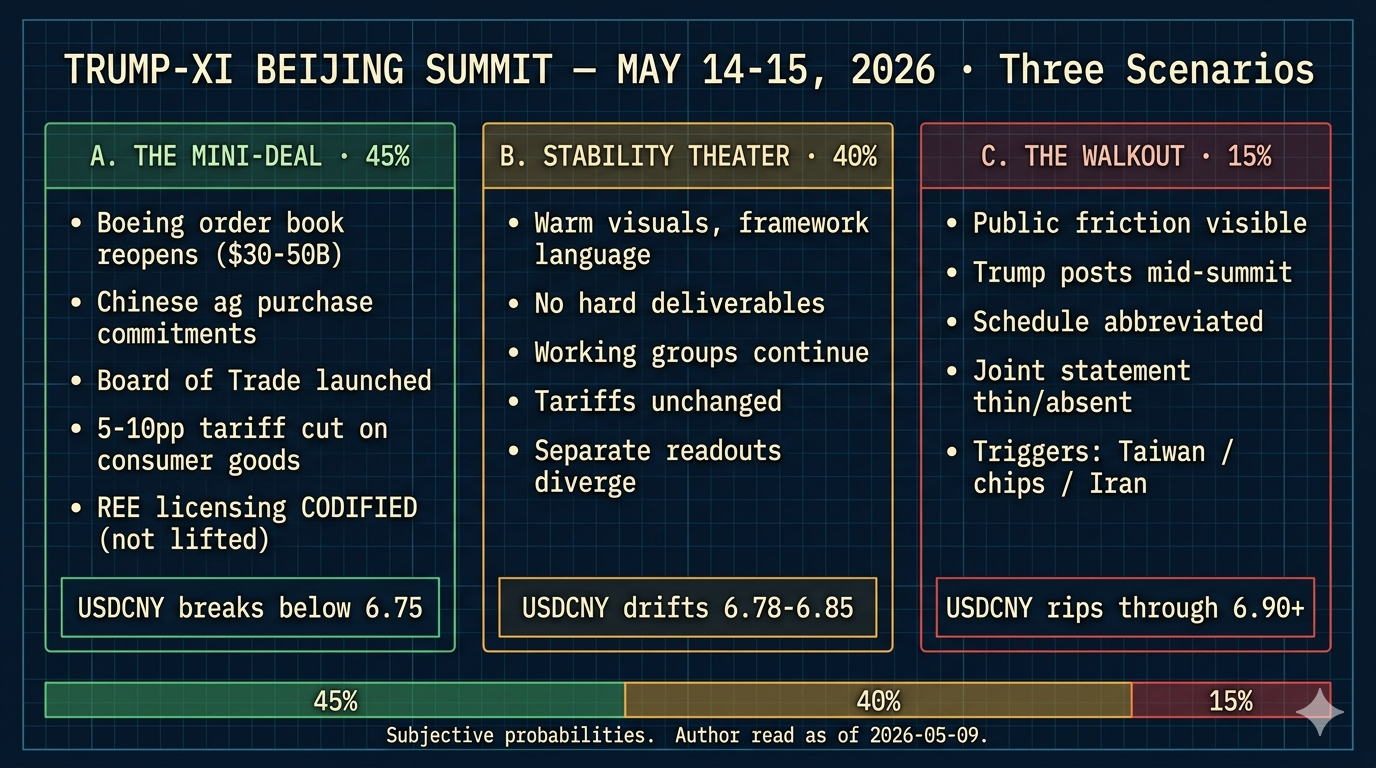
Scenario A: The Beijing Mini-Deal (45%)
A Mini-Deal looks like this. There is a joint press conference, not separate readouts. Headline numbers are cited: a Boeing order book reopening of $30-50B, Chinese agricultural purchase commitments back toward pre-trade-war run rates, a formal launch of the “Board of Trade” mechanism with named co-chairs, and a 5-10 percentage point tariff reduction on a curated list of consumer goods. The rare-earth export licensing framework is codified, not lifted — a critical distinction. China keeps its leverage; the US gets predictability.
This is not a “Phase Two” deal. It is a Phase 1.5 deal — large enough to claim, small enough that neither leader has to cash a check his domestic constituency cannot afford. Both sides need stability into 2026 and 2027. A Mini-Deal delivers that stability without forcing a reckoning on the issues that would actually move the needle: chip export controls, Taiwan, advanced AI compute.
Why 45%? Because the FX market is already there, the technical work in Paris is real, both leaders have run out of escalation room, and Boeing/agriculture purchase commitments are the textbook face-saving deliverable.
Tells (live on Friday): - Joint press conference (vs. separate readouts) - Specific dollar figures in the joint statement - Named senior Chinese signatories (Vice Premier He Lifeng = real) - USDCNY breaks below 6.75 in the day-after session
Scenario B: Stability Theater (40%)
This is the modal “summit since 2017.” Warm visuals, framework language (“constructive,” “candid,” “agreed to continue dialogue”), Boeing and agriculture mentioned in vague aspirational terms, the Board of Trade described as “to be established.” Tariffs unchanged. Working groups continue. Both sides claim victory in their own readouts and the readouts diverge meaningfully on key items.
The market has not fully priced this scenario. With CNY at 6.80, the long-CNY position assumes at least some concrete deliverable. A pure framework outcome triggers a mild unwind — call it CNY back to 6.85, a 2-3% selloff in the most hopeful trades (BA, ADM, MP), a relief rally in the most defensive (gold gives back nothing, defense holds).
Why 40%? Because pattern recognition: Trump-Xi summits since 2017 have produced exactly one substantive deal (Phase One, January 2020). The base rate is theater.
Tells: - Separate readouts diverge on key items (the giveaway is when one side claims a win the other side doesn’t acknowledge) - No joint dollar figures in announcements - Taiwan language is boilerplate - USDCNY drifts 6.78-6.85 in the day-after session
Scenario C: The Walkout (15%)
This is the fat tail. Public friction is visible during or immediately after the summit. Triggers could be a Taiwan provocation in the week prior (Lai government statements, US arms sale notification, PLA exercise), a chip-export-control escalation announced mid-summit, an Iran/Hormuz incident that pulls Trump’s attention and patience, or — most dangerously — Trump issuing a tariff threat during the summit on the basis of a perceived slight.
Why 15%? Because the tail is fatter than usual. Iran-Hormuz risk is non-zero (see the dual-blockade playbook from earlier this month). Trump’s negotiating style includes mid-meeting walkouts as a feature. And the gap between public expectations (rising) and substantive deliverables (limited) creates room for sudden disappointment.
Tells: - Trump posts on Truth Social during summit hours - Schedule is abbreviated (e.g., second-day events cancelled) - Joint statement is thin or absent - USDCNY rips back through 6.90, possibly retesting 7.00+ within 5 sessions
3. What’s Already Priced In
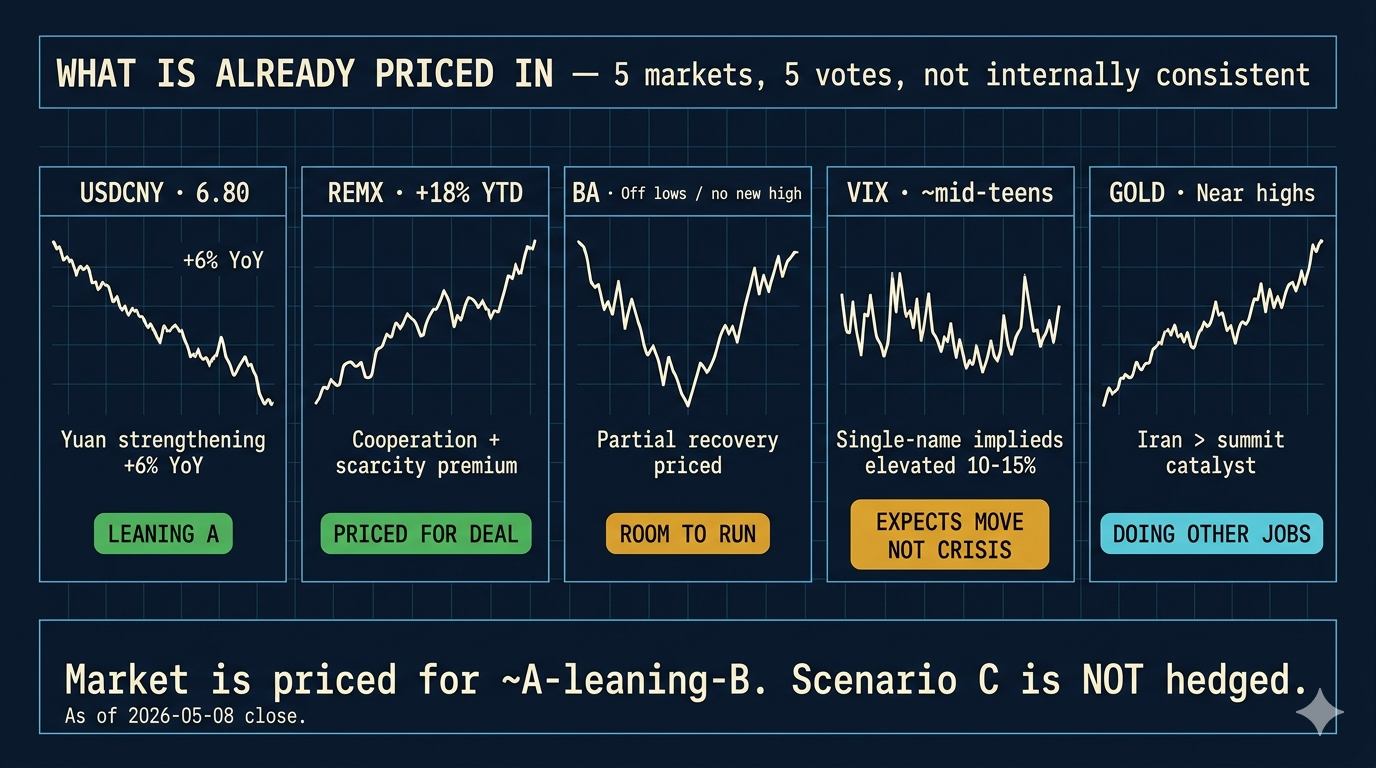
The market is doing five things simultaneously, and they are not internally consistent.
Yuan strength (6.80) is pricing roughly Scenario A. Twelve months ago, the consensus call was for a managed depreciation toward 7.50. We’re 9% richer than that. Either the consensus was wrong about Chinese stimulus / capital flows, or it was wrong about the trade trajectory. Probably both, but the FX move is too big to be only flow.
Equity sectors are mixed. REMX is +18% YTD (priced for cooperation premium and scarcity premium — a tension we’ll return to). Boeing is meaningfully off its 2024 lows but has not made a new high — partial pricing of order book recovery. Soybeans futures have a small positive risk premium baked in but ag equities (DE, ADM) are not stretched. Defense names have not sold off — ITA at year highs — which means Scenario C is not being unwound from the defensive complement.
Volatility is the most interesting tell. VIX is in the mid-teens. Single-name implieds on TSM, NVDA, BA into May 16 expiration are elevated 10-15% above 30-day average but not panicked. The market expects a move, not a crisis. That is the right setup for selling premium on the modal scenarios and buying convexity on the tails.
Gold at recent highs is doing a lot of jobs at once: Iran-Hormuz hedge, hard-asset rotation, dollar weakness, fiscal anxiety. The summit is not the dominant catalyst for gold. Don’t trim it for summit reasons.
Copper is a quiet bull tell — strength here historically front-runs constructive China tape.
Bottom line: the market is priced for ~A-leaning-B, not for A clean. Scenario A still has upside. Scenario B is mildly negative for risk. Scenario C is sharply negative because nothing is hedged.
4. Deep-5 Sector Treatment
4.1 Rare Earths & Critical Minerals
Pre-summit setup. This is the most directly negotiated sector. Paris working-group talks have explicitly addressed rare-earth supply chain framework. China controls roughly 85% of rare-earth processing capacity globally. The US has spent four years and ~$2B trying to rebuild domestic capacity. Going into the summit: REMX +18% YTD, MP +35% YTD on Mountain Pass expansion plus Pentagon offtake announcements. The market is priced for cooperation.
Scenario A impact. China formalizes the export licensing framework — predictable rules, not lifted controls. This is positive for Chinese-domiciled processors (more revenue visibility) and neutral-to-negative for Western pure-plays in the short term, because the “scarcity premium” partially deflates. The market may sell MP and LYC on the headline, then reverse over 1-2 weeks as it digests that codified controls still preserve scarcity.
Scenario B impact. No framework, status quo of episodic licensing. Western pure-plays retain their full premium. This is the most binary scenario for these names — they’re either re-rated higher (no negative news) or unchanged.
Scenario C impact. China hints at expanded export controls (gallium-style escalation, possibly extending to magnets or processed concentrates). Western pure-plays rip 15-25%. Tech-hardware downstream (AAPL, advanced semis, EVs) gets re-priced lower as supply-chain risk premium widens.
Tickers + structure. - MP, LYC.AX, USAR — long stock or LEAP calls. Trim into A on the headline, hold through B, add aggressively on C. - Pair trade: Long MP / Short a China-heavy REE basket (constructed via individual ADRs or via REMX with adjustments). Captures decoupling premium independently of summit outcome. - Tail hedge for tech downside: OTM AAPL Jun 2026 puts as cheap insurance against C. - Pentagon-offtake names (LYC, USA Rare Earth) have fundamental floors regardless of summit; treat as core.
Edge call. I disagree with consensus here, and it took me a while to convince myself. The street view is “any deal = bad for MP.” But that confuses codifying controls (good for predictability premium) with lifting them (would crush scarcity). A framework deal does the first, not the second. The real risk to MP isn’t Scenario A — it’s Scenario B, the boring nothing-burger. My read: buy MP weak into the summit on framework-anxiety selling.
Cross-reference. See critical-minerals/ for the structural thesis. This summit doesn’t change the thesis — it resolves a catalyst window. Trim trading positions, keep core.
4.2 Semiconductors / AI Chips
Pre-summit setup. The chip war is explicitly out of scope for this summit, per multiple pre-event signals. That is itself the trade. SOXX is near year highs. NVDA implieds into May 16 are bid 12-15% above 30-day. TSM ADR has been the cleanest single-name expression of US-China chip-supply tension and trades 8% off recent high.
Scenario A impact. Modest positive for the index, but the upside is muted because chip controls don’t get touched. Vol crushes hard the day after. The big winner is certainty — anything that takes Scenario C off the table reduces the supply-chain risk premium.
Scenario B impact. Range-bound. Vol crushes anyway because the event passes without incident. The post-event drift depends on what the working groups do, which is months out.
Scenario C impact. Sharp negative. Any escalation in chip controls — particularly an expansion of the Foreign Direct Product Rule or new HBM restrictions — repri ces TSM, ASML, SOXX 8-15% lower. Vol explodes.
Tickers + structure. - Pre-event: Sell TSM May 16 iron condor 5-10% wide. Vol is rich. Both A and B are crushed scenarios. - Hedge that with: Long TSM Jun 2026 OTM puts (15-20% OTM) sized to ~25% of the credit collected. This is the C tail. - Post-event directional (Monday May 18): If A, scalp long NVDA / SOXX into the next earnings cycle. If B, fade vol-crush rallies. If C, the put hedge prints and you sell into panic.
Edge call. Vol is mispriced lower in the tails. The market is treating chip-export-control escalation as “off the table for this summit,” which is technically correct, but the tape doesn’t trade off the agenda — it trades off Trump’s mood on Friday afternoon. Buy convexity, sell the body.
Cross-reference. asml-tsm-q1-2026-analysis/, nvda-q4-fy2026-analysis/, avgo-q1-fy2026-analysis/, photonics-update-2026-04-30/. The structural AI capex thesis is intact under all three scenarios. Summit affects path, not destination.
4.3 Agriculture
Pre-summit setup. Agricultural purchase commitments are the textbook Trump-Xi face-saving deliverable. They were the centerpiece of Phase One in 2020 and they will almost certainly anchor any Mini-Deal announcement. China is structurally short protein and feedgrain, US farm belt is structurally long Trump’s political base, and the math just works. Soybeans futures have a small positive risk premium going in. DE has lagged the broader industrial complex.
Scenario A impact. Big positive — the announcement is the catalyst that closes the gap between current prices and “if China actually buys what they promise.” Soy and corn futures rip 5-8%. ADM (margin on volume) gets a clean re-rate. DE benefits 2-3 quarters later as farm income recovers and equipment replacement cycles unlock — call it a swing trade for the year, not a one-day pop.
Scenario B impact. Modest positive. Vague aspirational language is enough to sustain current futures pricing but doesn’t catalyze a re-rate.
Scenario C impact. Modest negative. Ag is more about commitments than tariffs in this cycle, so a walkout doesn’t crush the sector — it just removes the upside.
Tickers + structure. - DE — long stock, this is the cleanest underowned expression of the Mini-Deal trade. Equipment cycle benefit is delayed; market under-discounts that. - ADM, BG — long stock, processor leverage to volume. Cleanest pure-A trade. - MOS, NTR — fertilizer secondary beneficiaries. - MOO ETF — broad sector exposure if you don’t want single-name selection.
Edge call. DE is underowned for this trade. Most desks are looking at processors and direct grain plays. DE benefits 2-3 quarters out as US farm income recovers, equipment replacement unlocks, and the implicit guarantee of Chinese demand reduces the risk premium farmers attach to capex. Long DE July or October calls is the asymmetric way.
Cross-reference. agricultural-food-security/ for the multi-year structural framing. This summit is a catalyst, not a thesis change.
4.4 Aerospace (Boeing / COMAC)
Pre-summit setup. Boeing is the single largest dollar-headline deliverable available to both leaders. China has a structural need for ~6,000 widebodies over 20 years. Boeing has a 737 MAX delivery overhang that could clear with a meaningful Chinese order. The 2024-2025 quality saga is largely behind it. BA stock is meaningfully off lows but well below 2019 highs.
Scenario A impact. Big positive. A $30-50B headline order — even if a chunk is “letters of intent” — moves the multiple, not just the EPS. BA could see 12-18% upside in 5-10 sessions on a clean announcement. The asymmetry is best expressed via call spreads.
Scenario B impact. Neutral. Boeing mentioned in vague terms, no specific orders, stock sells modestly into disappointment but doesn’t crater.
Scenario C impact. Negative. Walkout signals zero China orders for the medium term and re-opens the COMAC C919 narrative as a credible substitute. Stock could give back 5-8%.
Tickers + structure. - BA — long Jun 2026 call spread (e.g., 220/250) sized for the A scenario. Don’t pay for the moonshot; pay for the announcement. - Avoid the COMAC supply chain — if A delivers, names like SPR (Spirit AeroSystems) benefit from BA but displace COMAC suppliers. Net positive for US aerospace ecosystem. - Hedge: if you’re long BA, a small allocation to long-dated EADSY (Airbus) calls captures the alternate world where China splits the order book.
Edge call. BA is asymmetric to Scenario A and the call spread gives you the cleanest expression. Don’t take the trade if you can’t size for the call spread to be a near-zero in B and C — sizing matters more than direction.
Cross-reference. None directly published; this is a new sector for the article series.
4.5 Defense (Taiwan Tail)
Pre-summit setup. Defense names trade off two things: long-cycle order books (multi-year, summit-immune) and short-cycle headlines (Taiwan, Iran, Ukraine). Going into the summit, ITA is at year highs. LMT, NOC, RTX have all participated. KTOS (drones) has been the highest-beta expression of the autonomous-systems thesis.
Scenario A impact. Modest negative. A constructive summit reduces the perceived urgency of Taiwan defense buildout — at least at the margin. Defense names sell modestly, not dramatically, because the structural buildout (PRC deterrence, Indo-Pacific posture, drone procurement) continues regardless of summit outcome.
Scenario B impact. Neutral. Stability theater doesn’t change defense thinking either way.
Scenario C impact. Sharp positive. Any walkout that involves Taiwan rhetoric — and many do — accelerates the Indo-Pacific buildout narrative, increases PRC-deterrence urgency, and re-rates the entire sector higher. ITA could move 5-8% in a single session.
Tickers + structure. - Hold core defense exposure (LMT, NOC, RTX, ITA) — don’t trim for summit positioning. - Add KTOS or AVAV on Scenario C as the highest-beta expression. - Defense is a hedge to the rest of the book, not a directional summit bet. Sized as insurance.
Edge call. Defense’s asymmetric exposure is to Scenario C, and the rest of the book benefits from A. That makes defense the natural hedge — keep it. The temptation to trim into a “constructive” summit will be strong; resist it.
Cross-reference. defense-aerospace/, autonomous-drones/ for the structural buildout thesis. Iran/Hormuz playbook (iran-war-dual-blockade-playbook/) for the parallel tail.
5. Quick-5 Sectors
🔸 Precious Metals
Already running on Iran/Hormuz tail risk and the 2026 hard-asset rotation (per precious-metals-followup-2026-04/). Summit impact is secondary. A: mild headwind (-2-3% relief rally), buyable. B: sideways. C: rips +5%, the cleanest tail hedge in the book. Position: core hold (GLD, GDX, RGLD). Do not trim for summit reasons. Iran/Hormuz dominates this trade.
🔸 LNG / Energy
LNG is a candidate purchase commitment but US export capacity is constrained (terminals booked through 2028). The deliverable is future contract commitments, which benefits infrastructure (WMB, ET) more than producers (CHK, EQT). A: modest positive for pipelines. B/C: neutral. Position: long midstream infra (WMB, ET, ENB) over E&P for this catalyst. Crossref: lng-value-chain/.
🔸 Shipping / Maritime
Shipping is highly volume-sensitive. Tariff resolution boosts trans-Pacific volumes; escalation crushes them. A: positive (ZIM, MATX +5-8%). B: neutral. C: sharply negative. The trade is binary and over-determined by other factors (Red Sea, Hormuz, capacity). Position: skip for direct summit positioning. Crossref: maritime-freight/.
🔸 EVs / Batteries
The EV tariff/dumping narrative is largely decoupled from this summit — it lives in the IRA, EU CBAM, and country-specific industrial policy. A: neutral. B: neutral. C: TSLA marginally positive (less Chinese competition risk), BYD marginally negative. Position: long TSLA / short BYD pair if you want exposure; otherwise skip.
🔸 Pharma
Included for completeness. Biologics export controls are a low-probability tail. A/B: neutral. C: marginal positive for LLY/PFE on biologics carve-out hedge. Position: N/A for this trade. Mentioned to close the sector waterfront.
6. Master Trade Matrix
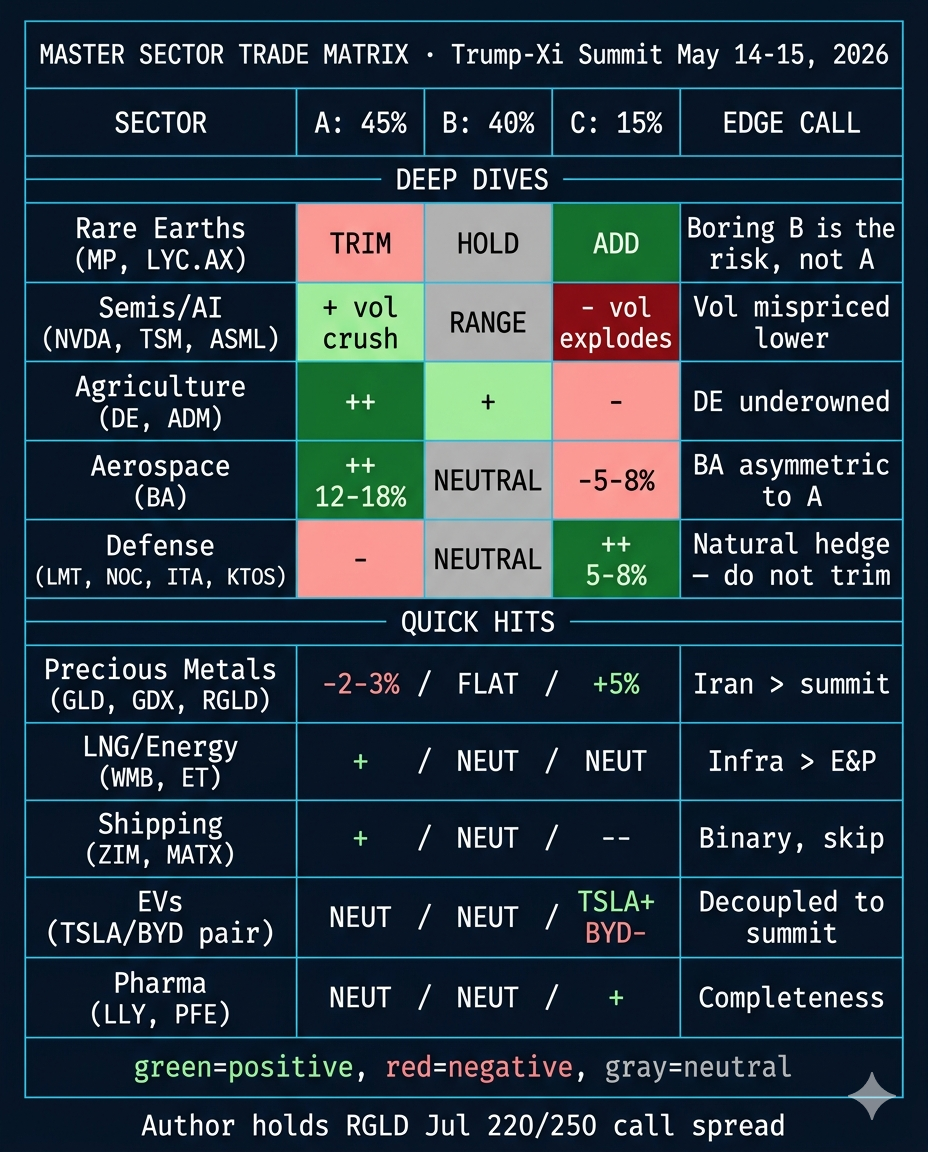
The single artifact to screenshot:
| Sector | Tier | Tickers | A: Mini-Deal (45%) | B: Stability (40%) | C: Walkout (15%) | Structure | Edge Call |
|---|---|---|---|---|---|---|---|
| Rare Earths | Deep | MP, LYC.AX | Trim | Hold | Add | Long stock + LEAP calls | “Boring B is the risk, not A” |
| Semis/AI | Deep | NVDA, TSM, ASML | Modest +, vol crush | Range, vol crush | Sharp -, vol explodes | Iron condor pre + OTM put hedge | Vol mispriced lower |
| Agriculture | Deep | DE, ADM, MOS | Big + (DE delayed) | Modest + | Modest - | Long DE calls; ADM stock | DE underowned |
| Aerospace | Deep | BA | Big + (12-18%) | Neutral | -5-8% | Jun call spread | BA asymmetric to A |
| Defense | Deep | LMT, NOC, ITA, KTOS | Modest - | Neutral | Sharp + (5-8%) | Hold core; add on C | Natural hedge — don’t trim |
| Precious Metals | Quick | GLD, GDX, RGLD | -2-3% | Flat | +5% | Core hold | Iran > summit |
| LNG/Energy | Quick | WMB, ET | + (purchase commits) | Neutral | Neutral | Long midstream | Infra > E&P |
| Shipping | Quick | ZIM, MATX | + | Neutral | Sharp - | Skip | Binary, over-determined |
| EVs | Quick | TSLA / BYD pair | Neutral | Neutral | TSLA +, BYD - | Pair if exposed | Decoupled to summit |
| Pharma | Quick | LLY, PFE | Neutral | Neutral | Mild + | N/A | Completeness |
7. Calendar & Tells
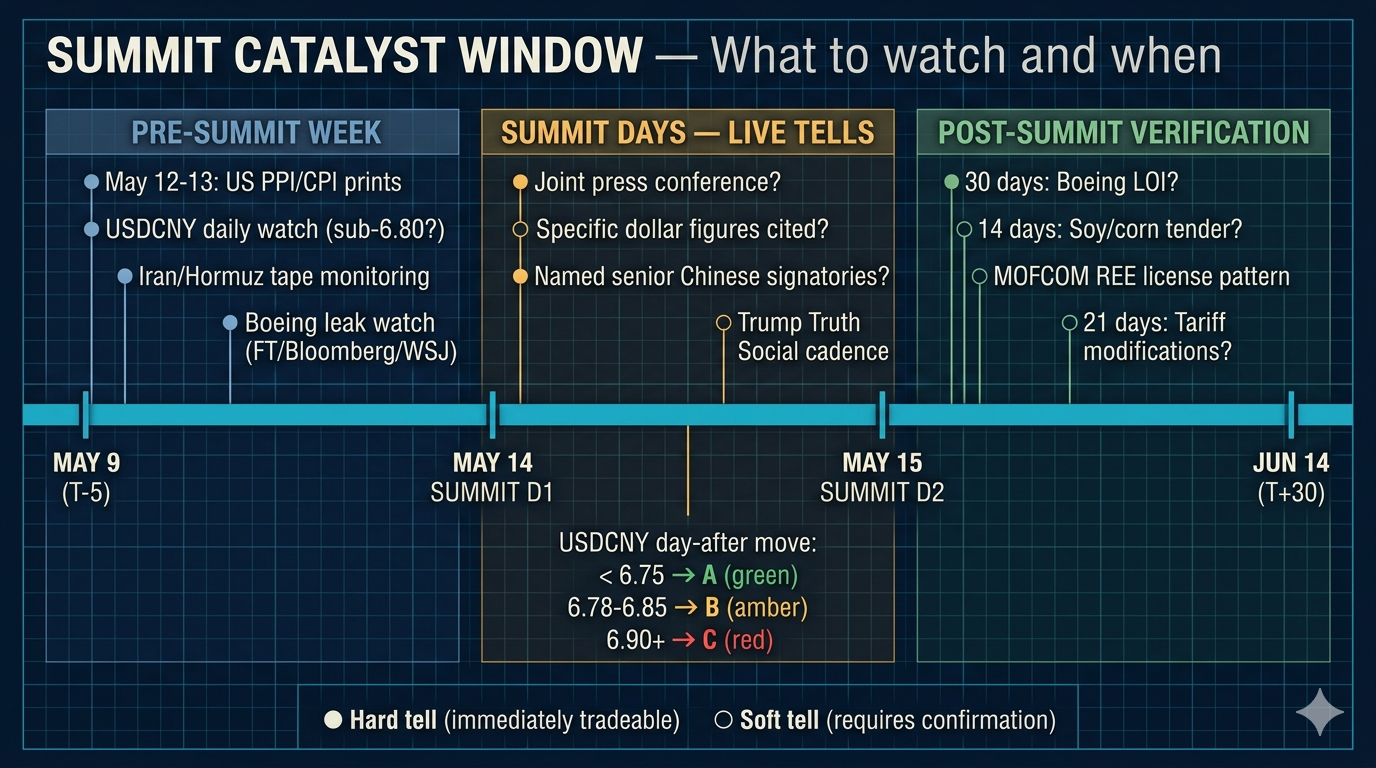
Pre-summit week (May 9-13): - May 12-13: US PPI/CPI prints — surprise upside complicates Trump’s tariff posture entering Beijing - USDCNY daily: stays sub-6.80 → market still leaning A; pops above 6.85 → repricing toward B - Iran/Hormuz tape — any escalation pulls Trump’s attention and dilutes summit prep - Boeing pre-announcement leaks (FT, Bloomberg, WSJ) typically run T-3 to T-1; absence of leaks = lower probability of a major BA headline
Summit days (May 14-15) — live tells: - Joint press conference scheduled? (Yes = A signal, No = B/C) - Specific dollar figures cited in the joint statement? (Yes = A confirmed) - Named senior Chinese signatories? (Vice Premier He Lifeng = real, junior officials only = theater) - Trump’s Truth Social cadence during summit hours (silence = constructive, posting = friction) - USDCNY day-after move (sub-6.75 = A; 6.78-6.85 = B; 6.90+ = C)
Post-summit verification (May 16 - June 14): - First Boeing Letter of Intent within 30 days = A confirmed - First Chinese soy/corn tender within 14 days = A confirmed - MOFCOM rare-earth license issuance pattern (volume + recipients) = A or B distinction - Tariff modification announcements within 21 days = A material vs. cosmetic
8. Risk & Hedges
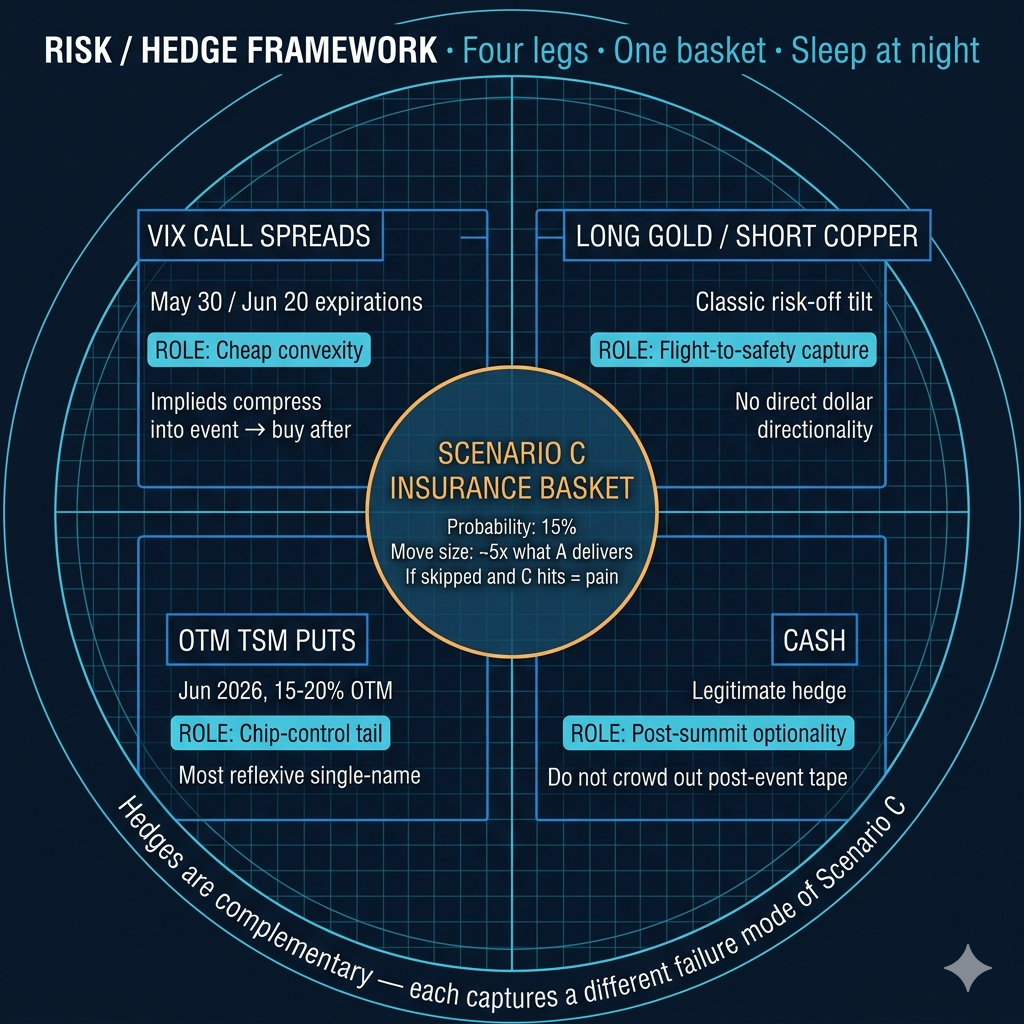
The article isn’t useful unless it tells you what to do if it’s wrong. The single best hedge basket against Scenario C surprise:
- VIX call spreads (May 30 / Jun 20 expirations): cheap convexity. Summit-week implieds will compress hard into the event; post-event vol-of-vol is what you want to own.
- Long gold / short copper pair: classic risk-off tilt without taking direct dollar directionality risk. Captures a flight-to-safety move in C without burning premium in B.
- OTM TSM puts (Jun 2026, 15-20% OTM): most reflexive single-name to chip-control escalation. Cheapest single-name expression of the C tail.
- Cash: legitimate hedge — don’t let event-driven positioning crowd out optionality for the post-summit tape, which is often more tradeable than the day-of move.
9. TL;DR — Three Things I’m Actually Doing This Week
I’ll spare you the “consider doing X” hedging. Here’s what’s going in my book between now and Friday’s close:
-
Modest long on the “Mini-Deal” basket — adding a BA Jun 220/250 call spread, picking up DE calls into any weakness, leaving MP alone (already comfortable size). Net delta is intentionally small. I’m getting paid for being right on direction and magnitude, not just direction.
-
Buying tail insurance even though it feels stupid — a VIX call spread and OTM TSM puts. The math is uncomfortable: Scenario C is only 15%, but the move is ~5x what A delivers. If I skip this and C hits, I’ll wish I’d burned the premium. If I buy it and B happens, the premium is the cost of sleeping at night.
-
Not touching precious metals — I’m holding the RGLD Jul 220/250 call spread through the summit. Gold isn’t running on Trump-Xi; it’s running on Iran/Hormuz and the structural rotation. The temptation to derisk into a “constructive summit” narrative is real. I’m resisting it.
10. Disclosures
- Author holds RGLD Jul 220/250 call spread, opened 2026-04-30
- This article is research and analysis, not personalized investment advice
- Probabilities are subjective and based on the author’s reading of public information as of 2026-05-09
- Structures discussed assume institutional reader sophistication regarding options, position sizing, and risk management
- The sectors and tickers mentioned have material liquidity differences; read the structure recommendation carefully before sizing
Sources
- FPRI: Trump-Xi Summit in Beijing
- CSIS: Trump-Xi Summit in Beijing — Managing the World’s Most Important Relationship
- Eurasia Review: What To Expect From The Trump-Xi 14-15 May Summit
- Brookings: What will happen when Trump meets Xi
- WEF: What to expect from the Trump-Xi summit
- Al Jazeera: USTR Greer on stability framing
- CFR: What to Expect Ahead of Next Week’s Trump-Xi Summit
- Atlantic Council: Experts react to the Trump-Xi meeting
- Trading Economics: USDCNY current
- FRED: DEXCHUS series (Chinese Yuan / USD spot)