May 3, 2026
The Robot Rising: When 600K US Manufacturing Jobs Sit Vacant, Who Builds Things?
600K+ unfilled US manufacturing jobs. Reshoring without automation is impossible. The market either dismisses industrial automation as "mature, boring" or overpays for humanoid via Tesla. The real trade is the structural floor: ROK, ABB, ISRG already earning 20%+ operating margins. Full teardown of 10 robotics + automation stocks.
The Robot Rising: When 600K US Manufacturing Jobs Sit Vacant, Who Builds Things?
“Geopolitical Edge” Investment Series
There are 600,000+ unfilled US manufacturing jobs. This isn’t a pandemic-era blip — it’s structural. Reshoring without automation is impossible.
I was tracking CHIPS Act progress — Intel Ohio, TSM Arizona, Samsung Texas. All projects are racing — and all are short workers.
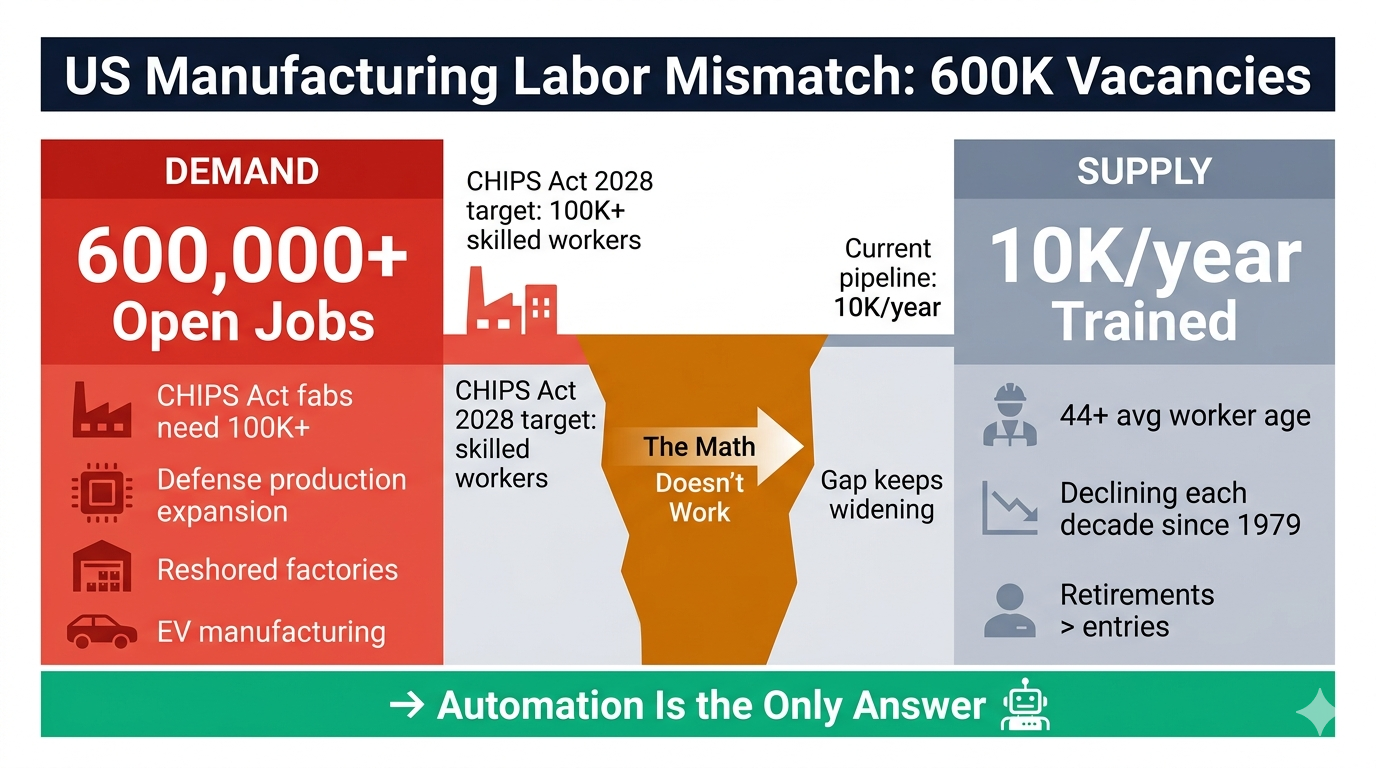
Then I saw the numbers: 600K+ unfilled US manufacturing positions. CHIPS Act fabs need 100,000+ skilled workers by 2028; the current pipeline produces only ~10,000/year. Average US manufacturing worker is 44+, retiring faster than entrants.
The math doesn’t work. Everyone knows the reshoring story — but the bottleneck isn’t tariffs or subsidies, it’s nobody to do the work. Manufacturer “Help Wanted” signs have hung for three years. Defense production (ammunition, radar, aircraft) backlogs are at the ceiling. The result: automate or don’t build.
And it’s already happening. Wall Street has two wrong takes on this sector: 1. Either industrial automation is “mature, boring, low-growth” — but ROK’s 2026 backlog is +18% YoY, the fastest in 15 years 2. Or humanoid robotics is overvalued via the Tesla Optimus hype — Tesla already trades on Optimus production-volume math, but the timeline is at least 3 years out
The actual trade is the structural floor: industrial automation leaders already earning 20%+ operating margins (ROK, ABB, ISRG). Humanoid is option upside layered on top, not the foundation of the thesis.
I ran the full fundamental workup on 10 robotics + industrial automation stocks. The conclusion:
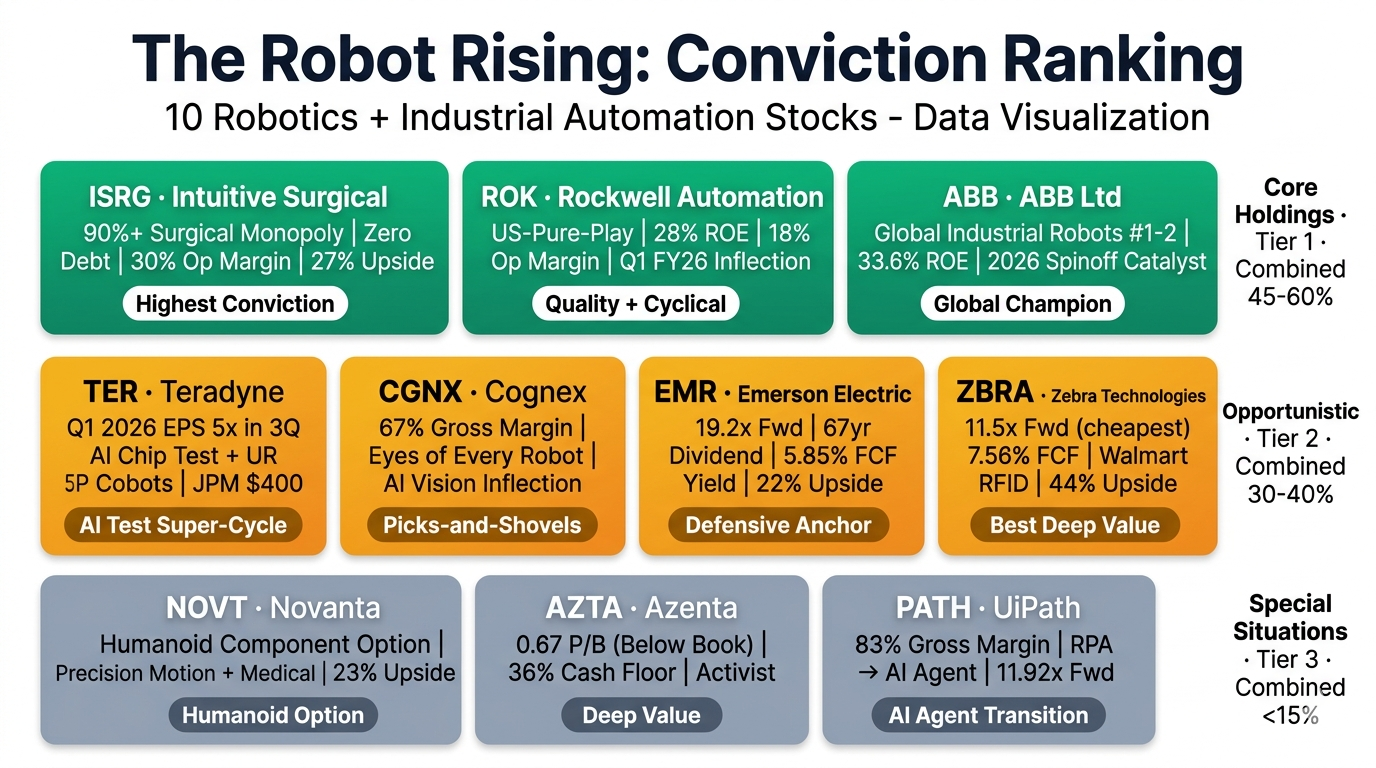
TL;DR: - Highest Conviction: Intuitive Surgical (ISRG) — 90%+ surgical robotics monopoly, 30% operating margin + 66% gross margin + zero debt, 24% drawdown is the entry window - Quality + Cyclical Compounder: Rockwell Automation (ROK) — US-pure-play automation, #1 reshoring beneficiary, 28% ROE + 18% operating margin - Global Champion: ABB Ltd — Global #1-2 industrial robots, electrification + automation dual exposure, H2 2026 Robotics spinoff catalyst - Picks-and-Shovels: Cognex (CGNX) — 67% gross margin “eyes of every robot,” AI vision inflection + cyclical bottom recovery - Best Deep Value: Zebra (ZBRA) — Forward P/E 11.5x (cheapest in group) + 7.56% FCF yield + Walmart RFID catalyst
Three Forces Driving the Robot Rising
Force 1: Labor Mismatch — The Reality of 600K Vacancies
Everyone talks about “reshoring.” Few drill into “who does the work.” Data:
- 600K+ unfilled US manufacturing positions — not cyclical, structural
- Manufacturing labor force participation declined every decade since 1979 — irreversible
- Average US manufacturing worker is 44+ — retiring faster than entrants
- CHIPS Act fabs need 100,000+ skilled workers by 2028 — current pipeline outputs ~10,000/year
- Defense production expansion — Army DCAS ammunition modernization, GD-OTS expansion, Naval shipbuilding — all need workers, all short
The math doesn’t work. Reshoring without automation is impossible. This isn’t a corporate choice — it’s a physical constraint.
Force 2: Industrial Automation — The “Boring” Winner Already Making Money
This is the variant view core. The market lumps these as “mature, low-growth” — but the data says otherwise:
- ROK 18% operating margin, 2026 EPS $11+ expected — not “future,” already happening
- ABB 33.6% ROE (highest in group) + 17%+ operating margin — Bjorn Rosengren’s Helix operating model is bedded in
- ISRG 30% operating margin + 66% gross margin + zero debt — this isn’t a medical device company, it’s a software-moat cash machine
- CGNX 67% gross margin — overlooked SaaS-style name in industrial automation
These already make money in 2026. No “if” required — just keep doing what they’ve done for decades, against a backdrop of CHIPS Act + reshoring + defense production stacking three demand vectors simultaneously.
Force 3: Humanoid Robot Timeline Compression — The Option on Top
Industrial automation is the foundation. Humanoid is option upside.
- Tesla Optimus moving from “sci-fi” to “factory pilot” (2026-2027)
- Figure, Apptronik, Agility Robotics raising at $20B+ valuations
- Amazon piloting humanoid in warehouses (Digit/Stretch programs)
- Public market exposure mostly via component suppliers — NOVT precision motion, CGNX vision, since pure-play humanoid companies are private
Labor cost arbitrage math: humanoid all-in <$30K beats US warehouse worker $45K+ benefits. Once that math is confirmed (not tomorrow), industry restructuring is irreversible.
But here’s the point: picks-and-shovels (CGNX, NOVT, TER’s Universal Robots) win regardless of which humanoid wins. Cleanest exposure form.
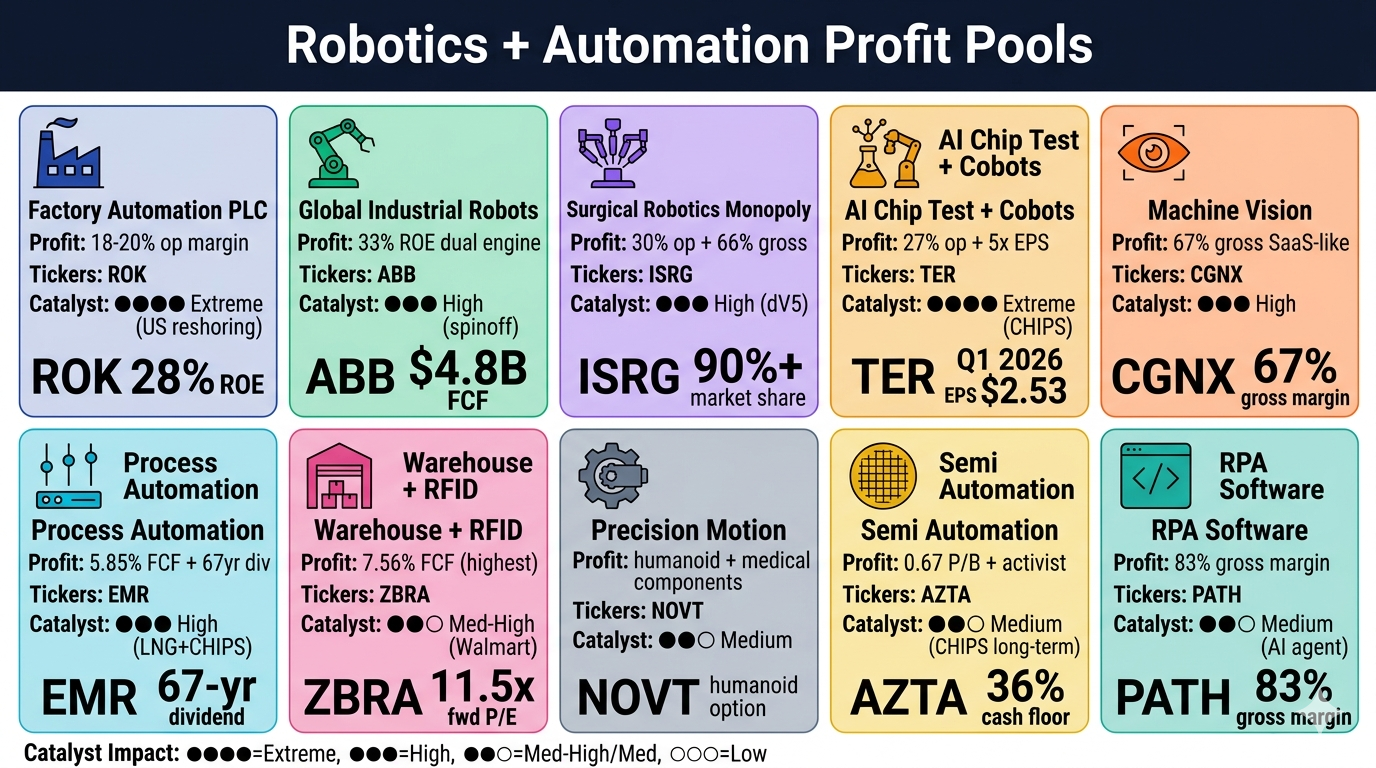
Where the Money Is: Robotics + Automation Profit Pools
| Subsector | Profit Profile | Key Tickers | Reshoring/CHIPS Catalyst |
|---|---|---|---|
| Factory Automation PLC | 18-20% op margin, software mix rising | ROK | Extreme — US-pure-play |
| Global Industrial Robots | 33% ROE, electrification + automation dual | ABB | High — global champion + spinoff catalyst |
| Surgical Robotics Monopoly | 30% op margin, 70%+ recurring | ISRG | High — dV5 cycle |
| AI Chip Test + Cobots | 27% op margin, AI test super-cycle | TER | Extreme — CHIPS direct |
| Machine Vision | 67% gross margin, software-shape unit econ | CGNX | High — AI vision + humanoid |
| Process Automation | 5.85% FCF yield, 67-year dividend | EMR | High — LNG + grid + CHIPS |
| Warehouse + RFID | 7.56% FCF yield, 11.5x forward | ZBRA | Med-High — Walmart RFID catalyst |
| Precision Motion | Humanoid components + medical robotics | NOVT | Medium — humanoid optionality |
| Semi Automation | 0.67 P/B (below book), activist | AZTA | Medium — long-term CHIPS Act |
| RPA Software | 83% gross margin (highest in group), GAAP positive | PATH | Medium — AI agent transition |
Power Rankings: Full Analysis of 10 Robotics + Automation Stocks
Tier 1: Core Holdings
Intuitive Surgical — ISRG | $457.78 | Market Cap: $162.13B
90%+ Surgical Robotics Monopoly + Zero Debt — Cleanest Moat in Group
| Metric | Value | Signal |
|---|---|---|
| P/E (TTM) | 55.5x | Monopoly premium |
| Forward P/E | 38.8x | dV5 leverage compression |
| EV/EBITDA | 40.5x | 30%+ EBIT margin |
| Gross Margin | 66.3% | Best in med-device |
| Operating Margin | 30.45% | Highest in group |
| Net Margin | 28.15% | Excellent |
| FCF | $2.8B | Strong |
| Cash | $4.6B | Substantial |
| D/E Ratio | 0.00 | Zero debt — pristine balance sheet |
| Current Ratio | 4.61 | Outstanding |
| Analyst Consensus | Buy, $582.35 | 27% upside |
Bull Case: ISRG is the most defensible monopoly in the group. da Vinci has 90%+ share of the global multi-port surgical robotics installed base — north of 9,200 systems globally, with each unit driving $1.8M of recurring annual revenue (instruments, accessories, services). The recurring share of revenue is 73% — this is software-shape revenue under a hardware label. The dV5 launch (FDA cleared March 2024) drives the next decade’s compounding: dV5 is dramatically faster, has integrated force-feedback, supports advanced AI-driven imaging, and creates a hardware refresh cycle for the 8,000+ legacy dV X/Xi systems in the field. Ion lung-biopsy platform is in early innings — bronchoscopic biopsy market TAM is ~$1.5B in US alone, with Ion at ~$300M run-rate growing 60%+ YoY. Single-Port (SP) platform is approved for urology and expanding to colorectal/general surgery. Pipeline of new procedures (advanced gynecology, hernia, bariatric, transluminal) keeps procedure-growth running at +15-18% even in mature markets. EPS trajectory: 2025 $7.87 → 2026E $9.50 → 2027E $11.50 — at 38x = $437 → $560 over two years, ~22% annualized. ZERO debt is a feature, not a bug.
Bear Case: 38.8x forward is rich for any name. Procedure growth has decelerated from +25% (2021-22) to +18% (2024-25) — comp curve gets harder. Competition is finally arriving — Medtronic Hugo (limited launch), J&J Ottava (delayed but in clinical trials), CMR Surgical Versius (Europe-focused). dV5 placement pace was modest in Q4 2025-Q1 2026 — hospitals struggling with utilization handoff from Xi to dV5 created near-term placement-volume softness.
Verdict: Highest Conviction. 90%+ market share + 30% operating margin + zero debt + 24% drawdown = buyable distress on an undisputed moat. $430 below is more ideal entry.
ISRG is the pure expression of monopoly. But what if you want not medical — but to bet directly on the “US reshoring” theme? The next stock has 60% revenue in North America, the highest leverage to the reshoring story.
Rockwell Automation — ROK | $407.43 | Market Cap: $45.78B
US-Pure-Play Automation — #1 Reshoring Beneficiary
| Metric | Value | Signal |
|---|---|---|
| P/E (TTM) | 46.6x | Cyclical-trough EPS |
| Forward P/E | 29.7x | Reasonable |
| EV/EBITDA | 26.1x | Slightly above 10-yr median |
| Gross Margin | 44.6% | Best for PLC vendor |
| Operating Margin | 18.16% | 20% target in striking range |
| ROE | 27.71% | Top-tier US industrial compounder |
| FCF | $900M | Cycle-resilient |
| Dividend Yield | 1.32% | 15+ years consecutive increases |
| Q1 FY26 EPS | $2.69 vs consensus $2.40 | Inflection |
| Analyst Consensus | Buy, $426.13 | 5% upside |
Bull Case: Rockwell is the highest-leverage US-listed name to the reshoring thesis. About 60% of revenue is North America — the highest concentration of any major automation OEM (vs ABB ~30%, Siemens ~40%). Customer mix overlaps with the exact verticals being reshored: automotive (Ford/GM EV plants in MI, OH, KY), semiconductors (Intel Ohio, TSM Arizona, Samsung Texas, Micron NY), pharma (Eli Lilly Indiana, Novo Nordisk NC), defense ammunition (Army DCAS modernization, GD-OTS plants), food/beverage manufacturing rebuild. Three-segment structure shifting toward software/services — Intelligent Devices (PLCs, drives, motors ~45%), Software & Control (FactoryTalk, ThinManager ~30%), Lifecycle Services (consulting, MRO, recurring contracts ~25%). Plex (acquired 2021) and Fiix (2023) added multi-tenant SaaS — ARR estimated $700M+, growing 25% YoY. Q1 FY26 EPS $2.69 (vs consensus $2.40) confirms backlog re-acceleration. FY26 order guide +12-15%. Operating margin expansion target 21% by FY27 — every 100bps adds ~$0.85 EPS.
Bear Case: ROK has been “about to inflect” since mid-2024. FY25 order growth was guided +6%, printed flat. Customer destocking proved deeper than management forecast. Plex/Fiix SaaS contributions are real but small relative to $8.3B base. Competitive intensity from Siemens (private global #1), Schneider Electric, Chinese-domestic vendors (Inovance, Estun) is rising. Beta 1.56 means a recession trims ROK 30-35%.
Verdict: Quality + Cyclical Compounder. 28% ROE + 18% operating margin + Q1 FY26 inflection confirmed = highest-leverage reshoring exposure. $380 below is more ideal entry.
ABB Ltd — ABB | $101.00 | Market Cap: $181.96B
Global #1-2 Industrial Robots + Electrification + 2026 Spinoff Catalyst
| Metric | Value | Signal |
|---|---|---|
| P/E (TTM) | 36.7x | Above historical ~22x |
| Forward P/E | 31.8x | Premium for EU industrial leader |
| EV/EBITDA | 24.7x | Above Siemens/Schneider |
| Gross Margin | 40.4% | Strong |
| Operating Margin | 17.99% | Best ever, converging on ROK |
| ROE | 33.55% | Highest in group |
| FCF | $4.82B | Highest absolute FCF in group |
| Cash | $5.93B | Substantial |
| D/E Ratio | 0.60 | Moderate |
| Beta | 0.93 | Below market |
| Analyst Consensus | Buy, $108-115 | 8-15% upside |
Bull Case: ABB is the global leader in three secular tailwind verticals: (1) Electrification — power distribution, EV charging, grid modernization — Electrification segment is ~$15B revenue at 19% operating margin; demand trajectory tied to data-center build-out (cross-ref: power-grid piece), reshored-factory wiring, and EU/US grid reinforcement. (2) Industrial Robotics — ABB and FANUC (private, JP) own 35-40% of global industrial robot installed base; ABB’s GoFa cobot line and IRB 1100 small-payload arms address the new general-manufacturing market. The pending spinoff of Robotics into a standalone listed company (announced March 2026, expected H2 2026 close) crystallizes SOTP value. (3) Motion + Process Automation — drives, motors, pumps, control systems for mining, water, pulp, food/beverage, oil & gas — slow-growth but high-margin recurring services revenue. Operating margin expanded 700bps in three years — execution proven. Beta 0.93 = defensive characteristics in market drawdown.
Bear Case: 31.8x forward / 5.3x sales / 11.8x book is defendable but full multiple for a 5-7% topline grower. Robotics spin-off creates short-term uncertainty (transitional taxes, dyssynergies, dual-listing complexity). China is 15% of revenue and Chinese auto OEMs are sourcing more from Inovance/Estun for new-vehicle plants — share loss is real.
Verdict: Global Champion. 33.6% ROE + $4.8B FCF + spinoff catalyst = global industrial robot + electrification dual-engine exposure. Wait for $95 below.
Tier 2: Opportunistic Positions
The three above are close-your-eyes-and-hold cores. The next four each have a specific bet.
Teradyne — TER | $345.42 | Market Cap: $54.08B
AI Chip Test Super-Cycle + Universal Robots Cobots
| Metric | Value | Signal |
|---|---|---|
| P/E (TTM) | 63.9x | Cyclical mid-cycle |
| Forward P/E | 35.4x | 2026 ramp compression |
| Gross Margin | 58.5% | Strong for ATE |
| Operating Margin | 27.21% | Excellent |
| ROE | 28.75% | Excellent |
| FCF | $1.0B | Robust |
| D/E Ratio | 0.03 | Essentially unlevered |
| Q1 2026 EPS | $2.53 | vs Q2 2025 $0.49 = 5x in 3 quarters |
| Analyst Consensus | Buy, $375.47 | 9% upside (JPM $400 4/30) |
Bull Case: TER is the picks-and-shovels play on AI-driven semiconductor test demand AND general manufacturing automation simultaneously — rare two-vertical exposure. Semi Test segment (~80% of revenue) is benefiting from a structural AI-chip-test super-cycle: each Nvidia Blackwell GPU requires ~3x the test time of an H100. CHIPS Act fab build-out adds incremental ATE demand. Universal Robots (cobots, ~9% of revenue ~$280M) is the dark-horse asset: UR’s e-Series cobots have 50% market share in collaborative robots, deployed in 80,000+ installations globally. Mobile Industrial Robots (MiR autonomous mobile robots) adds another 4% of revenue. Combined Robotics segment ~$420M growing 20%+ YoY — humanoid-adjacent optionality. Q1 2026 print + revenue +51% YoY validates the cycle.
Bear Case: Semi test is the most cyclical revenue line on the chip-equipment side — when the cycle turns, TER doesn’t just slow, it craters (FY22→23 revenue -15%). Top customer Apple (mobile SoC test) is ~25% of Semi Test, second customer Nvidia is rising. Loss of Apple share to advanced-test competitor Advantest (Japan) has been a perennial concern. UR cobots face brutal competition from Chinese vendors (Jaka, Han’s Robot, Aubo) at 30-50% price discount.
Verdict: Picks-and-Shovels Premium. AI chip test + cobot dual engines + JPM $400 target. $320 below is more ideal entry.
Cognex — CGNX | $55.94 | Market Cap: $9.34B
Machine Vision Pure-Play — 67% Gross Margin “Eyes of Every Robot”
| Metric | Value | Signal |
|---|---|---|
| P/E (TTM) | 82.7x | Cyclical-trough EPS |
| Forward P/E | 36.6x | Reasonable on normalized 2026 |
| Gross Margin | 66.92% | Software-shape unit economics |
| Operating Margin | 16.35% | Below normalized 22%+ |
| FCF | $100M | Modest |
| Cash | $340M | Solid |
| D/E Ratio | 0.05 | Essentially unlevered |
| Current Ratio | 3.74 | Excellent |
| Analyst Consensus | Buy, $65.50 | 17% upside |
Bull Case: CGNX is the purest play on machine vision in the public market — the “eyes” required by every industrial robot, every warehouse-automation system, every logistics conveyor, every emerging humanoid platform. The thesis is structural: (1) AI-driven vision algorithms (deep-learning, generative-AI assisted) collapsed the cost of programming/setup from weeks to hours, dramatically expanding the SAM, and (2) cobot/humanoid form factors mandate vision-in-the-loop — every Optimus, Figure, 1X, Apptronik humanoid uses N machine-vision modules. Logistics and consumer electronics, the two segments that drove the 2022 peak, are recovering: Amazon’s renewed automation CapEx, Apple’s manufacturing reshoring, and the post-destocking warehouse-vision refresh cycle all add 5-7% to 2026 revenue. New product cycle: VisionPro Deep Learning 4.0 launched late 2025. Operating margin expansion path from current 16% to historical 22-25% drives EPS to $1.20-1.50 by 2027. The 2026-27 cycle pattern is the ideal entry: post-destocking, pre-AI-vision-adoption.
Bear Case: Concentration risk is real — top customer Amazon contributes ~10% of revenue. Competition from Keyence (private, JP) is the perennial concern. AI vision is a double-edged sword: while it expands SAM, it also lets competitors close the gap faster.
Verdict: Cyclical Bottom Recovery + AI Option. 67% gross margin won’t disappear. Wait for $50 touch — more ideal.
Emerson Electric — EMR | $137.45 | Market Cap: $77.29B
67-Year Dividend Aristocrat + 5.85% FCF Yield (Highest in Group)
| Metric | Value | Signal |
|---|---|---|
| P/E (TTM) | 33.6x | FY23 one-time gain noise |
| Forward P/E | 19.2x | Cheapest among Tier 1/2 mature names |
| EV/EBITDA | 17.5x | Below peer median |
| Gross Margin | 48.04% | Solid |
| Operating Margin | 19.88% | Strong |
| FCF | $4.5B | Robust |
| FCF Yield | 5.85% | Highest in Tier 1/2 |
| Dividend Yield | 1.61% | 67-year increase track |
| Analyst Consensus | Buy, $167.23 | 22% upside |
Bull Case: EMR is the underpriced workhorse of the basket. Process Automation (combined post-NI test + measurement business) is the dominant supplier of process control instrumentation, valves, sensors, and analytical equipment to oil/gas, chemicals, pharma, food/beverage, power, and industrial gases globally. Reshoring + LNG build-out (cross-ref to lng-value-chain) + power-grid CapEx surge (cross-ref to power-grid-infrastructure) all directly drive EMR’s process-automation revenue. National Instruments (acquired 2024 for $8.2B) added high-end test & measurement to the stack. Software-attached revenue (DeltaV, Plantweb, Aspen Technology partnership) is approaching 20% of revenue at 70%+ gross margin. Helix operating model has compressed corporate overhead and accelerated R&D efficiency — operating margin from 19.5% (FY22) to 24.5% (FY25). 67-year consecutive dividend increase track is one of the longest streaks in the S&P 500. 5.85% FCF yield + 1.61% dividend = 7.5% return-of-capital floor.
Bear Case: Process automation has been a low-growth segment for two decades — 4-6% organic growth is the secular run-rate. NI integration has been bumpy: Software & Test segment posted -3% YoY in Q1 FY26.
Verdict: Underpriced Workhorse. 19.2x forward + 67-year dividend + 22% analyst upside = defensive automation exposure.
Zebra Technologies — ZBRA | $227.08 | Market Cap: $10.98B
Warehouse Automation + RFID Catalyst — Deepest Value in Group
| Metric | Value | Signal |
|---|---|---|
| P/E (TTM) | 27.8x | Mid-cycle |
| Forward P/E | 11.46x | Cheapest in group |
| P/S | 2.02x | Cheapest sales multiple |
| EV/EBITDA | 13.2x | Below peer median |
| Gross Margin | 46.3% | Solid |
| Operating Margin | 15.44% | Healthy |
| FCF | $830M | Strong cash machine |
| FCF Yield | 7.56% | Highest in group |
| Analyst Consensus | Buy, $327.36 | 44% upside |
Bull Case: ZBRA is the pure-play on warehouse + retail + healthcare logistics digitization. The core business (handheld scanners, mobile computers, label printers) is the dominant supplier to FedEx, UPS, USPS, Amazon, Walmart, Target, Kroger, and most major hospital systems globally. The thesis is two-fold: (1) post-destock recovery — 2023-24 customer destocking was the deepest in 15 years; replenishment cycle is happening now; (2) RFID adoption inflection — Walmart’s RFID mandate (rolling through 2024-26 across all categories) is the catalyst that takes ZBRA RFID from $300M run-rate to $700M+ by 2027; Amazon, Target, Macy’s all rolling out RFID in parallel. Fetch Robotics (acquired 2021) added autonomous mobile robots for warehouses; ~5% of revenue but growing 25%+. Zebra Workcloud (the SaaS layer for workforce + asset management) is approaching 10% of revenue at 70%+ gross margin. 11.5x forward / 7.56% FCF yield / 2x sales is a value re-rating waiting to happen — return to 15x forward + 5% FCF yield = $290-310. The 36% drawdown from $353 is buyable distress.
Bear Case: ZBRA’s core hardware (handhelds, scanners, printers) is a commoditizing market — Honeywell, Datalogic, and Chinese vendors (Newland, Urovo) are gaining share at price points ZBRA cannot match. Symbotic is the explicit competitor in warehouse automation: SYM has won Walmart’s high-end warehouse AS/RS contracts that ZBRA’s Fetch could not. Post-destock recovery has been “next quarter” for six quarters.
Verdict: Best Deep Value. 11.5x forward + 7.56% FCF yield + 44% analyst upside = largest cycle-recovery asymmetry in group.
Tier 3: Special Situations
The last three each have a unique angle but don’t belong as core positions.
| Name | Price / Mkt Cap | Core Bet | Key Metrics | Biggest Risk | Verdict |
|---|---|---|---|---|---|
| NOVT $127.87 | $4.56B | Precision motion + humanoid optionality + margin recovery | Gross margin 41.6%, $385M cash | Margin compression persists, life sciences destock 6+ quarters | <3% position. Humanoid component option |
| AZTA $24.91 | $1.15B | Semi automation + CHIPS Act + 0.67 P/B + activist | Cash $415M (36% of mcap) + 0.67 P/B | Revenue flat 4 years, turnaround “about to” for 2 years | <2% position. Deep-value turnaround |
| PATH $10.67 | $5.59B | RPA → AI agent transition + 83% gross margin | 11.92x forward, 6.30% FCF yield | RPA market AI agent disruption risk | Watch. Wait for AI agent transition evidence |
NOVT is the cleanest “if humanoid happens” component option — each humanoid robot has 28-50 actuated joints, each requiring high-precision motor + encoder + controller. AZTA is extremely cheap turnaround — 0.67 P/B + 36%-mcap cash floor limits downside. PATH is the RPA→AI agent cognitive transition, too early to call.
Variant View
Market consensus: Either (1) industrial automation is “boring, mature, low-growth,” or (2) humanoid robots are the next “$1T market” disrupting everything.
Our view: Both consensus views are wrong. The actual trade is the structural floor — boring industrial automation already earning 20%+ margins on a labor mismatch that’s getting worse. Humanoid is upside optionality, but the floor pays whether or not humanoid happens.
Why the market is wrong: 1. Industrial automation isn’t “boring” — it’s accelerating — ROK and ABB grew automation revenue 12-15% in 2025, the fastest in 15 years. Reshoring is the catalyst nobody wanted to admit was real until CHIPS Act fabs broke ground. 2. Humanoid is overpriced via Tesla — TSLA’s Optimus optionality is already in the $1T+ market cap. The cheaper way to play humanoid is the picks-and-shovels (NOVT, CGNX) where motion sensors and vision systems get bought regardless of which humanoid wins. 3. ISRG’s monopoly is misunderstood — analysts model it as a hardware company. It’s actually a recurring revenue platform with 90%+ market share — the closest analog is what AAPL was before iPhone monetization fully emerged.
6 Investment Philosophy Perspectives
| Perspective | Conclusion | Core Rationale | Biggest Risk |
|---|---|---|---|
| 🏦 Quality Compounding (Buffett/Munger) | LONG ISRG + ROK | ISRG zero debt + 30% op margin + 73% recurring. ROK 28% ROE + #1 reshoring beneficiary | ISRG Hugo/Ottava competition; ROK Siemens share loss |
| 🚀 Imaginative Growth (Baillie Gifford) | LONG ABB + NOVT | ABB 33% ROE + electrification + Robotics spinoff catalyst. NOVT humanoid component option | ABB China share loss; NOVT life sciences destock |
| 📈 Fundamental L/S (Tiger Cubs) | LONG TER + ZBRA | TER AI chip test super-cycle + Universal Robots. ZBRA Walmart RFID catalyst + 44% upside | TER Apple loss to Advantest; ZBRA Symbotic competition |
| 💎 Deep Value (Klarman) | LONG ZBRA + AZTA + EMR | ZBRA 11.5x fwd + 7.56% FCF. AZTA 0.67 P/B + 36% cash floor. EMR 19.2x + 67-year dividend | ZBRA destock prolonged; AZTA turnaround stalled; EMR process automation low growth |
| ⚡ Catalyst-Driven (Tepper/Ackman) | LONG ROK + ABB | ROK Q1 FY26 inflection confirmed + orders +18%. ABB H2 2026 Robotics spinoff | ROK “about to inflect” continues; ABB spinoff complexity |
| 🌍 Macro Tactical (Druckenmiller) | LONG entire sector (heavy ROK+ABB+ISRG) | 600K labor mismatch + CHIPS Act + reshoring + humanoid optionality = long-term structural theme | AI capex slowdown compresses semi automation; recession trims everyone |
6/6 perspectives are LONG — direction unanimous: long the robot rising.
Pre-Mortem: If We Lose Money in 2 Years
Failure Path A (~25% probability): Reshoring Slowdown - CHIPS Act, IRA implementation delays or rollback - Intel/Samsung/TSM fab construction speed slows - ROK orders +18% return to flat - Warning signals: Intel Ohio / TSM Arizona fab delays; CHIPS Act FY27 budget cut significantly
Failure Path B (~15% probability): Recession Crushes Automation Capex - Manufacturers defer automation capex to protect cash - ROK/CGNX order data turns sharply negative - Warning signals: ISM Manufacturing PMI <45 for 3 consecutive months; automation orders book-to-bill <0.9
Failure Path C (~10% probability): Humanoid Disappointment - Tesla Optimus delivery delayed to 2028+ - Private humanoid company valuations crash - NOVT/CGNX humanoid option fails - Warning signals: Tesla Optimus 2027 delivery target publicly cut; Figure/Apptronik layoffs
Action Triggers
| Signal | Action | Ticker |
|---|---|---|
| ISRG drops below $430 | Major add | ISRG |
| ROK pulls back to $380 | Add | ROK |
| ABB pulls back below $95 | Initiate or add | ABB |
| ZBRA RFID quarterly >$100M | Add | ZBRA |
| TER Q2 2026 Semi Test orders +30% | Add | TER |
| CGNX touches $50 | Cycle bottom add | CGNX |
| Tesla Optimus delivery delayed >1 year | Trim NOVT | NOVT |
| AZTA activist announces large buyback | Add | AZTA |
Portfolio Construction Guide
Core (45-60%): ISRG 15-20% | ROK 15-20% | ABB 10-15% Opportunistic (30-40%): TER 8-12% | CGNX 5-10% | EMR 8-12% | ZBRA 5-10% Satellite (<15%): NOVT 3-5% | AZTA 1-2% | PATH 0% (watch)
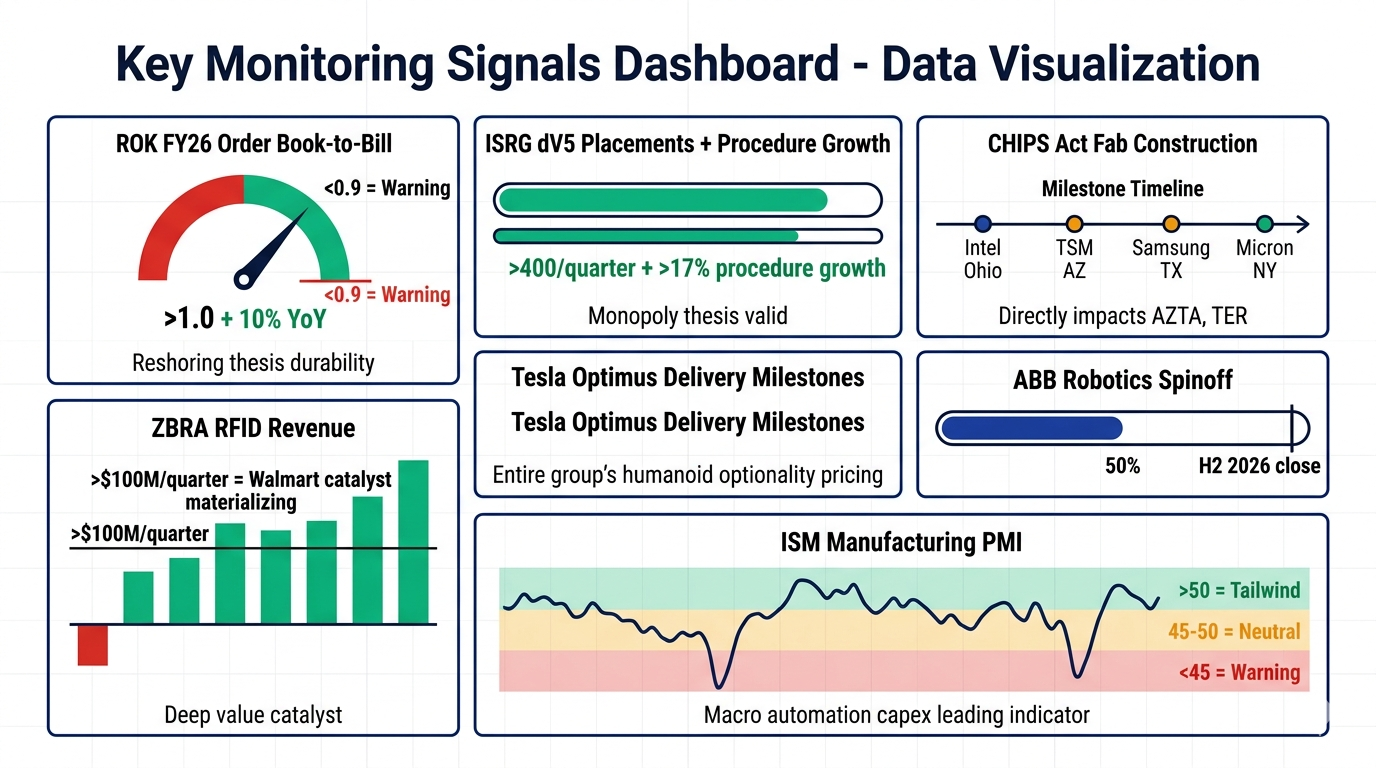
Key Signals to Monitor
- ROK FY26 order book-to-bill — >1.0 + 10% YoY order growth = thesis intact
- ISRG dV5 placements + procedure growth — >400/quarter + >17% procedure growth = thesis valid
- CHIPS Act fab construction progress — Intel/TSM/Samsung milestones directly affect AZTA, TER
- ZBRA RFID revenue — Each quarterly break above $100M = Walmart catalyst materializing
- Tesla Optimus delivery milestones — Affects entire group’s humanoid optionality pricing
- ABB Robotics spinoff completion — H2 2026 milestone
- ISM Manufacturing PMI — >50 = macro tailwind; <45 = automation capex deceleration warning
Data as of: April 18, 2026. All valuations based on closing prices that day. Fundamental data sourced from Finviz / StockAnalysis.com / Yahoo Finance.
Disclaimer: This article is for educational and research purposes only, and does not constitute investment advice. The author may hold positions in some of the securities mentioned.