May 16, 2026
$RKLB Q1 FY2026 Deep Dive: 34% in One Day Was Wall Street Admitting Three Things It Couldn't Admit Before
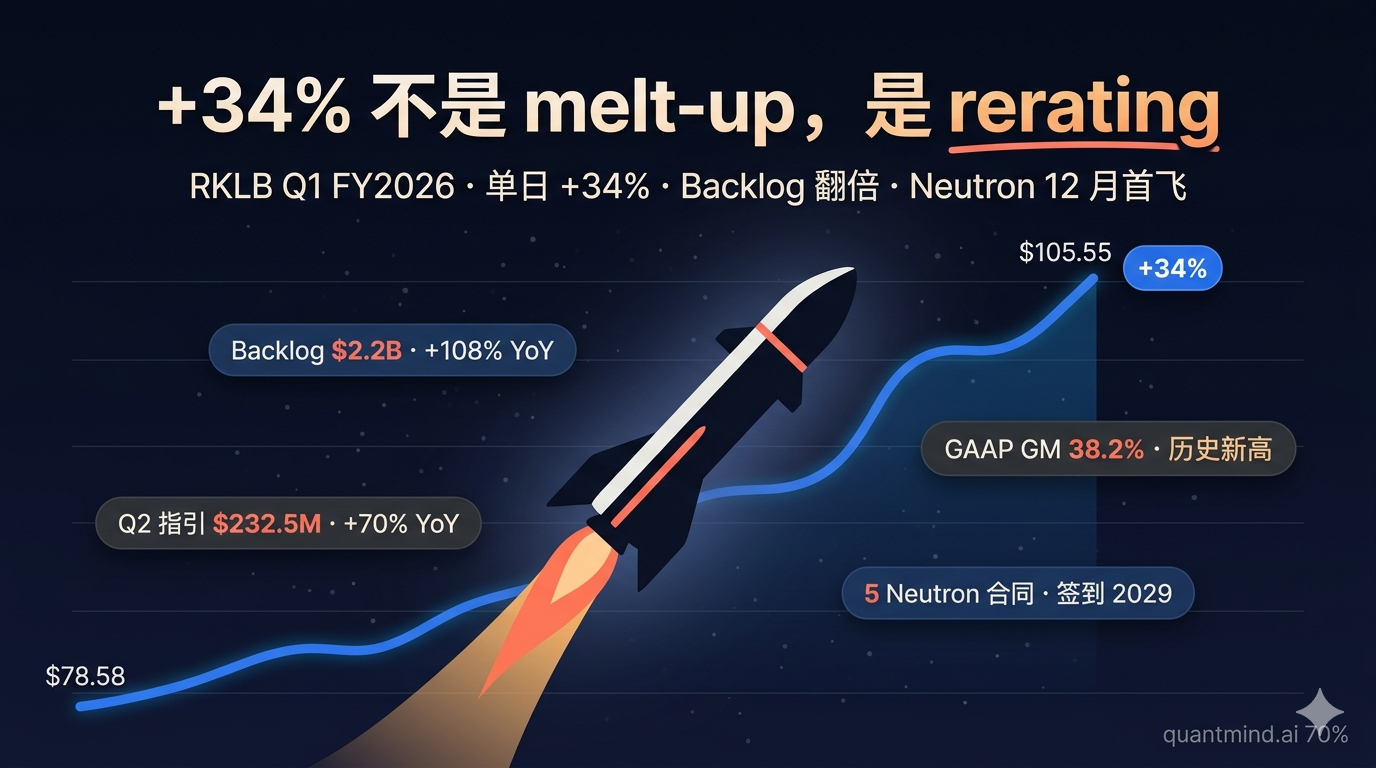
Rocket Lab surged 34% on May 8 — the largest single-day move in company history. Q1 revenue $200.3M (+63.5% YoY), backlog $2.2B (+108% YoY, doubled), GAAP gross margin 38.2% (record), Q2 guide $232.5M (+70% YoY, 10-15% above consensus). The market admitted three things at once: Neutron demand is signed (5 contracts including the largest deal in company history), vertical integration is producing margin (M&A flywheel intact), and RKLB has graduated from small-sat launcher to mission-critical national security infrastructure. Neutron maiden flight in Dec 2026 is the binary event. The only investable pure-play space alpha in public markets.
title: “$RKLB Q1 FY2026 Deep Dive: 34% in One Day Was Wall Street Admitting Three Things It Couldn’t Admit Before” date: 2026-05-10 ticker: RKLB
$RKLB Q1 FY2026 Deep Dive
Backlog Doubles, Neutron Books Itself Through 2029, Stock Has Best Day Ever — The Only Pure-Play Space Alpha You Can Actually Buy
A Scene First
This week SpaceX’s private secondary market chatter pegged its valuation north of $400 billion. Same week, Blue Origin slipped New Glenn cadence again. ULA Vulcan stayed quiet. The medium-lift launch market — the most strategically critical link in the US space economy — has exactly one working horse, and that horse is private.
Then on May 8, 4:30 PM ET, Rocket Lab walked out and said:
- Q1 revenue $200.3M, the largest in company history
- Backlog $2.2 billion, more than doubled YoY (+108%)
- Q1 launch sales alone exceeded all of FY2025
- Neutron manifest “filling fast through end of decade” — including the largest single contract in company history: 5 Neutron + 3 Electron through 2029
- Q2 guide $225-240M — accelerating, not decelerating
The next morning the stock opened at $105.55 from a $78.58 close. +34.3% in one day. Best day in company history.
This wasn’t a beat-and-rip. This was the market re-rating an entire investment thesis.
TL;DR
RKLB Q1 revenue $200.3M (+63.5% YoY), Adj EPS -$0.02 vs -$0.04 est, GAAP gross margin 38.2% (record), backlog $2.2B (+108% YoY), Q2 guide $225-240M (+70% YoY at midpoint), Neutron debut on track for end of 2026, +34% on the print.
| Dimension | Verdict |
|---|---|
| Fundamentals | Clean beat across both segments + record backlog + accelerating guide. No ambiguity. |
| Position call | Long-core — accumulate on pullbacks, hold through Neutron debut. |
| Biggest variable | Neutron maiden flight in Dec 2026 (binary event) + ATM dilution overhang. |
| Action Price | $95 (first tranche, 15% position), $85 (add, 25%), $75 (heavy, 35%) |
If you only remember one line: “34% wasn’t ‘too much, too fast.’ It was the market admitting three things it couldn’t admit yesterday — Neutron demand is real, vertical integration is producing margin, and RKLB is no longer a SpaceX wannabe but the only listed full-stack space infrastructure player.”
The Three Things Wall Street Just Admitted
Thing #1: Neutron Demand Is Signed, Not Theoretical
For 18 months the bear case was simple: “Cool rocket, but does anyone actually want to buy a Falcon 9 alternative when SpaceX prices keep dropping?”
This print buried that question.
- 5 dedicated Neutron contracts signed in Q1 (vs zero in some prior quarters)
- The largest single contract in company history was awarded — 5 Neutron + 3 Electron through 2029, undisclosed mega-constellation customer
- Manifest is “filling fast through the end of the decade”
Why this matters: A Neutron launch ASP is approximately $50-55M. Five signed launches = ~$250-275M of contracted revenue locked in before the rocket has even flown. The customer base voted with their checkbook before Wall Street voted with the multiple.
The strategic logic that drove customers to sign: SpaceX is private, not always available, and increasingly prioritizes Starlink internal demand. ULA Vulcan is more expensive and lower cadence. Blue Origin New Glenn is unproven. Customers who need medium-lift redundancy have one realistic public-market alternative — Rocket Lab.
That alternative is no longer a slide deck. It’s a $2.2B backlog.
Thing #2: Vertical Integration Is Producing Margin
GAAP gross margin 38.2% — record high. Non-GAAP 43%.
For context, Q1 FY2025 GAAP gross margin was about 32%. That’s 600 basis points of expansion in 12 months, while revenue grew 63%. Operating leverage and mix shift are both working.
The driver is the M&A flywheel everyone called “destruction of capital” 18 months ago:
| Acquisition | Capability | Status | Why It Matters |
|---|---|---|---|
| Mynaric | Laser optical communications | Closed 2026-04-14, $155.3M | The supply bottleneck for SDA Tracking/Transport Layer. RKLB now owns the pipe. |
| Motiv Space Systems | Mars-proven robotics, motion-control | Definitive agreement | Spacecraft components in-house |
| Geost | Space-domain imaging payloads | Closed earlier | Payload self-supply for SDA wins |
| Gauss (organic) | Hall-effect propulsion thruster | Launched | Captures the satellite-propulsion bottleneck |
Every component RKLB used to buy from a third party at a markup, it now manufactures internally. The margin shows up in the GM line.
This is the Palantir-of-space thesis in numerical form. Vertical integration + government anchor + commercial optionality = expanding margins on accelerating revenue. Multiples expand on this combination, not on growth alone.
Thing #3: It’s Mission-Critical National Security Infrastructure Now
Look at where RKLB shows up in the defense procurement stack today:
- Anduril $30M HASTE contract — hypersonic test launches; HASTE is now ~1/3 of RKLB’s 70+ launch backlog
- Space Force missile defense program — selected (program scope classified)
- Golden Dome SDA layers — RKLB positioned as a Tracking/Transport Layer satellite provider; Mynaric closes the laser-comm gap that was holding back its proposals
- Hypersonic test demand — the Pentagon is the largest hypersonic R&D customer on Earth; Electron/HASTE is the cheapest test article available
18 months ago RKLB was “small-sat launch + niche space systems.” Today it is in three of the Pentagon’s highest-priority spend categories: hypersonic testing, SDA constellations, and assured access to space. That re-categorization changes the customer concentration profile, the contract durability, and — critically — the addressable budget pool.
It also changes who ultimately owns the floor under the stock. A company that builds infrastructure the DoD treats as critical doesn’t trade at small-cap-launcher multiples. This print made that transition undeniable.
Headline Numbers
| Metric | Q1 FY2026 | Consensus | YoY | Beat/Miss |
|---|---|---|---|---|
| Revenue | $200.3M | $190.9M | +63.5% | ✅ +$9.4M |
| Space Systems revenue | $136.7M | $132.1M | strong | ✅ |
| Launch revenue | $63.7M | $59.0M | strong | ✅ |
| GAAP Gross Margin | 38.2% | — | +600bps | ✅ record |
| Non-GAAP Gross Margin | 43.0% | — | — | ✅ |
| Adj. EPS | -$0.02 | -$0.04 | improved | ✅ |
| Net Loss | -$45.0M | — | from -$60.6M | ✅ |
| Adjusted EBITDA | -$11.8M | — | from -$30.0M | ✅ |
| Backlog | $2.2B | — | +108% | ✅ record |
Both segments beat. Margin expanded. Loss narrowed by half. Backlog doubled. There is no soft spot in this print.
Q2 Guide — The Real Catalyst
| Q2 FY2026 Guide | Range | Implies |
|---|---|---|
| Revenue | $225M – $240M | +12-19% sequential, +70% YoY at midpoint |
| GAAP Gross Margin | 33% – 35% | Compression from Neutron pre-flight COGS |
| Non-GAAP Gross Margin | 38% – 40% | Healthy |
| Adjusted EBITDA Loss | ($20M) – ($26M) | Wider than Q1 — Neutron ramp |
| Stock-Based Comp | $19M – $21M | Stable |
The critical detail nobody is talking about: consensus going into the print was modeling Q2 around $200-210M. The midpoint of $232.5M is a 10-15% upside surprise to the forward quarter, not just the reported quarter.
That is what re-rates a stock 34% in a day. Beating the printed quarter is table stakes. Beating the next quarter that nobody had baked in yet — that is the thesis change.
The GAAP GM compression to 33-35% is expected and healthy: Neutron pre-flight test campaigns, ground infrastructure, and engine qualification are hitting COGS before any Neutron revenue arrives. Management was explicit. The market correctly looked through it.
Liquidity, Dilution, and the ATM Question
- Cash on hand: $1.21B
- Total available liquidity: >$2B (including ATM facility)
- ATM funded Mynaric ($155M) + Motiv + Neutron capex
The bear’s strongest remaining argument: RKLB’s ATM is an open dilution channel. Every rip into the $100s gets met with secondary supply. Until Neutron generates cash, there is structural overhang.
The counterpoint: With $1.21B cash + ATM access + improving EBITDA + customer prepayments coming on signed Neutron contracts, RKLB likely does not need another raise before Neutron flies in Dec 2026. After the maiden flight, the funding gap closes organically.
If you believe Neutron flies on schedule, dilution is a one-time tax, not a recurring rent. If you don’t, dilution is the slow leak that eats your upside. The whole thesis lives or dies on Dec 2026.
Valuation: Is 50x Sales Crazy?
At $105 the company is roughly:
- Market cap: ~$53B
- 2026E revenue (extrapolating Q1+Q2 guide): ~$900M-1.0B
- EV/Sales 2026E: ~50-55x
| Company | EV/Sales 2026E | Growth | Adj Margin |
|---|---|---|---|
| RKLB | ~50-55x | +60%+ | -2% |
| Palantir (PLTR) | ~45-50x | +30% | +30% |
| AST SpaceMobile (ASTS) | ~30-40x | early | negative |
| Lockheed (LMT) | ~2-3x | +2% | +12% |
| Boeing (BA) | ~1x | low | breakeven |
The honest assessment: 50x sales is rich on growth alone, expensive but defensible on growth-plus-margin-expansion-plus-government-anchor, and outright cheap if Neutron works and 2027 revenue scales to $1.5-2B.
The question to ask is not “is it expensive?” Of course it is. The question is: what does the multiple compress to if Neutron flies and 2027 revenue does $1.7B? Answer: roughly 30x EV/Sales, in line with PLTR — at which point the stock is $130-150 by mechanical multiple stability alone.
That is the bull case, sized correctly.
Three Scenarios — 35 / 45 / 20
🟢 Bull Case — $130-150 (probability 35%)
- Q2 prints at high end ($240M+)
- Neutron static fire test successful by Q3
- Successful Neutron debut launch in Dec 2026
- Additional mega-constellation contract win (Kuiper backup, Telesat, sovereign LEO)
- Multiple expands toward 35-40x as time-to-revenue compresses
⚪ Base Case — $90-115 (probability 45%)
- Quarters print in-line with guide
- Neutron slips to Q1-Q2 2027 (industry norm — every maiden flight has slipped)
- Stock chops sideways $90-115
- Multiple compresses slightly on extended time-to-revenue, offset by continued backlog growth
- This is the modal outcome — boring but not broken
🔴 Bear Case — $55-80 (probability 20%)
- Major Neutron test failure or 6+ month slip
- Anchor customer cancellation (anchor on the largest contract walks)
- DoD continuing-resolution chokes HASTE pipeline
- Macro risk-off compresses high-multiple growth names broadly
- Stock retraces to the prior breakout zone
What I’m betting: the base case is the median, the bull case is the modal upside, the bear case is fat-tailed but fundable through the ATM. Ratio implies 35/45/20 with positive expected value at $95-100, neutral at $105-115, negative above $130 short-term.
The Position
This is where I stand. Long-core. Accumulate on pullbacks. Hold through Neutron.
The trade structure I’d actually run:
| Price | Position | Action |
|---|---|---|
| $105+ (now) | If you have nothing, don’t chase here. Initiate 5-10% via Jan 2027 $100-110 calls instead. | |
| $95 (first pullback) | First tranche, 15% position | |
| $85 (deeper pullback) | Add to 25% position | |
| $75 (panic) | Heavy add to 35% position |
For traders: the IV stays elevated through Dec 2026. Diagonal call spreads (long Mar/Jun 2027 calls / short weekly OTM calls) capture both directional upside and theta decay.
For long-term holders already up 5x: trim 25-33% on this rip, hold the core through the Neutron event. You don’t get to ride a thesis for free — you pay tax on conviction by booking some gains when the market gives you a 34% gift in one session.
What I’m Watching Next
- June-July 2026: Q2 print — must hit or beat the $232.5M midpoint
- August 2026: Neutron qualification milestones, customer #2 for the large mega-constellation deal
- Sept-Oct 2026: Neutron static fire / wet dress rehearsal
- Dec 2026: Neutron maiden flight — binary event, the entire thesis
- Throughout: Additional Golden Dome / SDA contract awards; Pentagon FY27 budget cycle
- Risk monitor: ATM utilization rate; if it accelerates above $100M/quarter the dilution argument gets sharper
Conclusion
The market just admitted three things it couldn’t admit before this print: Neutron demand is signed, vertical integration is producing margin, and RKLB has graduated from “small-sat launcher” to “mission-critical national security infrastructure.”
The next exam is December 2026. If Neutron flies, the multiple holds and the stock works toward $130-150. If it slips materially, the multiple compresses and we get the $80-90 reset that becomes the next great entry point.
Operationally: - At $105 the IRR is mediocre → don’t chase - $95 → first tranche - $85 → add - $75 → heavy
Treat RKLB as the only pure-play space alpha you can actually buy. SpaceX is private. Blue Origin is private. ULA is locked inside Boeing/Lockheed. The entire investable universe of space-economy alpha for public markets right now is one ticker. That scarcity is part of the multiple, and it isn’t going away.
Closing Thought
The two data points that hit me hardest:
- Q1 launch sales exceeded all of FY2025. Not “matched.” Exceeded. In one quarter. The demand inflection is not a forecast — it’s a reported number.
- GAAP gross margin 38.2%, record. Vertical integration isn’t a slide anymore; it’s in the P&L. Every basis point of GM expansion is worth ~$5-7 of equity value at this multiple.
34% wasn’t a melt-up. It was a rerating. Wall Street had been pricing RKLB as “could-be SpaceX-lite if everything goes right.” This print said the company isn’t trying to be SpaceX-lite — it’s trying to be the listed counterweight to SpaceX, and the customer base, the Pentagon, and the backlog all just nodded.
Six months from now we either celebrate Neutron’s first ascent or we get the entry point of the cycle. Both outcomes are tradable. The thing that isn’t tradable is being absent.
Analysis based on Rocket Lab Corp Q1 FY2026 earnings reported May 8, 2026 post-market. Sources: Rocket Lab IR, Stocktitan 8-K filing, Motley Fool earnings call transcript, CNBC, Benzinga, StockStory, Parameter, Blockonomi. ⚠️ Not investment advice. For research purposes only.