Mar 22, 2026
The Photonics Power Ranking: 8 Stocks Powering AI's Optical Backbone
A definitive ranking of 8 photonics companies powering the AI infrastructure supercycle — from Coherent to IPG Photonics. Covering COHR, FN, CIEN, GLW, VIAV, LITE, AAOI, and IPGP with actionable buy/hold/pass verdicts, valuation analysis, and portfolio allocation.
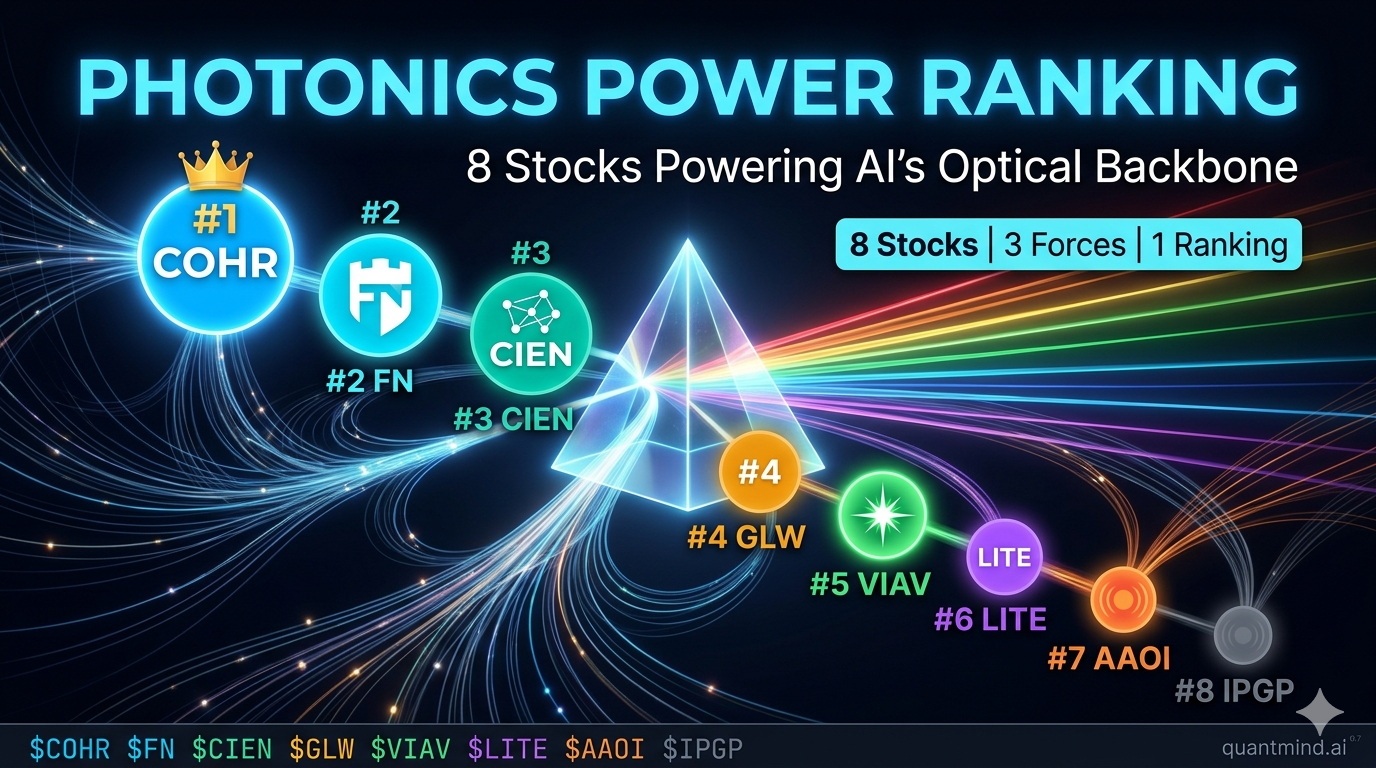
The Photonics Power Ranking: 8 Stocks Powering AI’s Optical Backbone
I spent a week tearing apart 8 photonics companies side by side. The result that surprised me most: the stock everyone’s ignoring has the highest IRR in the group.
OFC 2026 just ended. NVIDIA dropped $4 billion into photonics companies. My feed is wall-to-wall COHR and LITE rockets.
But nobody’s done the actual comparison. Eight companies, same ruler, ranked.
So I did. And one result genuinely caught me off guard.
Here’s the verdict first.
The Definitive Ranking
| Rank | Ticker | Verdict | Fwd P/E | AI Revenue % | One-Line Thesis |
|---|---|---|---|---|---|
| #1 | COHR | BUY | 34x | 71% | NVIDIA’s $2B bet + most vertically integrated photonics platform |
| #2 | FN | BUY | 34x | 55% | Sole-source 1.6T manufacturer for NVIDIA + zero debt fortress |
| #3 | CIEN | BUY | 49x | 42% | $7B backlog + only 1.6T coherent platform shipping at scale |
| #4 | GLW | HOLD | 49x | 38% | Meta’s $6B fiber deal is real, but already priced in |
| #5 | VIAV | BUY | 19x | Growing | The cheapest AI-adjacent play in photonics — and nobody’s talking about it |
| #6 | LITE | HOLD | 60x | >60% | Best technology in the sector, worst risk/reward at this price |
| #7 | AAOI | SPEC BUY | N/A | 56% | $4B Amazon deal + lottery ticket upside, but binary outcome |
| #8 | IPGP | PASS | 56x | <5% | Industrial lasers, no AI story — the sector’s biggest value trap |
If you remember one thing: COHR has the best risk/reward. VIAV is the hidden alpha. IPGP is a trap.
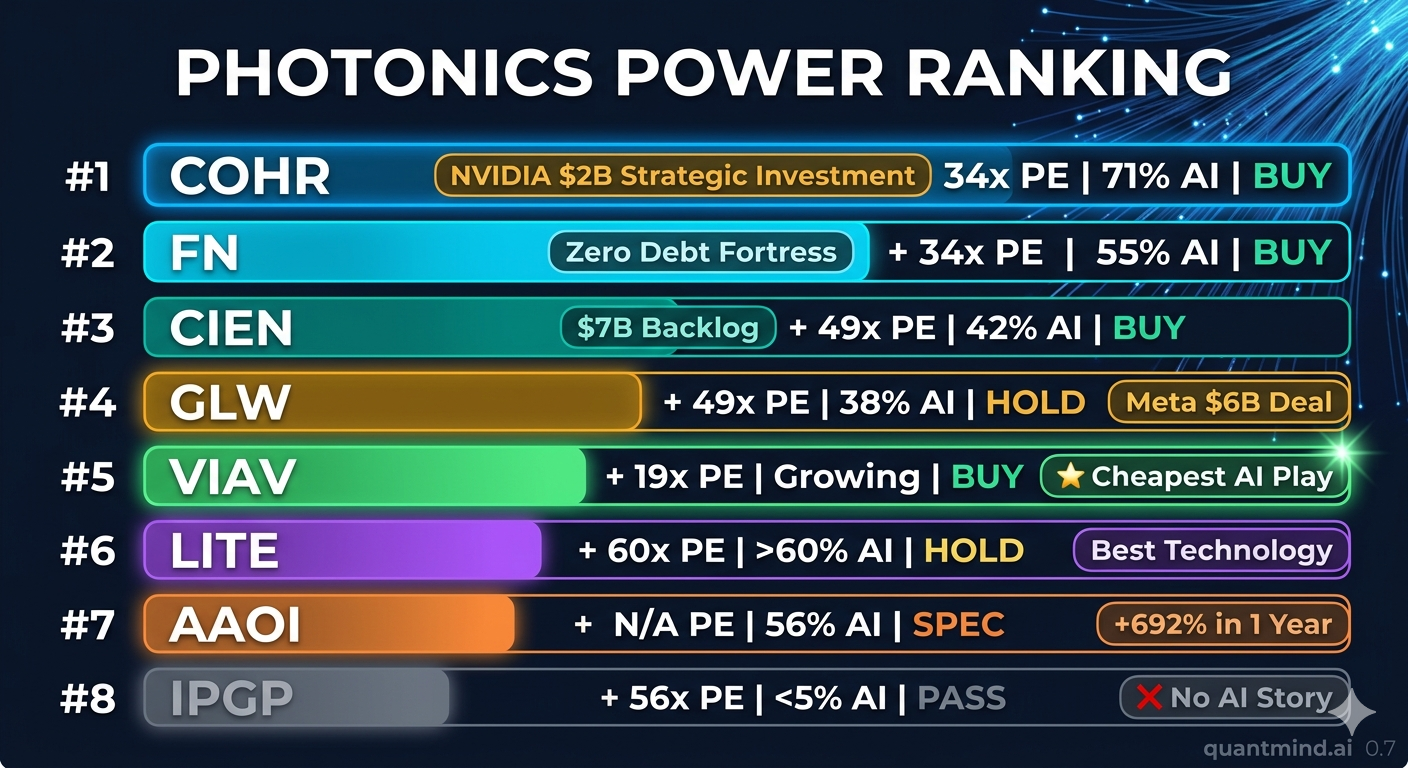
This ranking will be controversial. Especially LITE at #6 — the best technology in the sector, ranked below a test equipment company? Keep reading.
Three Forces Reshaping the Industry
Force 1: The 800G → 1.6T → 3.2T Transceiver Migration
Every AI GPU cluster needs optical interconnects — between GPUs, between racks, between data centers.
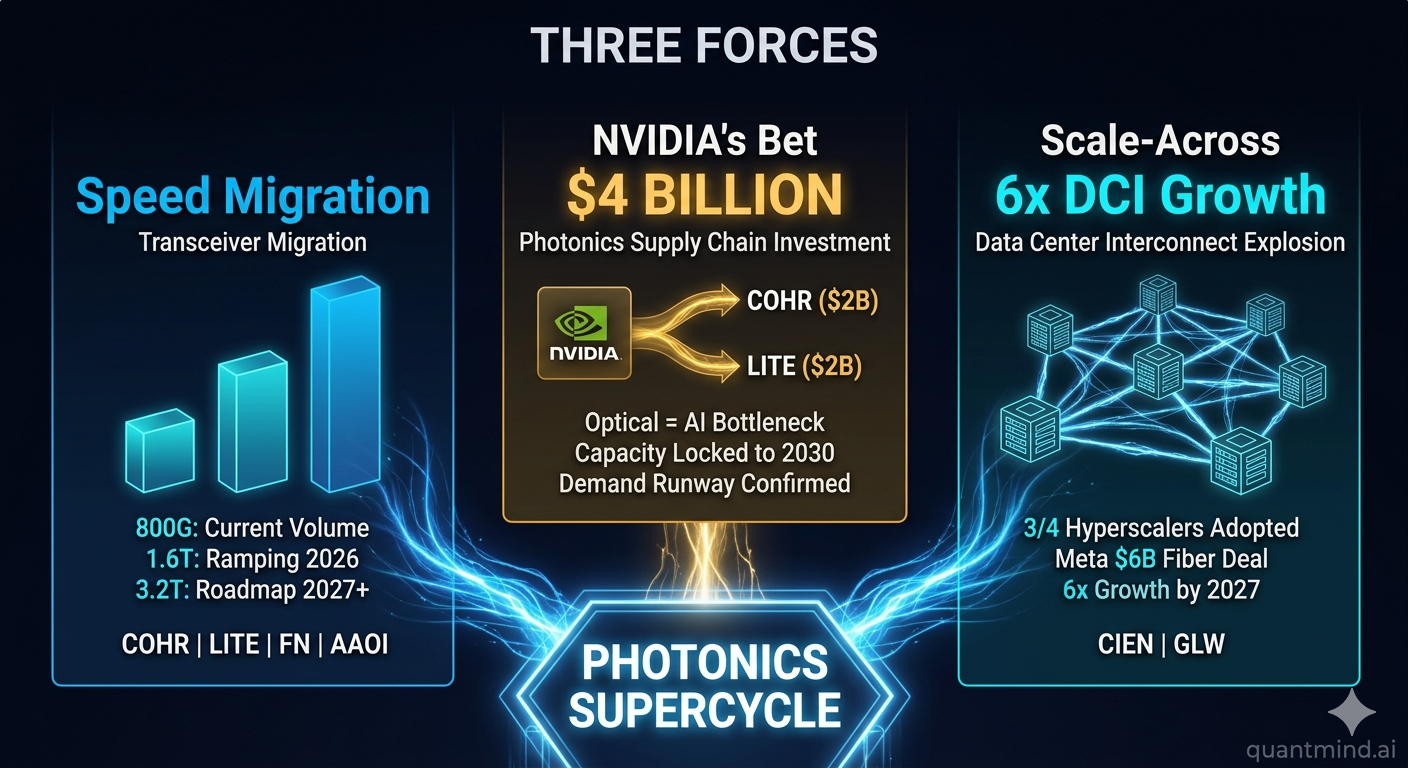
- 800G (current volume) — COHR, LITE, FN shipping at scale
- 1.6T (ramping now, H1-H2 2026) — COHR, LITE, FN in production ramp; AAOI first orders
- 3.2T (roadmap, 2027+) — COHR and CIEN demonstrated prototypes at OFC 2026
This isn’t an “if” story. It’s a “how fast” story.
Force 2: NVIDIA’s $4B Photonics Investment
On March 2, NVIDIA invested $4 billion into the photonics supply chain — $2B into Coherent, $2B into Lumentum — with supply agreements extending to end of decade.
Three implications: 1. Optical interconnects are the bottleneck for AI scaling — not GPUs 2. NVIDIA is locking in supply before competitors can access photonics capacity 3. The demand runway extends to at least 2030
When NVIDIA votes with $4 billion in cash, you listen.
Force 3: The “Scale-Across” Architecture Revolution
AI models are too large for a single data center. Hyperscalers are building clusters of data centers that operate as one virtual supercomputer, connected by ultra-high-speed optical links.
Ciena coined “scale-across” and projects 6x growth in DCI demand through 2027. Three of four major hyperscalers have adopted this architecture.
Tier 1: Core Holdings
#1 COHR (Coherent) — 34x Forward P/E | BUY
Why not LITE at #1?
This was the biggest mental shift in the whole exercise. LITE has better technology — 200G/lane EML monopoly, VCSEL breakthrough, $400M OCS backlog. But investing isn’t a technology beauty contest. It’s a risk/reward contest.
COHR wins on four words: full stack ownership.
- From InP wafers to finished transceivers — vertically integrated, no supplier chokepoints
- 71% of revenue from AI/datacenter — highest direct exposure in the group
- Datacenter book-to-bill >4x — the most extreme demand signal I’ve seen in this sector
- NVIDIA’s $2B isn’t just capital — it’s an exclusive supply agreement through end of decade
The market still has people calling COHR “a leveraged turnaround.” Leverage is down from 2.3x to 1.7x. NVIDIA’s cash accelerates that further. That narrative is dead.
Key numbers: - Q2 FY2026 revenue: $1.69B (+17% YoY, +22% pro forma) - Non-GAAP gross margin: 39%, operating margin: 19.9% - 1.6T ramp active across multiple hyperscalers; 3.2T roadmap shown at OFC 2026 - 6-inch InP wafer capacity targeting 2x by Q4 FY2026
Action Price: Buy $230-240 (25-30x forward) | Trim above $300
#2 FN (Fabrinet) — 34x Forward P/E | BUY
The lowest-risk pure AI execution story in this sector.
- 100% sole-source manufacturer for NVIDIA Blackwell 1.6T transceivers
- Net cash >$900M, zero debt — a fortress in an industry where everyone else carries billions in debt
- Q2 FY2026 revenue: $1.13B (+36% YoY) — fastest growth since IPO
- Building 10 expansion adds ~$3B in revenue capacity, doubles 1.6T production
The market worries about NVIDIA customer concentration (28%). Flip it: if you want AI optical transceivers at scale, you must go through Fabrinet. That’s not dependency — that’s irreplaceability.
Key risks: Thailand single-country manufacturing, 12.4% thin gross margins, EML laser supply constraints
Action Price: Accumulate below $500 | Trim above $600
#3 CIEN (Ciena) — 49x Forward P/E | BUY
The deepest technology moat at the optical networking layer.
- WaveLogic 6: Industry’s only 1.6T coherent platform at scale — 72 customers signed
- $7B backlog grew by $2B in a single quarter — unprecedented forward visibility
- “Scale-across” architecture: 3 of 4 hyperscalers adopted
- Cloud revenue = 42% of total — structural pivot from telco to hyperscale
- S&P 500 inclusion — passive fund buying creates a structural demand floor
Here’s what’s interesting: CIEN posted a “triple beat” in Q1 FY2026 (revenue, EPS, margins all exceeded), and the stock dropped 14%. Buy-side whisper numbers wanted even more.
When a stock gets punished for being “merely excellent,” that’s usually your entry point.
Action Price: Buy below $280 (40x forward) | Reduce if backlog declines QoQ
Tier 2: Strategic Positions
#4 GLW (Corning) — HOLD / Accumulate on Dips
Meta’s $6B fiber deal, Springboard plan upgraded to $11B in incremental revenue, Contour fiber innovation — all real.
But 49x forward P/E has priced it all in. Corning is fundamentally a diversified industrials company where only 38% of revenue is AI-exposed. You’re paying 49x for an AI story, but buying a company that also sells display glass and automotive products.
Accumulate below $110. Hold at current levels.
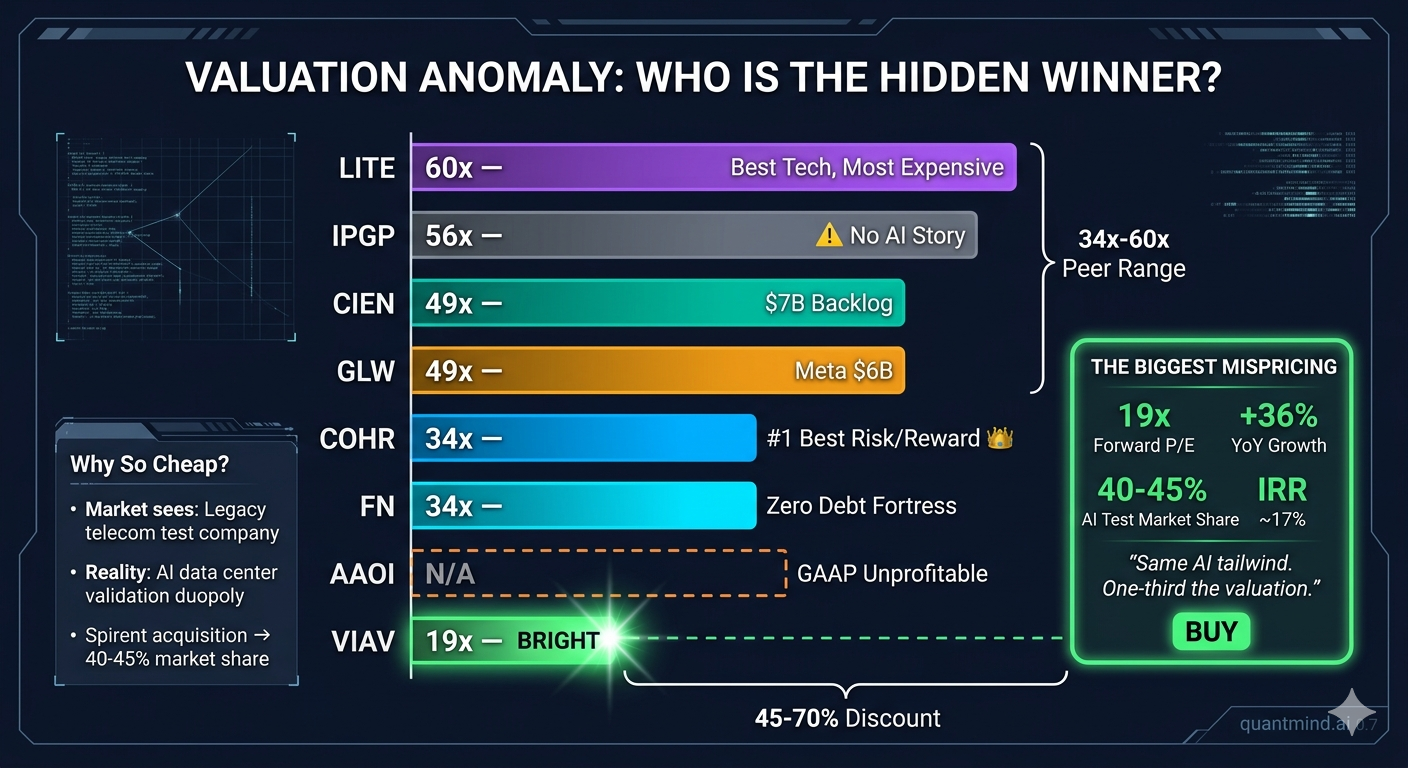
#5 VIAV — The Biggest Mispricing in This Report
19x forward P/E.
I triple-checked this number. In a sector where peers trade at 34x to 60x, VIAV sits at 19x.
Why? Because the market still sees “legacy telecom test company.” But the Spirent acquisition ($425M) gave VIAV 40-45% market share in AI data center Ethernet validation.
Think about what that means: every 800G and 1.6T transceiver that COHR and LITE ship needs to be tested by either VIAV or Keysight.
Same AI tailwind. One-third the valuation.
- Q2 FY2026 revenue: $369M (+36% YoY)
- Q3 guidance: $386-400M (consensus was $355M — 11% above)
- 1.6T TestCenter D2 just launched at OFC 2026
- OSP anti-counterfeiting business provides a 33%-margin defensive floor
IRR ~17% — highest in the report. If the market wakes up to VIAV’s AI exposure, multiple expansion alone drives 30%+ upside.
Buy at current levels. This is the alpha in this article.
#6 LITE (Lumentum) — HOLD
Best technology in the sector, no question: 200G/lane EML monopoly, $400M+ OCS backlog, VCSEL breakthrough at OFC 2026.
But 60x forward P/E + $2B net debt + negative free cash flow = zero margin for error.
One quarterly miss at this valuation means a 25-35% drawdown. Technology leadership doesn’t equal investment leadership.
Buy below $580 (45x forward). Hold at current levels.
Tier 3: Speculative & Avoid
#7 AAOI — Speculative Buy (Half Position)
The lottery ticket. Up 692% in one year. From near-death to guiding FY2026 revenue above $1 billion (+119%). The $4B Amazon deal and $200M+ 1.6T order are real.
But: GAAP-unprofitable, FCF of negative $354M, Amazon + Microsoft = 82% of revenue, only 5 analysts covering, $100M ATM dilution risk.
Binary outcome. Position size: 1/3 to 1/2 of normal.
#8 IPGP — PASS
56x forward P/E for 17% growth in industrial lasers? No.
AI exposure under 5%. Chinese competitors (Raycus, Maxphotonics) have achieved technology parity in commodity cutting. Gross margins compressed from 45-55% to 36%.
Defense laser (CROSSBOW) and EV battery welding are real opportunities but too small to justify this multiple.
Below $85 (35x forward) it gets interesting. At current prices, pass.
6 Investment Philosophy Views
The same data, six completely different lenses. This is where conviction either hardens or cracks.
1. Quality Compounder (Buffett / Munger)
“Would I be happy owning this for 20 years if the market closed tomorrow?”
Pick: FN — Zero debt, $900M net cash, sole-source tollbooth position. Buffett abhors leverage; FN is the only pristine balance sheet in this group. The 12.4% gross margin is structurally thin by design (EMS model) — ROIC and capital efficiency are what matter, and both are excellent.
Why not COHR? Buffett would wait for the $2.6B net debt to clean up. Why not GLW? 49x P/E violates “wonderful company at a fair price.”
2. Imagination Growth (Baillie Gifford / ARK)
“If everything goes right, how big could this be in 5-10 years?”
Pick: COHR — Full-stack vertical integration from InP wafers to 3.2T transceivers. NVIDIA’s $2B validates the decade-long runway. Book-to-bill >4x is the demand signal Baillie Gifford hunts for — capacity, not demand, is the constraint. If AI infrastructure spending doubles consensus, COHR’s datacenter segment alone could be $10B+ by FY2028.
3. Fundamental Long/Short (Tiger Cubs)
“Where is the market most wrong?”
Pick: Long VIAV / Short IPGP — The cleanest pair trade in photonics. VIAV at 19x with 36% growth and 40-45% AI test market share vs. IPGP at 56x with 17% growth and <5% AI exposure. PEG spread: 0.53x vs. 3.3x — a 6x divergence. Even modest convergence generates significant alpha. Hedge ratio: 1.5 VIAV for every 1 IPGP.
4. Deep Value (Klarman / Howard Marks)
“What would a private buyer pay? Where’s the margin of safety?”
Pick: VIAV — 19x forward P/E in a 34-60x sector. The discount exists because GAAP earnings are suppressed by Spirent amortization (trailing P/E 443x scares screens). OSP anti-counterfeiting (33% margins, government contracts) provides a safety floor — if AI fails, this business alone supports $15-18/share. Replacement cost for Spirent’s assets: 2-3x what VIAV paid.
5. Catalyst-Driven (Tepper / Ackman)
“What specific event forces the market to re-price this in 6-18 months?”
Pick: LITE — Highest catalyst density in the sector:
| Catalyst | Timeline |
|---|---|
| OCS revenue → $100M/quarter | H2 2026 |
| 1.6T volume ramp | Q3-Q4 FY2026 |
| Q3 earnings (May 12) | 7 weeks out |
| FCF inflection (negative → positive) | H2 FY2026 |
COHR’s catalysts are partially priced in. LITE’s are still ahead — the information gap is wider. But at 60x, any miss gets punished 3-5x harder. Half-size position, take profits into events.
6. Macro-Tactical (Druckenmiller / Soros)
“What is the macro regime telling me?”
Pick: COHR — Druckenmiller reads NVIDIA’s $4B photonics investment as a leading indicator: “The optical bottleneck is real, and NVIDIA is paying up to solve it.” Book-to-bill >4x during an upcycle = capacity-constrained pricing power. If Fed cuts in H2 2026, long-duration growth stocks re-rate — COHR at 34x has more expansion room than CIEN at 49x or LITE at 60x. Macro stop: cut if 10Y yield > 5.5%.
Philosophy Consensus
| Ticker | Quality | Growth | L/S | Value | Catalyst | Macro | Score |
|---|---|---|---|---|---|---|---|
| COHR | — | #1 | — | — | — | #1 | 2 wins |
| FN | #1 | — | — | — | — | — | 1 win |
| VIAV | — | — | Long | #1 | — | — | 2 wins |
| LITE | — | — | — | — | #1 | — | 1 win |
| IPGP | — | — | Short | — | — | — | 1 loss |
Convergence: COHR and VIAV each win 2 frameworks — growth+macro and value+L/S respectively. When philosophies that disagree on everything converge on the same names, that’s high-conviction signal.
Pre-Mortem: How This Thesis Could Fail
Being honest about the failure paths:
- AI capex cliff — DeepSeek-type efficiency breakthroughs reduce compute and optical needs. All 7 AI-exposed names drop 30-50%.
- Silicon photonics disruption — Broadcom or Intel’s integrated silicon photonics reaches price-performance parity, eroding LITE and COHR’s moats.
- Hyperscaler vertical integration — NVIDIA, Google, or Amazon build their own transceiver fabs.
- Rate shock — At 34-60x forward P/E, these are long-duration assets. Rates to 7%+ compress multiples across the board.
- Tariff escalation — Broad-based tariffs on optical components disrupt supply chains and margins.
Of these five, #1 and #3 keep me up at night. But in the next 12-18 months, the three forces have far more certainty than any of these risks.
Portfolio Allocation
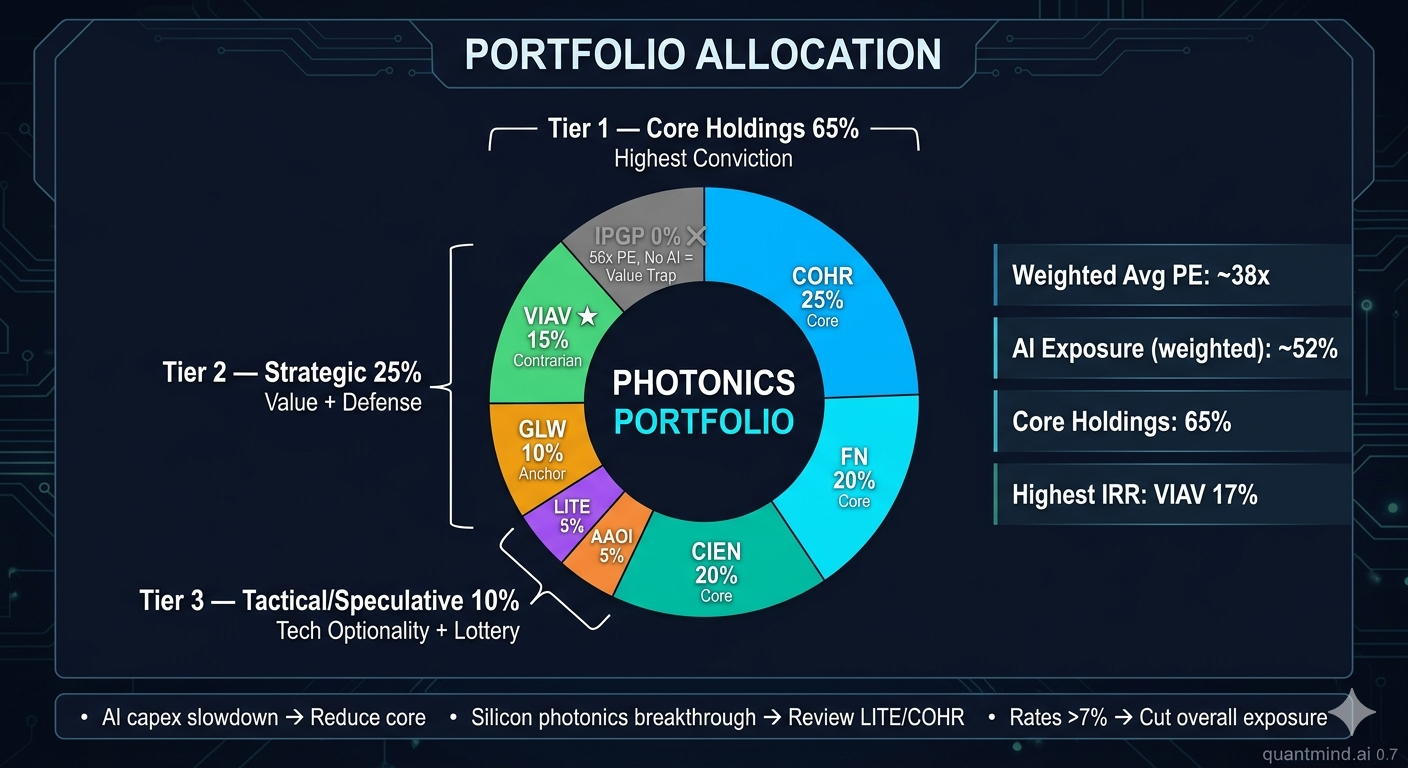
| Role | Ticker | Weight | Fwd P/E |
|---|---|---|---|
| Core | COHR | 25% | 34x |
| Core | FN | 20% | 34x |
| Core | CIEN | 20% | 49x |
| Contrarian | VIAV | 15% | 19x |
| Anchor | GLW | 10% | 49x |
| Tactical | LITE | 5% | 60x |
| Speculative | AAOI | 5% | N/A |
| Avoid | IPGP | 0% | 56x |
The Bottom Line
Photonics is the circulatory system of AI. What flows through those fibers isn’t data — it’s certainty. And in the face of certainty, what you need isn’t the best technology. It’s the best risk/reward.
That’s why COHR ranks #1, VIAV is the hidden winner, and IPGP — sitting at 56x with no AI story — is the biggest value trap in this sector.
Data as of March 22, 2026. Based on public information. Not investment advice.
quantmind.ai