May 4, 2026
Photonics Empire II: $700B Capex Confirmed — Time to Rewrite the Allocation?
Five weeks ago I ranked 8 photonics companies. Last night, Mag-7 Q1 2026 raised combined 2026 capex to $695-725B. 7 of 8 names unchanged in ranking, 1 trimmed (LITE short-term), 2 internal weight tweaks — but conviction in every name went up.
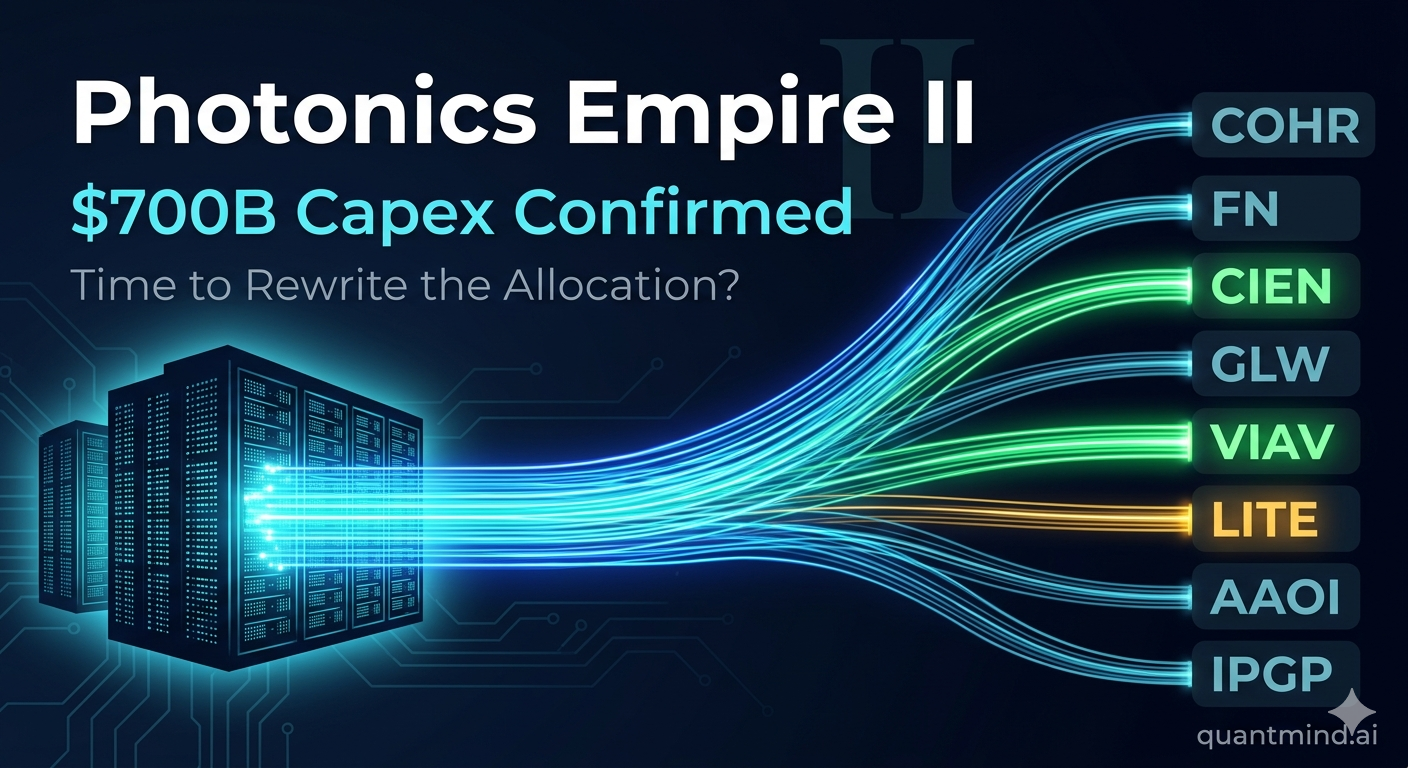
title: “Photonics Empire II: $700B Capex Confirmed — Time to Rewrite the Allocation?” date: 2026-04-30 tickers: [COHR, LITE, FN, CIEN, GLW, VIAV, AAOI, IPGP]
Photonics Empire II: From “Hypothesis” to “Fact”
$700B AI Capex Just Got Confirmed — Time to Rewrite the Allocation?
A Letter to Five-Weeks-Ago Me
Five weeks ago I ranked 8 photonics companies side by side and made a bet: AI capex would keep climbing, and photonics is the cleanest lever on it.
That day I listed 5 failure paths. The first one was the most lethal:
“AI capex cliff — DeepSeek-style efficiency breakthroughs, every AI-exposed name down 30-50%.”
Last night (April 29), Mag-7 reported Q1 2026. GOOGL, MSFT, META all printed after the close; AMZN reported same evening. Combined 2026 capex guidance is now $695-725B — every single one of them raised.
That most lethal failure path got knocked out by last night’s data.
But this isn’t a victory lap. It’s a colder question: when the biggest external variable moves from hypothesis to fact, how do you adjust the allocation and priorities inside?
TL;DR
Upstream just printed — Mag-7 Q1 2026 cut “AI capex cliff” risk from ~30% to ~10%, and MSFT CFO’s “we don’t have enough GPU to go around” line is an amplifier signal for the entire photonics deck.
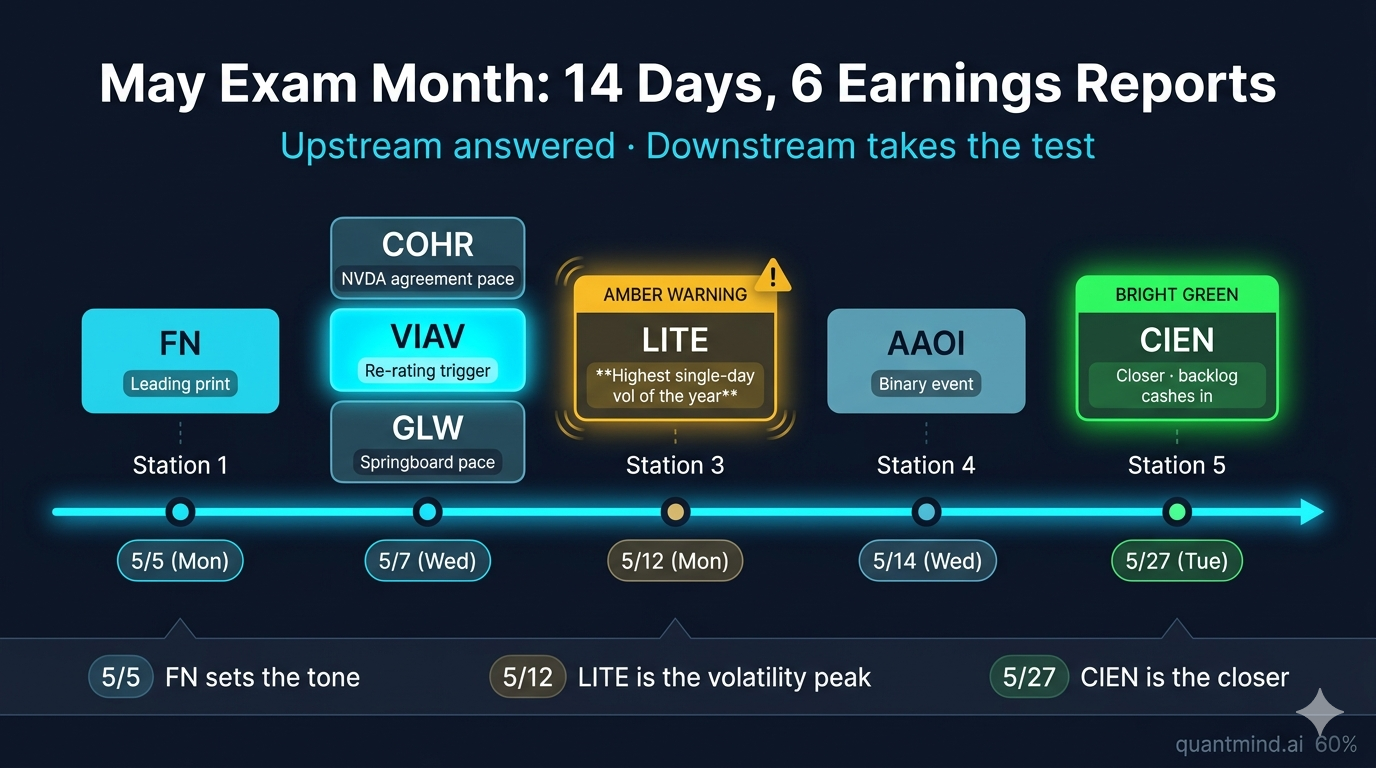
Downstream is the next 14 days: 5/5 FN, 5/7 COHR + VIAV + GLW, 5/12 LITE, 5/14 AAOI, 5/27 CIEN. This is the thesis exam month.
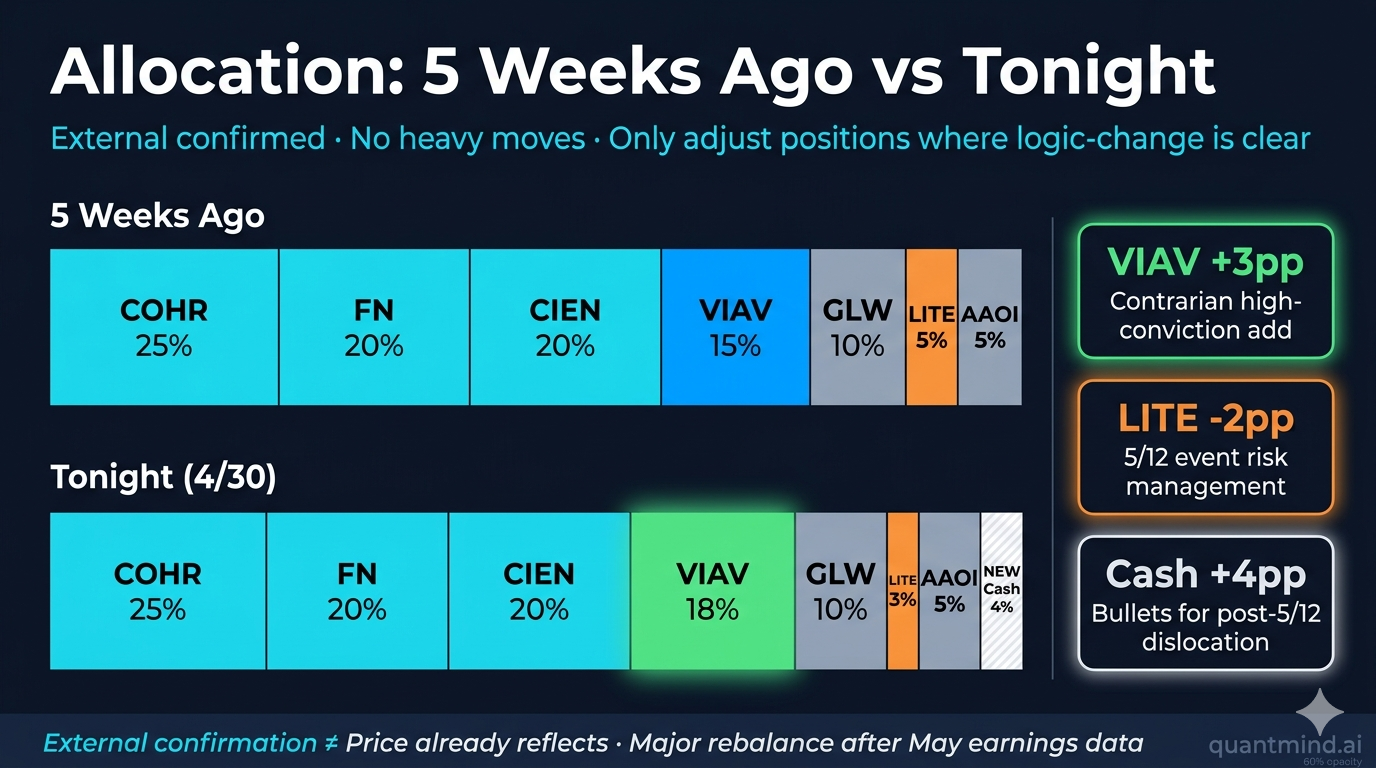
I’m not making heavy moves on allocation, but I’m trimming LITE (event risk before 5/12), adding to VIAV (hidden alpha upgraded), and holding 4% cash for the post-5/12 dislocation window.
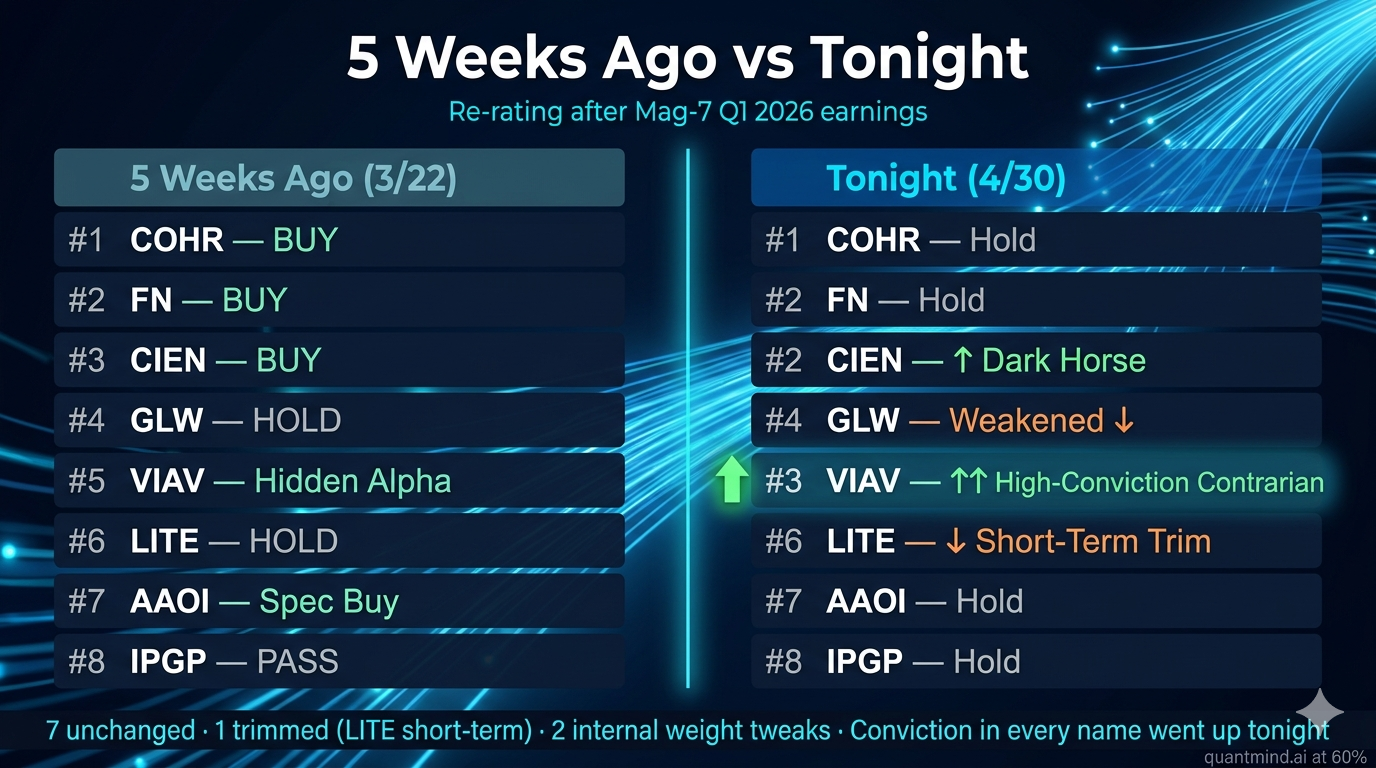
| Ticker | 5 Weeks Ago | Tonight’s Update | Trigger |
|---|---|---|---|
| COHR | #1 BUY | #1 hold | Mag-7 validates demand; valuation unchanged |
| FN | #2 BUY | #2 hold | NVDA 1.6T sole-source unchanged |
| CIEN | #3 BUY | #2 dark horse | META acceleration = scale-across cashing in |
| GLW | #4 HOLD | #4 weakened | Pure-AI names’ relative advantage widens |
| VIAV | #5 hidden alpha | #3 high-conviction contrarian | $700B capex = test demand amplified |
| LITE | #6 HOLD | #6 short-term trim | Event risk into 5/12 |
| AAOI | #7 spec | hold | Position cap unchanged |
| IPGP | #8 PASS | hold | AI exposure still <5% |
The one-liner: 7 of 8 names unchanged in ranking; 1 trimmed (LITE short-term); 2 internal weight tweaks. But the conviction in every name went up because of last night.
Upstream Confirmation: Four Numbers + One Detail
I wrote a full Big Tech Q1 2026 breakdown for last night’s prints. Here I’ll pull only the parts that matter for photonics specifically.
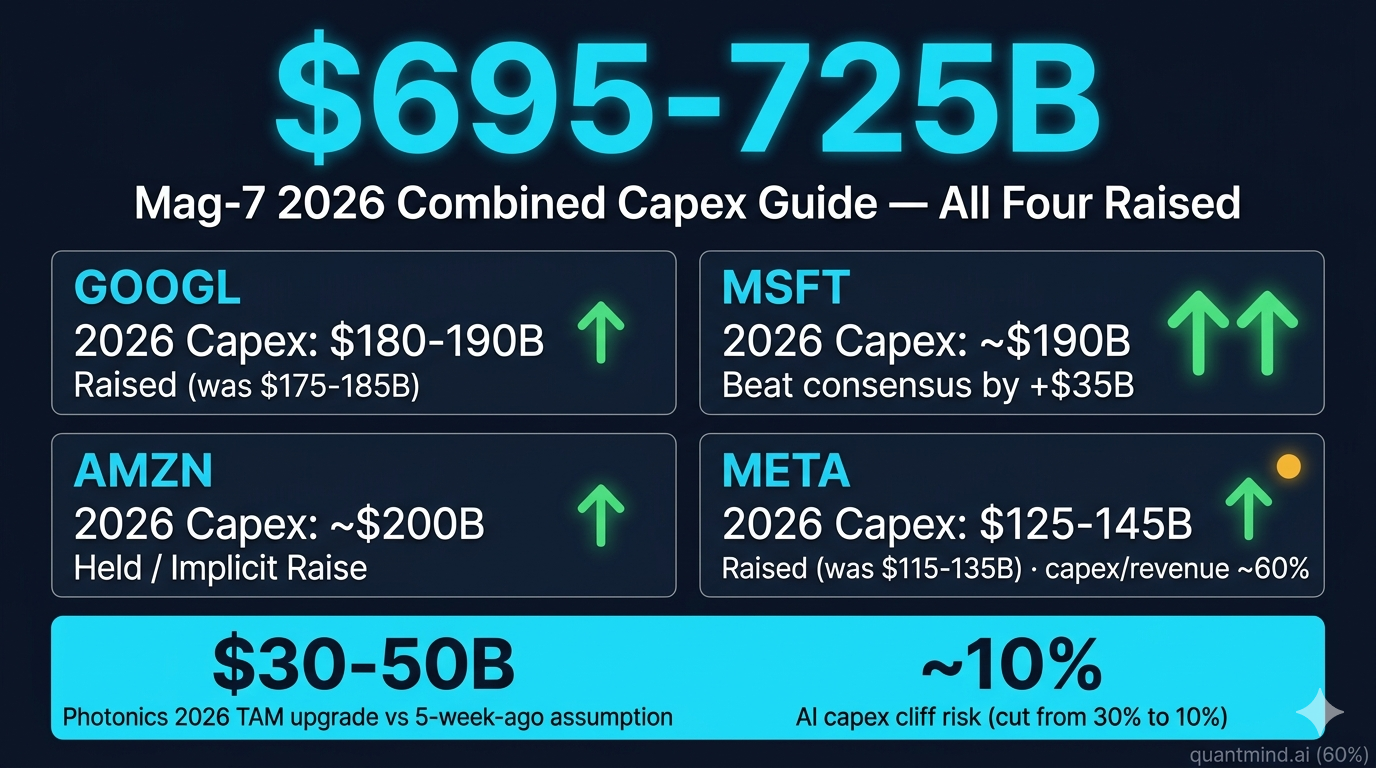
Number 1: Combined 2026 Capex of $695-725B (all four raised)
| Company | 2026 Capex Guide | Direction This Quarter |
|---|---|---|
| GOOGL | $180-190B | Raised (was $175-185B) |
| MSFT | ~$190B | Beat consensus by $35B+ |
| AMZN | ~$200B | Held / implicit raise |
| META | $125-145B | Raised (was $115-135B) |
| Total | $695-725B | All raised |
Five weeks ago I used “$600-650B range” as the working assumption. Reality came in 7-10% higher. Every $1 of incremental hyperscaler capex feeds 4-6 cents into the photonics chain (transceivers ≈ 4-5% of AI server BoM; ≈ 12-18% of DCI capex). Translation: photonics 2026 TAM just got $30-50B bigger than I had penciled in.
Number 2: GOOGL Cloud Backlog $460B (doubled QoQ)
CFO Anat Ashkenazi: “We expect to recognize slightly more than 50% of this within the next 24 months.” That’s roughly $230B of contracted revenue with a 24-month delivery window.
Translation into photonics: This $230B isn’t a vibe. It’s 24 months of pre-signed optical network expansion orders. Every hyperscale region buildout means 800G/1.6T transceiver volumes plus WaveLogic 6 coherent links. CIEN and COHR are the most direct beneficiaries.
Number 3: AWS Reaccelerated to +28% (15-quarter high)
AWS back to 2022-era growth. The driver underneath it: AI inference workload edge expansion — more inference nodes = more DCI links = more 1.6T coherent modules.
CIEN coined the “Scale-Across” architecture. Five weeks ago it was a forecast; last night AWS +28% was the first time the architecture became a number.
Number 4: META Capex Raised to $125-145B, Capex/Revenue ~60%
META has the highest capex intensity in the whole pack. Most of that spend will flow to “scale-across” datacenter clusters — and META is the hyperscaler most reliant on external photonics suppliers (unlike GOOGL with TPUs, META doesn’t internalize networking silicon).
Direct beneficiaries: Ciena WaveLogic 6, Coherent 1.6T transceivers, Corning fiber. META is the largest marginal buyer for all three.
The Detail: MSFT CFO Amy Hood’s One Sentence
“If we put all our incremental GPU capacity into Azure, Azure would grow more than 40%. But we have to allocate to Copilot, GitHub Copilot, and internal workloads.”
Read it three times. It means: there isn’t enough GPU to go around.
What does “not enough GPU” really mean? It means the network connecting the GPUs isn’t enough either: - An H100 / B200 cluster needs full sets of 800G / 1.6T transceivers to come online - Every hyperscaler is fighting for the same optical module capacity - When MSFT publicly admits supply constraint, the bottleneck likely isn’t just GPU itself (NVDA is ramping), it’s also the photonics connecting them
This is the amplifier signal for the entire photonics deck — and it came directly from a hyperscaler CFO.
Five weeks ago I called COHR’s >4x book-to-bill “the most extreme demand signal I’ve ever seen.” Last night MSFT confirmed it from the supply-constraint side.
Re-Rating the 8 Names
Upgrade: CIEN (#3 → “#2 dark horse”)
5-week-ago thesis: $7B backlog + WaveLogic 6 only 1.6T coherent at scale.
New facts from last night: - META capex raised by ~$10B at midpoint — direct scale-across beneficiary - AWS reaccelerated to +28% — DCI demand cashing in earlier than expected - GOOGL backlog $460B — 24 months of pre-signed contracts = 24 months of pre-signed DCI equipment orders
CIEN’s “Scale-Across” narrative was a hypothesis 5 weeks ago. It now has three hyperscaler data points behind it.
May 27 Q2 print is the inflection. If backlog adds another $15B+ QoQ, CIEN should move to portfolio #1.
Upgrade: VIAV (#5 hidden alpha → “#3 high-conviction contrarian”)
5-week-ago thesis: 19x P/E in a 34-60x sector is structurally too cheap. Spirent acquisition gave VIAV 40-45% AI Ethernet test market share.
New facts from last night: - $695-725B capex raise = test equipment demand scales up - Supply-constrained signal = industry capacity expansion accelerates = test gear acceptance volume grows - Every incremental 1.6T transceiver COHR/LITE ships → another VIAV D2 test sale
May 7 Q3 print is the catalyst. If Q3 revenue holds +35% YoY and Q4 guide raises again, multiple expansion from 19x to 25x (sector floor) alone is 30%+ upside.
VIAV is the name most likely to go from “ignored” to “rediscovered” in this group. It’s the largest add in this rebalance.
Hold: COHR (still #1)
Core thesis unchanged: NVDA $20B + 71% AI revenue + full-stack vertical integration.
What changed last night is conviction, not ranking: - AI capex didn’t cliff → COHR’s premium multiple isn’t getting punctured - Supply-constrained signal = COHR’s >4x book-to-bill gets external corroboration
May 7 Q3 print. I’m not adding into earnings — valuation already prices in optimism; at 34x, any miss has very little tolerance.
Hold: FN (still #2)
NVDA Blackwell 1.6T 100% sole-source position is completely unchanged. Zero debt, $900M+ net cash balance sheet unchanged.
What changed last night: MSFT supply constrained = NVDA shipments accelerate further out = FN 1.6T contract manufacturing accelerates.
May 5 (Mon) Q3 is the leading print for the whole sector. If FN raises guidance, COHR / LITE / VIAV in that same week likely get bid up ahead of their own prints.
Mild Downgrade: GLW (#4 → still hold, but relative weakness)
5-week-ago thesis: Meta’s $6B fiber deal + Springboard upgraded to $11B in incremental revenue. None of that changed.
But its relative position weakens: When the pure-AI names (COHR / FN / CIEN) get their AI exposure validated more concretely by last night’s data, GLW’s “discount-AI play” (only 38% optical revenue) becomes relatively less attractive.
GLW’s non-AI segments (display, automotive glass, life sciences) didn’t benefit from the capex wave. You’re paying 49x for the whole bundle.
Short-Term Downgrade: LITE (#6 → trim before 5/12)
5-week-ago thesis: best technology in the sector (200G/lane EML monopoly, $400M+ OCS backlog, VCSEL breakthrough), but 60x P/E + $2B net debt + negative FCF = zero margin for error.
Last night doesn’t change that calculus. Mag-7 capex tailwind helps COHR / FN / CIEN; for LITE specifically, the marginal benefit is bounded — LITE’s bottleneck is its own execution, not market demand.
May 12 Q3 is the single biggest one-day vol event for any photonics name this year. - Beat + raise → 25-35% one-day pop - Any miss → 25-35% one-day drop
I’m cutting LITE from 5% to 3%, parking the 2% in cash for the post-5/12 window. This is the only “trim” in the rebalance — not because I’m bearish, but because of event risk management.
Hold: AAOI (lottery, capped 5%) + IPGP (PASS)
AAOI: $4B Amazon deal binary outcome unchanged, position cap unchanged. IPGP: 56x P/E for 17% growth + AI exposure <5%. Last night’s capex raise is essentially zero benefit — IPGP makes industrial lasers, not AI optics.
May Exam Month: 14 Days, 6 Earnings Reports
In the next two weeks, 6 of these 8 companies report. This is photonics thesis exam month — upstream answered last night, now downstream takes the test.
| Date | Company | Key Question | What I’m Watching |
|---|---|---|---|
| 5/5 (Mon) | FN | 1.6T volume ramp / Building 10 startup | Revenue $1.15B+, gross margin holds 12%+ |
| 5/7 (Wed) | COHR | NVDA agreement pace / leverage trajectory | Datacenter revenue +50% YoY |
| 5/7 (Wed) | VIAV | Spirent integration / D2 shipments | Q4 guide raise of 11%+ |
| 5/7 (Wed) | GLW | Springboard pace | Optical revenue +25% YoY |
| 5/12 (Mon) | LITE | OCS backlog, 1.6T ramp, FCF inflection | Highest single-day vol of the article |
| 5/14 (Wed) | AAOI | Amazon contract execution | Binary event |
| 5/27 (Tue) | CIEN | Backlog QoQ change | $85B+ is high-conviction signal |
Earnings dates approximate; refer to company official disclosures.
5/5 FN sets the tone for the entire sector earnings week. 5/12 LITE is the volatility peak — any miss/beat contagiously moves the whole deck. 5/27 CIEN is the closer — backlog is the final proof of thesis cashing in.
Updated Allocation
| Role | Ticker | Old | New | Change |
|---|---|---|---|---|
| Core | COHR | 25% | 25% | — |
| Core | FN | 20% | 20% | — |
| Core | CIEN | 20% | 20% | — |
| Contrarian | VIAV | 15% | 18% | +3pp |
| Anchor | GLW | 10% | 10% | — |
| Tactical | LITE | 5% | 3% | -2pp |
| Speculative | AAOI | 5% | 5% | — |
| Cash | — | 0% | 4% | +4pp (event bullets) |
| Avoid | IPGP | 0% | 0% | — |
Why not bigger moves?
External validation doesn’t equal internal price reflection — those two clocks frequently run out of sync. I don’t have a real-time price stack for these 8 names since 3/22, so I’m only adjusting positions where the logic changes are clear and don’t depend on knowing exact current prices:
- VIAV +3pp: valuation contrarian + capex tailwind, double layered
- LITE -2pp: 5/12 event risk management (not bearish)
- Cash +4pp: dry powder for the post-5/12 dislocation (if LITE misses to $480, all of it goes back to LITE)
For 6 companies reporting in two weeks, the next material rebalance happens after we see actual prints — that’s late-May homework, not tonight’s.
Skepticism: Where Could I Be Wrong?
Three honest counter-arguments.
1. “5 Weeks of Price Action Already Priced This In”
COHR / FN / CIEN — names already in mainstream AI narratives — may have already absorbed the Mag-7 capex tailwind in the past 5 weeks. If so, even beats on 5/5-5/12 won’t push prices higher = good news exhausted.
How to verify: Watch the 24-hour reaction to the prints. Beat with no rally → trim. Hedge: Use the 4% cash for “good news exhausted” pullback entries.
2. “Supply-Constrained Azure” Could Just Be GPU Shortage, Not Network Shortage
I read Amy Hood’s quote as confirmation of an optical bottleneck — that’s an interpretation that could be wrong. NVDA is still ramping; MSFT’s bottleneck might be GPU count itself, not the network connecting them.
How to verify: NVDA’s late-May earnings. If NVDA significantly raises shipment guidance but photonics order books don’t match the cadence, my read was wrong. Hedge: No heavy single-name additions before NVDA prints.
3. “Earnings Cluster Survivor Bias” — 6 Companies Reporting at Once Means Statistically 1-2 Disappoint
With 6 reports in two weeks, statistically at least 1-2 will miss or guide below. If the disappointer is a core position (COHR or CIEN), a 25-35% single-name drawdown will materially hurt the portfolio.
How to verify: Track each name’s first-day post-earnings reaction. Hedge: Worst case, use PHO ETF (Invesco Dynamic Building & Construction — imperfect optical exposure) or build an equal-weight 8-stock basket to dilute single-name risk.
Long-Term Monitoring Variables
Five weeks ago I didn’t list long-term monitoring variables. Adding them now. Over the next 4 quarters, these data points decide whether the thesis holds:
- GOOGL Cloud Backlog: Can it keep growing QoQ? Flatlining would shake the entire capex cashing-in thesis.
- MSFT Azure growth rate: Can it accelerate to +42% in H2 2026? That’s the cleanest “supply unblocked” signal.
- NVDA shipment guide vs. photonics order book sync: If NVDA raises but photonics names don’t, my “optical bottleneck” read is wrong.
- COHR book-to-bill: Hold >3x = thesis intact. Drop to <2x = inflection signal.
- CIEN backlog QoQ: Hold +$15B/quarter = scale-across cashing in. Drop to +$5B = thesis failure.
- VIAV multiple expansion path: 18 months from 19x to 25-30x = contrarian success. Stuck at 19x = value trap.
- HBM memory pricing: External variable for hyperscaler margins — indirectly affects capex intensity.
The Next Stop
Five weeks ago: a thesis. Last night: upstream confirmation. Next 14 days: downstream cashing in.
In between, I don’t move heavy weight — I wait for data.
If 5/5-5/27 plays out: - COHR + FN both beat → push COHR to 28% (4% cash + 1% trimmed from GLW) - VIAV beats and raises Q4 → push VIAV to 22% - LITE misses on 5/12 and drops to $480 → all cash deployed into LITE, push to 5% - LITE beats on 5/12 and pops → hold LITE at 3%, don’t chase - CIEN adds $15B+ backlog on 5/27 → push to 22% (dark horse cashes in to #1)
End of May I’ll write the third installment to close the “hypothesis → upstream confirmation → downstream cashing in” loop.
When the biggest external variable shifts from hypothesis to fact, the priority isn’t celebration — it’s updating the boundaries of your uncertainty.
Five weeks ago I made an 8-name relative ranking. Tonight I’m more confident in 7 of them and more cautious on 1 (LITE). But none of them got “declared a winner” because of last night’s data.
Upstream printed. Downstream starts May 5.
Based on public information as of April 30, 2026, plus Mag-7 Q1 2026 earnings on April 29. All judgments are independent estimates and do not constitute investment advice.
Related: Big Tech Q1 2026 Earnings Deep Dive | The Photonics Power Ranking: 8 Stocks Powering AI’s Optical Backbone (3/22)
quantmind.ai