May 10, 2026
Photonics Empire 2.5: The Ruler Changed — Why GLW Is Now #1 and NOK Is the Structural Value Play
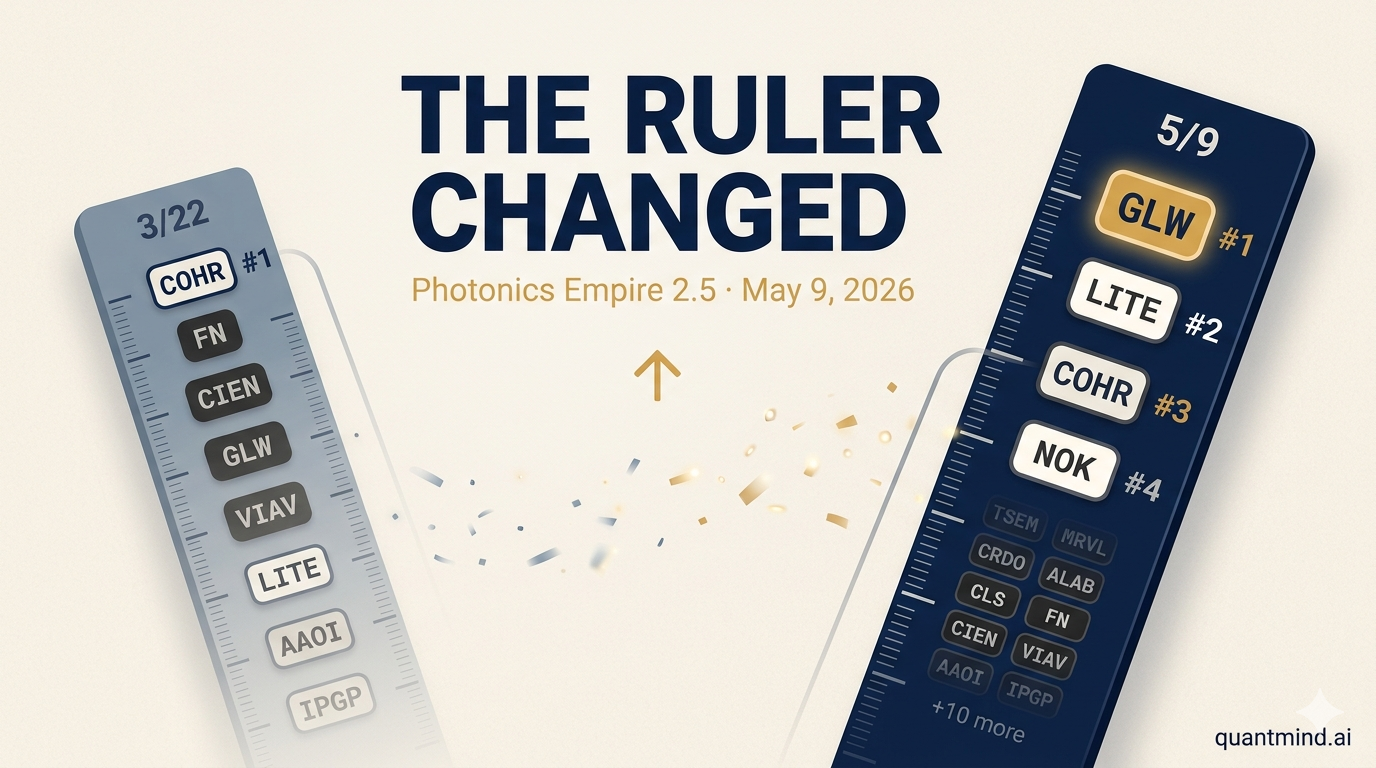
Six photonics names reported in nine days. All beat. Half sold off anyway. NVDA committed up to $3.2B to GLW; LITE joins the Nasdaq-100 on May 18; NOK raised optical guidance 800bps mid-cycle. The original 8-name framework is now 14 names across 6 tiers: GLW #1 (catalyst), LITE #2 (index inclusion), COHR #3 (highest quality), NOK #4 (structural value). Two whole tiers added: foundry (TSEM) and optical DSP (MRVL/CRDO/ALAB).
title: “Photonics Empire 2.5: The Ruler Changed — Why GLW Is Now #1 and NOK Is the Structural Value Play” date: 2026-05-09 tickers: [GLW, LITE, NOK, COHR, TSEM, MRVL, FN, CRDO, ALAB, CIEN, VIAV, CLS, AAOI, IPGP] adjacent: [ONTO]
Photonics Empire 2.5: The Ruler Changed
Why GLW Is Now #1, LITE Jumps to #2, COHR Returns to #3, and NOK Is the Structural Value Play at #4
A Letter to Nine-Days-Ago Me
Nine days ago I closed Photonics Empire II with a calendar:
5/5 FN sets the tone. 5/12 LITE is the volatility peak. 5/27 CIEN is the closer.
That calendar had two errors and two assumptions that nine days of news invalidated.
The errors: LITE printed 5/5 (not 5/12). AAOI printed 5/7 (not 5/14). I had the dates wrong.
The assumptions: I kept ranking COHR at #1 because that’s where COHR was on March 22 — when “highest direct AI revenue percentage + full-stack moat + NVDA $2B equity” was the right ruler. But the catalyst landscape has moved. By May 9, three names have new structural information that COHR doesn’t:
- GLW locked in NVDA’s $3.2B equity commitment + 10x optical capacity expansion + $10B 2030 GenAI revenue target — co-packaged optics replacing copper at the substrate layer. The single biggest structural deal in the entire photonics cycle.
- LITE got added to the S&P 500 on March 23 and announced May 8 it joins the Nasdaq-100 / QQQ on May 18. Twin index inclusions in two months on top of +90% YoY revenue and a $2B+ NVDA cash injection. Mechanical forced buying from passive funds.
- NOK raised Optical+IP guidance from 10-12% to 18-20% mid-cycle (an 800bps raise). The cheapest direct hyperscaler-AI exposure on the board, at ~14x P/E.
If you weight catalysts honestly, COHR isn’t #1 anymore. GLW is. And LITE — which I had at #12 in the prior version of this patch — should be #2. COHR slides to #3 (highest-quality core after the two catalyst names) and NOK lands at #4 as the structural value play.
This is a mid-month patch — Article 2.5, not the closer. Real Article 3 still ships end of May after CIEN (5/27) and NVDA late-May. But the ruler change can’t wait three weeks.
Plus: framework corrections. The original 8-name list was missing three real names (MRVL, ALAB, CLS) and two whole tiers (foundry, optical DSP). Plus one phrase that was factually wrong (“FN sole-source”).
This article is now four things at once: a scoreboard, a re-ranking, a tier expansion, and an honest admission that the original ruler stopped working.
TL;DR
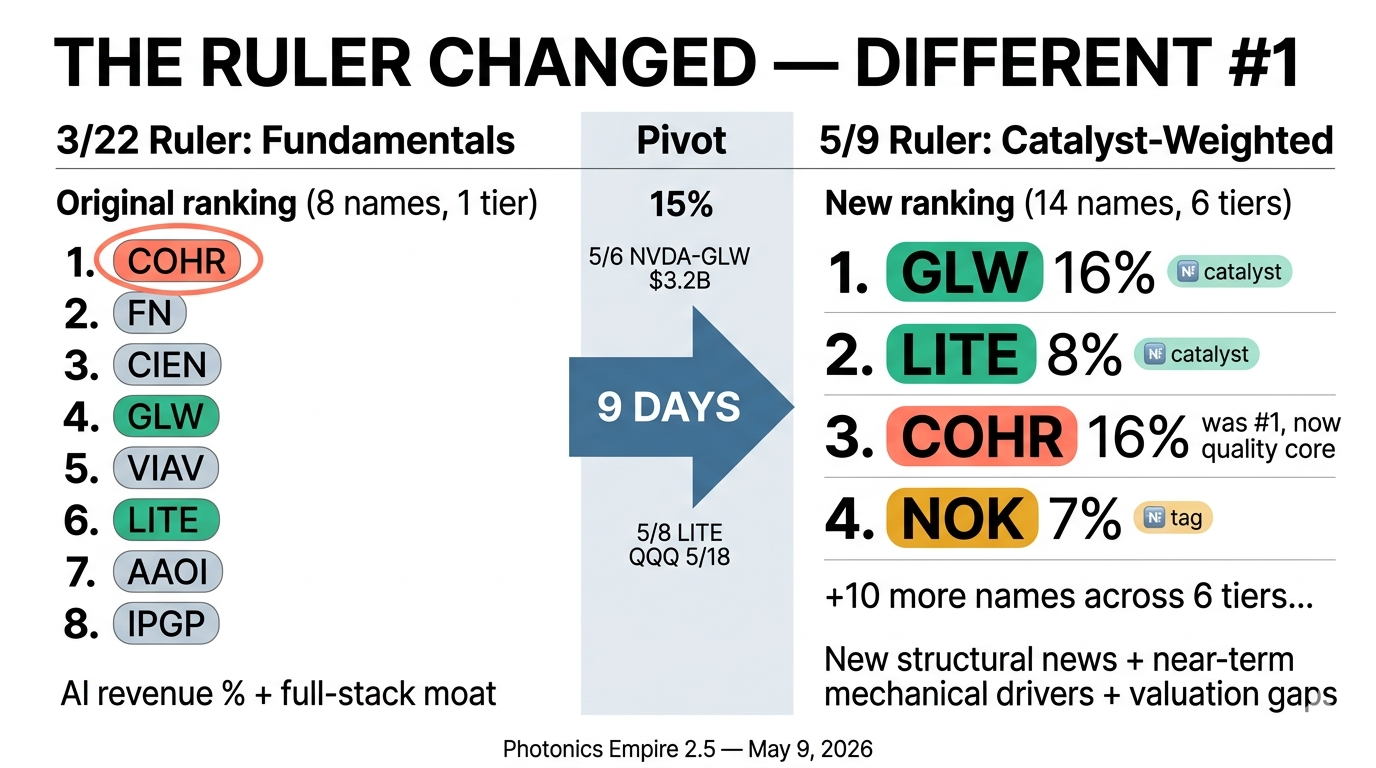
The ruler changed. I was ranking by 3/22 fundamentals (full-stack moat, AI revenue %). The 5/9 ruler weights new catalysts. Different rulers, different #1.
New top 4 (catalyst-weighted, then quality-weighted): - #1 GLW — NVDA $3.2B partnership announcement (5/6) + 10x capacity + $10B 2030 target. Single biggest structural deal in the cycle. - #2 LITE — Joins QQQ on 5/18 (already in S&P 500 since 3/23) + +90% YoY revenue + NVDA $2B cash injection + +145% YTD. Twin index forced-buying catalysts stacked on a fundamental beat. - #3 COHR — Highest absolute AI exposure (75% of revenue) + full-stack moat + NVDA $2B from March. Drops from #1 because no new structural catalyst, but lands at #3 because the -10% post-print drop made the entry better, not worse. The deepest moat in the deck. - #4 NOK — Cheapest direct AI exposure (14x P/E) + 600-800bps mid-cycle guide raise + +49% AI/Cloud customers + Infinera vertical PIC integration. Structural value play — slow-burn 18-24 month re-rating thesis, not a near-term catalyst.
Plus: framework corrections. Added MRVL (#6, optical DSP incumbent), CRDO (#8, DSP challenger), ALAB (#9, PCIe-to-optical), CLS (#12, system EMS), TSEM (#5, foundry). Two missing tiers (foundry + optical DSP) added. FN’s “NVDA sole-source” phrasing corrected to “preferred 1.6T assembler” — accurate to the actual three-line NVDA optical supply chain.
Allocation rewritten to reflect the ruler shift: GLW 16% (+6pp from old anchor weight), LITE 8% (+5pp from “trim”), COHR 16% (-9pp but post-drop entry compensates), NOK 7%, FN 14% (-6pp), CIEN 11% (-9pp), MRVL/TSEM 5% each, CRDO/ALAB 4% each, CLS 3%, VIAV 6% (-12pp post-rally), AAOI 1%, IPGP 0%, cash 0%.
Which Ruler Are We Using?
Before any specific name discussion, the meta-question. Two rulers give two different answers:
| Ruler | What it weights | Article 1 (3/22) #1 | Article 2.5 (5/9) #1 |
|---|---|---|---|
| 3/22 Fundamentals | AI revenue %, vertical integration, balance sheet, book-to-bill | COHR | COHR (still high quality) |
| 5/9 Catalyst-Weighted | Fresh structural news, near-term mechanical drivers, valuation gaps | — | GLW |
I’ve been carrying COHR-#1 forward by inertia since March. That’s not analysis — that’s anchoring. Let me articulate why each ruler matters and which one this article should use.
The 3/22 ruler answers: “If you had to hold one name for 3 years, which has the deepest moat?” → COHR. 75% of revenue is datacenter & comm. Full-stack from InP wafers to finished modules. NVDA-locked through end of decade. That ruler is still right for that question.
The 5/9 ruler answers: “Where is the next 6 months of alpha most likely to come from, given what we now know?” → GLW. NVDA’s $3.2B is new. CPO replacing copper in NVDA rack-scale systems is new. $10B 2030 revenue target is new. None of that was on the table on 3/22.
This article uses the 5/9 ruler — because the entire premise of a “patch” is to incorporate new information. If the ruler doesn’t change, the patch is just bookkeeping.
Which means GLW is #1, LITE is #2, COHR slides to #3, and NOK lands at #4 as the structural value play. That ordering is uncomfortable because it contradicts the original article’s centerpiece — but the ruler is more honest than the historical conviction.
A reasonable counter: “Then why isn’t NOK #3 — it’s the cheapest valuation and survived the rotation.” Because under a strict catalyst-weighted ruler, NOK doesn’t have a near-term event the way GLW (NVDA deal) and LITE (QQQ) do. Its 4/23 print is already 16 days old. The 14x → 25x re-rating thesis is real but slow-burn — 18-24 months, not a 60-day move. COHR’s full-stack moat is the deepest in the deck and the -10% post-print drop made the entry better, not worse. So #3 goes to highest-quality core (COHR), #4 goes to cheapest structural value (NOK).
The Real Scoreboard: Six Reports, One Pattern
| Date | Ticker | Headline Result | First-Day Reaction |
|---|---|---|---|
| 4/23 | NOK | Optical Networks +20% YoY; AI & Cloud customer revenue +49%; raised Optical+IP guide from 10-12% to 18-20% | Rallied, holding |
| 4/28 | GLW | Optical +36% to $1.8B; two new multi-billion hyperscaler deals; Springboard upgraded to 2030 | Strong rally |
| 4/29 | VIAV | Revenue +43% YoY; NSE +54% with Spirent; raised Q4 guide | +13.5% |
| 5/4 (AMC) | FN | Revenue +39% to $1.21B; DCI +90%; record telecom $628M | -13.5% |
| 5/5 | LITE | Revenue +90% YoY to record $808M; NVDA’s direct investment added $2B+ to cash; Q4 guide above | -5% (“sell the news” — before QQQ news) |
| 5/6 | GLW + NVDA | NVDA to invest up to $3.2B; 3 new US fabs; 10x optical capacity; $10B revenue target by 2030 | +12% |
| 5/6 | COHR | Revenue $1.81B (+27% pro forma); DC&Comm +41% to $1.36B (75% of total); Q4 guide $1.91-2.05B | -10% |
| 5/7 | AAOI | Revenue +51% to $151M; datacenter +154%; EPS miss; net loss widened to $14.3M | Down sharply |
| 5/8 | LITE (post-print) | Announced inclusion in Nasdaq-100 effective 5/18, replacing CoStar | Surged again |
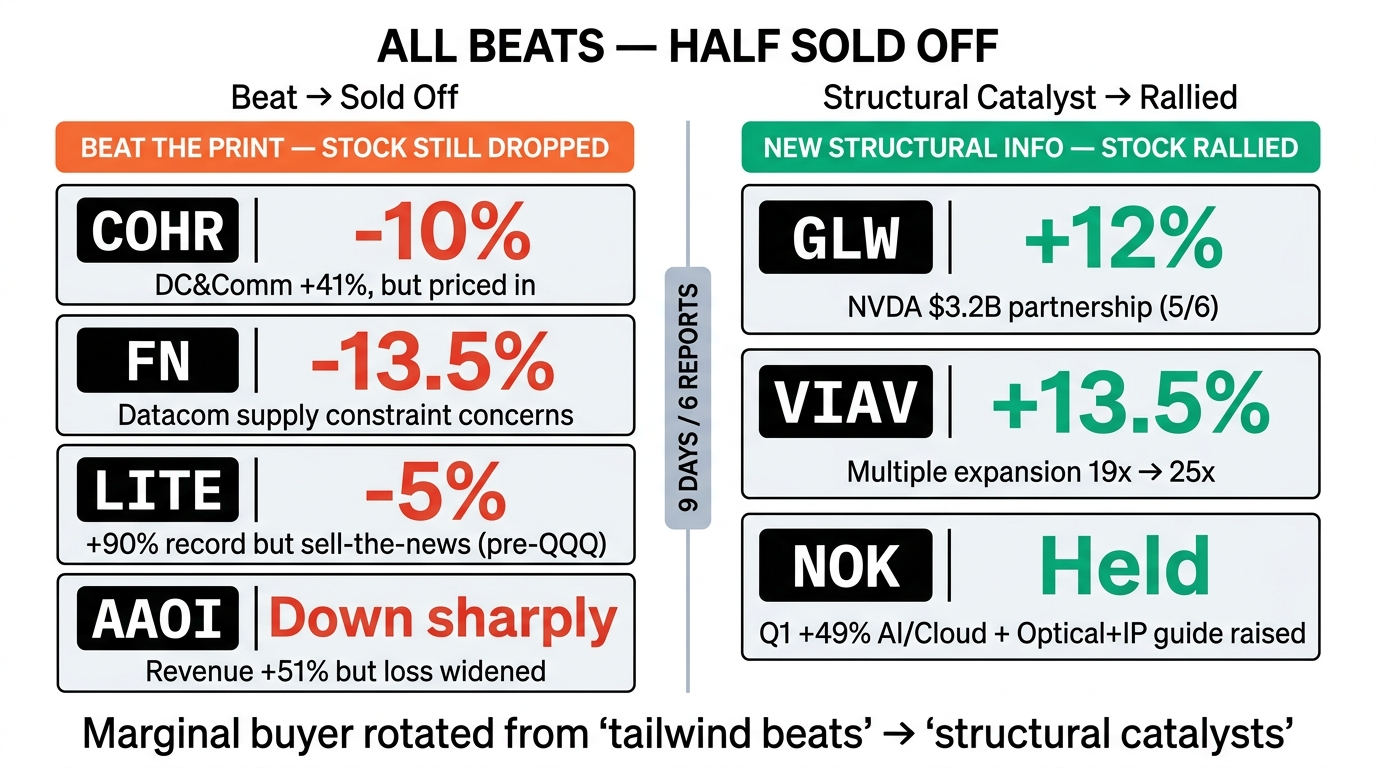
Revenue column: every name beat. Reaction column: four sold off, three rallied (counting LITE’s post-print recovery on QQQ news). Rallies are dominated by new structural information; drops by expected beats already in the price.
This is the marginal buyer rotating from tailwind beats to structural catalysts. The names that ran first take the hardest hit on the print, then mean-revert only if a fresh catalyst arrives (LITE got one with QQQ).
The New #1: GLW
Five weeks ago I had GLW at #4 with HOLD because “Meta’s $6B fiber deal is already priced in.” That was wrong — not on the valuation, but on what NVDA was about to do. The 5/6 partnership reframes the entire GLW thesis:
| NVDA-GLW Deal Terms | Value |
|---|---|
| NVDA equity investment commitment | Up to $3.2B (warrants at $180/share + pre-funded warrant) |
| New US manufacturing facilities | 3 (North Carolina, Texas) |
| US optical connectivity capacity expansion | 10x |
| US fiber production capacity expansion | +50% |
| Target GenAI revenue by 2030 | $10B |
| Strategic intent | Replace copper with optical glass in NVDA rack-scale systems (co-packaged optics) |
The strategic intent line is everything. NVDA isn’t buying GLW fiber for traditional data center use — they’re integrating GLW glass inside the rack for co-packaged optics. Same shift NVDA’s $4B March COHR/LITE investments were positioning for, but one layer down: the actual glass substrate.
GLW goes from “49x for the bundle” to “NVDA’s strategic substrate supplier.” #1 catalyst-weighted, allocation 14%.
The New #2: LITE — Twin Index Inclusions Plus a +90% Print
LITE has a triple stack of catalysts compressed into 60 days. Each one alone would be meaningful. Together they’re the strongest near-term setup in the deck.
Catalyst 1: Nasdaq-100 / QQQ Inclusion on May 18
Announced May 8 (yesterday). Effective prior to market open on Monday, May 18. LITE replaces CoStar Group (CSGP). Mechanical impact:
- Invesco QQQ Trust ETF alone tracks ~$300B AUM.
- Nasdaq-100 trackers globally manage $600B+.
- Every passive fund tracking the index must buy LITE shares to match composition. Estimated forced demand: $1-2B+ over the inclusion window.
- Front-running typically begins on announcement (5/8) and runs into the effective date (5/18). Stock has already started moving on 5/9.
Catalyst 2: S&P 500 Inclusion on March 23 (Already Banked)
Less than two months earlier, LITE was added to the S&P 500. SPX is the largest passive flow target globally — that inclusion contributed to LITE’s already-extraordinary YTD performance.
Catalyst 3: Q3 FY26 Print on May 5 — Best Fundamentals in the Deck
- Revenue +90% YoY to record $808M
- Cash + ST investments up by $2.02B (driven by NVDA’s direct investment)
- Non-GAAP operating margin expanded >2,100bps YoY
- Q4 FY26 guide: $960-1,010M (midpoint +22% sequential, EPS +24% sequential)
The 5% drop on the print was a sell-the-news event before the QQQ announcement. After 5/8, the picture is completely different.
Stock Performance Context
- +339% in 2025
- +145% YTD 2026
- Market cap now ~$70B (3-4x CSGP’s $13B at the index swap)
Risk
QQQ inclusion is a technical catalyst, not structural. Forced buying compresses around the effective date, then forced demand stops. Post-inclusion drift can be flat or negative if fundamentals don’t keep pulling. Don’t size LITE as a long-duration core — size it as a 60-day catalyst trade with fundamental floor.
LITE moves from #12 / 3% in the prior framework to #2 / 8% in the catalyst-weighted ruler. Don’t chase if it gaps up further; trim into strength after 5/18 if QQQ pop overshoots.
Sidebar: Why LITE’s QQQ Catalyst Doesn’t Transfer to Other Photonics Names
A reasonable question: if QQQ-driven passive flows are bullish for photonics, why didn’t COHR, GLW, FN, or NOK get added too?
Because QQQ has hard structural rules that automatically filter out most of the deck.
QQQ inclusion criteria (Nasdaq-100 Index): 1. Must be Nasdaq-listed (NYSE excluded automatically) 2. Non-financial company 3. Among the ~100 largest non-financial Nasdaq-listed stocks by market cap (~$15-20B floor) 4. Sufficient liquidity and seasoning (≥3 months listed) 5. Replacements happen when a current member is removed (this case: CoStar / CSGP being dropped)
Why each photonics peer was filtered out:
| Ticker | Listing | Market Cap | Status |
|---|---|---|---|
| LITE | Nasdaq | ~$70B | ✅ Eligible + largest available — selected |
| MRVL | Nasdaq | ~$80B+ | Already in QQQ for years — not an addition |
| COHR | NYSE | ~$40B | ❌ Wrong exchange |
| GLW | NYSE | ~$50B | ❌ Wrong exchange |
| CIEN | NYSE | ~$30B | ❌ Wrong exchange |
| FN | NYSE | ~$20B | ❌ Wrong exchange |
| NOK | NYSE (ADR) | ~$30B | ❌ Wrong exchange + foreign domicile |
| VIAV | Nasdaq | ~$5B | ❌ Market cap too small |
| CRDO | Nasdaq | ~$25B | Borderline — plausible future candidate |
| ALAB | Nasdaq | ~$15B | Borderline + IPO’d 2024 (needs more seasoning) |
| TSEM, AAOI, IPGP | Nasdaq | <$10B each | ❌ Too small |
The structural fact: five of the highest-conviction photonics names (COHR, GLW, CIEN, FN, NOK) are NYSE-listed and structurally cannot be in QQQ — they’d have to switch listings, which essentially doesn’t happen. Among Nasdaq-listed photonics names, LITE was uniquely large enough to qualify. The 339% rally in 2025 + 145% YTD pushed it across the cap threshold; the next-largest Nasdaq photonics name (CRDO at ~$25B) is still well below LITE.
The implication for the ranking: LITE’s QQQ alpha is non-replicable by the rest of the deck. COHR/GLW/FN/NOK can’t catch the same passive flow even if they keep beating — the listing alone disqualifies them. So treat LITE’s catalyst as genuinely unique to LITE, not as a leading indicator that other photonics names will follow.
Watch list: CRDO and ALAB are the next photonics-adjacent QQQ candidates if growth continues. CRDO at ~$25B is plausible at the next annual rebalance (December); ALAB needs more seasoning. Neither is a near-term catalyst — call it a 12-18 month watch.
The New #3: COHR — Highest-Quality Core, Better Entry After the Drop
COHR was #1 in the original ranking. Three pieces of evidence say it’s not catalyst-weighted #1 today — but it lands cleanly at #3.
Why it’s no longer #1: 1. The print landed flat. Q3 FY26 was strong: revenue $1.81B (+27% pro forma), DC&Comm $1.36B (+41% YoY, now 75% of revenue), Q4 guide $1.91-2.05B. Stock dropped 10% the next day. The market said: this beat is already priced. 2. No new structural catalyst. NVDA’s $2B equity investment was March news, already in the price. Vertical integration is structural but not new. CPO replacing copper is happening at GLW (substrate) and CRDO (DSP), not COHR specifically. 3. The original ruler was “highest AI exposure %, full-stack moat.” That ruler still says COHR is the highest-quality name — but the article is about change in catalyst landscape, and COHR has the least change of the top names.
Why it lands at #3 (not #4 or lower): 1. The -10% drop made the entry better, not worse. COHR was overstretched into the print at 34x. Post-drop, the multiple is closer to fair. Same fundamentals, lower price. 2. Highest absolute AI revenue on the board. $1.36B/quarter datacenter & comm — larger than LITE’s total revenue, larger than NOK’s optical. Volume matters when network builds compress. 3. Full-stack vertical integration. From InP wafers to finished transceivers — only COHR and (via Infinera) NOK have this. COHR’s is broader and shipping at greater scale. 4. NVDA-locked through end of decade. The original $2B investment came with supply commitments; that’s still in force.
#3 with 16% allocation — meaningful core weight, post-drop entry. If NVDA late-May explicitly flags optical bottleneck, COHR can move back to #2 or #1. If FN’s datacom supply constraint propagates to COHR’s modules, drops further.
The New #4: NOK — The Structural Value Play
NOK reported Q1 on April 23, before any US-listed photonics name. The print’s strength is in the layer — not just one quarter, a mid-year guide raise of 800bps on Optical+IP.
| Metric | Q1 2026 |
|---|---|
| Optical Networks revenue | +20% YoY |
| AI & Cloud customer revenue | +49% YoY |
| 2026 NI guide | 6-8% → 12-14% |
| 2026 Optical+IP guide | 10-12% → 18-20% |
| Gross margin | 45.5% (+320bps YoY) |
| Infinera synergies | €200M for 2026 on track |
NOK was missing from the original list for two reasons:
Framing bias. The original 8-name ranking framed photonics as “US-listed direct AI capex exposure.” Within that frame, the system-vendor slot was already filled by CIEN. No room for a foreign large-cap with 35% legacy mobile drag.
Outdated mental model. The Nokia in my head was the pre-Infinera Nokia — Finnish wireless and IP routing with secondary optical assets. Nokia closed Infinera in February 2025. The combined entity is the only company in this universe with internally fabricated photonic integrated circuits + system-level integration + a $2B annual R&D budget. Closer to COHR’s “full stack ownership” than anything else in the deck.
NOK’s real photonics pedigree: - OFC 2026 launch — four new DSPs, optical front ends spanning indium phosphide and silicon photonics, 1.6T-capable coherent pluggable for IP-over-DWDM and “scale-across” applications. - 2.4T-capable coherent pluggable on roadmap (sampling mid-2027, GA H2 2027). The only 2.4T pluggable announced in this group. - 70% TCO reduction on the new multi-rail optical line system, available H2 2026.
At ~14x P/E in a 30-49x sector, NOK is the cheapest direct hyperscaler-AI exposure on the board.
NOK’s Valuation vs Peers: The SOTP Discount Math
The 14x headline is the consolidated multiple. Inside Nokia, the Optical+IP segments grow 18-20% — peer-equivalent growth — but they’re priced at a 50-70% discount to peers because they’re bundled with slower-growing mobile networks and IP routing.
Forward multiples comparison:
| Ticker | Forward P/E | EV/Revenue | 2026 Growth |
|---|---|---|---|
| NOK (consolidated) | ~14x | ~1.5x | ~5% headline / 18-20% Optical+IP segment |
| COHR | ~34x | ~5x | ~25% |
| LITE | ~60x+ | ~22x | +50%+ |
| FN | ~30x | ~3x | ~30% |
| CIEN | ~35-49x | ~6x | ~25% |
| GLW | ~25-30x | ~3-4x | ~15-20% (optical +36%) |
| VIAV | ~20x | ~3x | +30%+ |
| MRVL | ~30x | ~6x | ~25% |
| CRDO | ~80x | ~25x | +50%+ |
| ALAB | ~70x | ~20x | +50%+ |
The SOTP estimate:
If NOK’s Optical+IP segment was valued at CIEN-like multiples (CIEN trades ~6x EV/Revenue with similar growth):
| Segment | Estimated Revenue | Multiple Applied | Implied Value |
|---|---|---|---|
| Optical+IP Networks | ~€4B annualized | 6x EV/Revenue (CIEN-equivalent) | ~€24B |
| Mobile Networks | ~€8B annualized | 1.5x (mature wireless) | ~€12B |
| Cloud and Network Services | ~€3B annualized | 2x | ~€6B |
| Nokia Technologies (licensing) | ~€1.2B annualized | 8-10x (high margin) | ~€10B |
| SOTP estimate | ~€52B | ||
| Current market cap | ~€27B | ||
| Theoretical upside | ~85-90% |
Realistic re-rating path (not full SOTP):
SOTP gaps in diversified companies rarely fully close — investors price the consolidated multiple until forced otherwise (spinoff, separation, mix shift). A realistic 18-24 month path is partial closure: consolidated multiple from 14x → 22x (still well below the 30-49x pure-play peer band) = ~+57% upside.
Why the gap exists structurally: - ~35% of Network Infrastructure is legacy fixed / copper / IP routing — slower growth - Mobile Networks (~35% of total revenue) is mature wireless — secular pressure - Investors price what shows at the consolidated line, not the segment line
The catalyst that closes part of the gap: - AI & Cloud customer revenue +49% YoY is driving mix shift toward optical - If Optical+IP grows from ~22% of total revenue today to ~30%+ by 2028, the consolidated multiple has to move - Infinera synergies (€200M for 2026, on track) fall to gross margin = explicit margin lift, not just revenue mix - 600-800bps mid-cycle guide raise on Optical+IP is the leading indicator of mix shift accelerating
Bottom line: NOK’s photonics is the cheapest in the deck on segment-equivalent metrics — a 50-70% multiple discount that exists for structural (SOTP) rather than fundamental reasons. The thesis isn’t full gap closure; it’s partial gap closure over 18-24 months as mix shift forces re-rating.
This is also why NOK is a value-driven position, not a catalyst-driven trade — the closure happens at the speed of investor mind-changing, not at the speed of an event.
Why #4, not #3
Three honest reasons: 1. No near-term catalyst. Unlike GLW (NVDA $3.2B announcement 5/6) or LITE (QQQ inclusion 5/18), NOK has no scheduled event that forces multiple expansion in the next 60 days. Q1 print is already 16 days old. 2. Slow-burn re-rating. Even if the SOTP closure works, it’s an 18-24 month story, not a 60-day move. The math says +57% (partial) to +90% (full); the timing says wait. 3. Consolidated growth still 12-14%. Legacy mobile (~35% of revenue) drags the consolidated multiple even while Optical+IP runs 18-20%. Investors pay for what shows up at the corporate line.
#4 with 7% allocation — structural value play, sized to be patient. Build only on Q2 print confirmation (late July) that Optical+IP holds 18-20% and AI & Cloud customers stay >+30% YoY.
The Two Tiers I Never Ranked
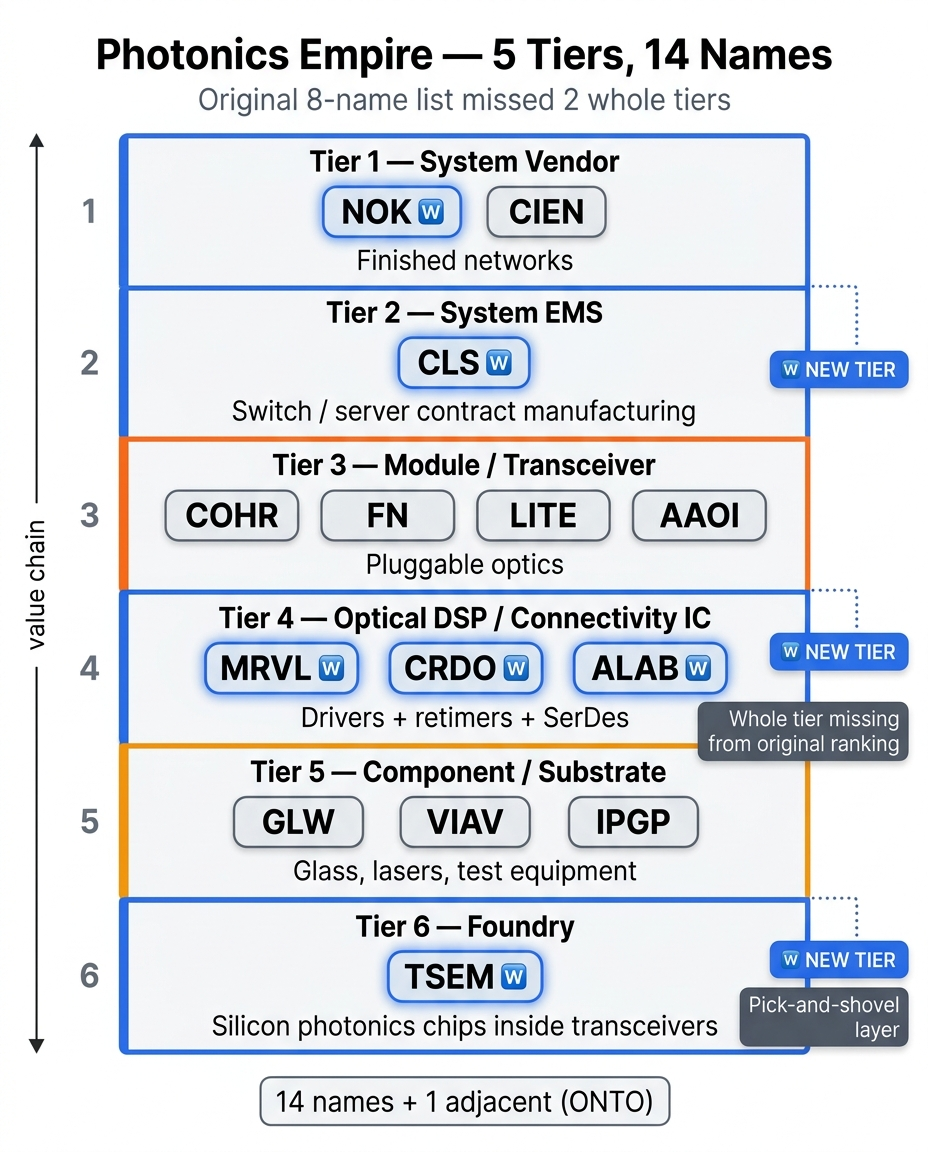
Both Photonics Empire I and II treated photonics as a flat 8-name list. The universe is tiered, and the original list omitted two whole tiers.
| Tier | What it sells | Names in original 8 | Names we missed |
|---|---|---|---|
| System vendor | Finished networks | CIEN | NOK |
| System EMS | Switch / server contract manufacturing | — | CLS |
| Module / transceiver | Pluggable optics | COHR, FN, LITE, AAOI | — |
| Optical DSP / Connectivity IC | Drivers + retimers + SerDes for transceivers | — | MRVL, CRDO, ALAB |
| Component & substrate | Glass, lasers, test equipment | GLW, VIAV, IPGP | — |
| Silicon photonics foundry | The actual chips inside transceivers | — | TSEM |
Two whole tiers and five names — not a few details, half the scaffolding.
Tier — Foundry: TSEM (#5)
TSEM (Tower Semiconductor) is the leading independent silicon photonics foundry. NVDA partnership for 1.6T modules; 400Gbps/lane breakthrough with COHR (the chip-level enabler for 3.2T). Multi-fab footprint: Israel, 2 US, 2 Japan (TPSCo), Italy 300mm (with STMicro). Competitors: GFS (Fotonix), TSMC SiPh, Intel Foundry (captive), STMicro, IMEC. TSEM wins on independence + customer breadth + 3.2T pathway. Pick-and-shovel — wins regardless of which transceiver maker wins. 5%.
Tier — Optical DSP: MRVL (#6) + CRDO (#8) + ALAB (#9)
A 1.6T transceiver isn’t just a SiPho die — it needs a high-speed DSP. An entire layer the original list skipped.
- MRVL (incumbent, #6, 5%) — Ara 3nm 1.6T DSP shipping in mass volume to global hyperscalers. COLORZ 1600 ZR/ZR+ pluggable. Electra 2nm coherent DSP. The dominant player; without MRVL, the DSP layer story is incomplete.
- CRDO (challenger, #8, 4%) — Q3 FY26 +201% YoY. Cardinal 1.6T optical DSP launched. DustPhotonics acquisition $750M (closes Q2 2026) gives CRDO SerDes + DSP + Silicon Photonics + AEC under one roof. Direct competition to MRVL post-close.
- ALAB (new entrant, #9, 4%) — Q1 2026 +93% YoY. PCIe 6 dominant. aiXscale Photonics acquisition Oct 2025 for fiber-chip coupling. Optical fiber coupler in qualification at major AI platform provider; volume shipments 2027.
Three different risk structures: incumbent shipping in volume (MRVL), mid-vertical-integration (CRDO), early-pivot (ALAB). 5+4+4 = 13% across the layer, diversified not stacked.
System-Level EMS: CLS (#12)
Celestica (CLS) — FN’s peer at the system layer. Q1 2026 HPS (Hardware Platform Solutions) revenue $1.7B (+63% YoY, 42% of company). Awarded hyperscaler CPO Ethernet switch program using 1.6T silicon + co-packaged optics + liquid cooling, ramp 2027. 1.6T switch program with two hyperscalers ramping H2 2026.
CLS at the switch system layer is structurally similar to FN at the transceiver module layer — build to the customer’s design. The difference: CLS won the next-generation 1.6T CPO switch program; FN dominates the current-generation 1.6T transceiver assembly. CLS’s HPS programs are typically single-sourced — strong pricing power. #12 in catalyst-weighted ranking, 3%.
The FN Correction
The phrase from Photonics Empire II — “FN is NVDA’s sole-source 1.6T manufacturer” — was wrong.
Actual NVDA 1.6T optical procurement: 1. Innolight (300308.SZ) — 50%+ of NVDA’s 800G procurement, $3.3B 2024 revenue (+123% YoY). The largest supplier. 2. COHR — direct + NVDA $2B equity. 3. TFC (300394.SZ) + Fabrinet — TFC designs, FN assembles. Industry-referred to as “NVDA’s in-house production line.”
Correct framing: FN is NVDA’s preferred high-volume optical assembler — the pick-and-shovel name at the transceiver assembly tier (analogous to TSEM at foundry) — but not the exclusive supplier. The thesis isn’t broken; the classification changes from “sole-source” to “preferred high-volume assembler” — meaningful at the margin for pricing power. #7 ranking, 14% allocation.
Sidebar: Is Photonics Overpriced? The TAM Check
A reasonable concern given the names that just printed +90% (LITE) and +201% (CRDO): is the sector in bubble territory?
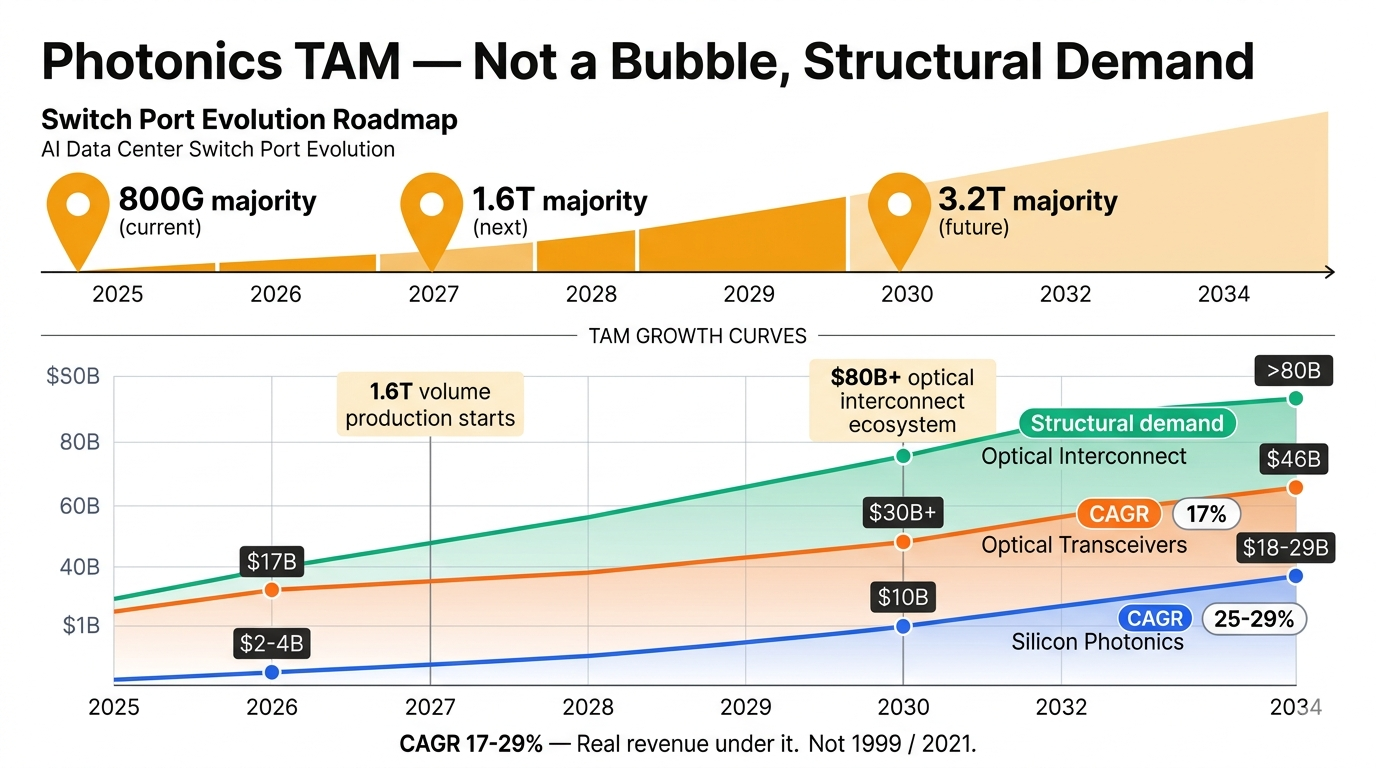
TAM projections (multiple research sources):
| Segment | 2026 | 2030 | 2034 | CAGR |
|---|---|---|---|---|
| Silicon photonics (chip layer) | ~$2-4B | ~$10B | ~$18-29B | 25-29% |
| Optical transceivers (broader) | ~$17B | ~$30B+ | ~$46B | 17% |
| Optical interconnect (combined ecosystem) | — | — | >$80B by early 2030s | — |
| Photonics overall (incl industrial/telecom) | ~$1.46T | $1.79T | — | 4.16% |
Switch port evolution roadmap (key driver of the AI optical TAM): - 2025: majority 800G - 2027: majority 1.6T - 2030: majority 3.2T - 1.6T module ASP: $1,300-1,500 currently
Sector valuation aggregate (rough): - Photonics-exposed market cap (top 14 names): ~$300-400B - Q1 2026 photonics-attributable revenue: ~$5B/quarter, ~$20B annual run-rate - Blended EV/Revenue: ~15-22x with 25-50% growth depending on name - Comparison: 1999 dotcom 60-80x P/E with negative earnings (bubble); 2021 SaaS peak 25-40x EV/Revenue (corrected sharply); photonics today 15-22x with real revenue
Verdict by tier:
| Tier | Names | Valuation read |
|---|---|---|
| Priced for perfection | LITE 60x+, CRDO 80x, ALAB 70x | Vulnerable. Any deceleration breaks the multiple. |
| Fully valued on growth | COHR 34x, MRVL 30x, FN 30x, CIEN 35-49x | PEG 1.0-1.5x. Defensible, no margin for error. |
| Catalyst-justified | GLW 25-30x | NVDA $3.2B re-rating event. |
| Underpriced (segment basis) | NOK 14x | SOTP discount 50-70% vs peers — the only true value. |
| Pick-and-shovel fair | TSEM ~25x, CLS ~20x | Monopoly-like positions in their tier. |
The honest read: photonics is not a bubble — TAM is growing 4x to early 2030s with real revenue under it. But it’s also not uniformly cheap. The sector is bimodally distributed: a handful of names priced for perfection (LITE post-QQQ, CRDO, ALAB), a wide middle band of fully-valued cores (COHR, FN, CIEN, MRVL, GLW), and exactly one clear bargain (NOK).
Where the alpha sits in this distribution: 1. GLW (#1) — NVDA catalyst hasn’t fully played out; multiple expansion + revenue growth compound 2. NOK (#4) — SOTP gap closing slowly delivers +57% over 18-24 months even without a catalyst 3. TSEM (#5) — only independent merchant SiPh foundry; monopoly economics if competitors don’t gain share
Where the risk sits: 1. LITE (#2) — post-5/18, technical buying ends; fundamentals must keep pulling at +50%+ growth 2. CRDO (#8) / ALAB (#9) — multiples assume execution at perfect rate; integration risk on DustPhotonics + aiXscale 3. Pure-play module names (COHR / FN) — recent -10% / -13.5% drops on great prints show the market won’t pay for “good enough” beats anymore
Bottom line: Photonics is fully priced, not over-priced. The TAM is real (4x growth to early 2030s with documented hyperscaler demand), but the valuations have already absorbed 60-70% of expected TAM realization for the pure-plays.
- Buy the cheap (NOK), the catalyst-justified (GLW), and the structural pick-and-shovel (TSEM)
- Trim the priced-for-perfection during catalyst windows (LITE post-QQQ; CRDO/ALAB on integration risk)
- Hold the fully-valued cores (COHR, FN, MRVL, CIEN) — they’re not bubble-rich, but don’t chase them either
Name selection matters more than sector exposure right now.
Sidebar: ONTO Is Adjacent, Not Core
Onto Innovation (ONTO) sells metrology and inspection equipment for advanced packaging. Q1 2026: revenue $292M, advanced packaging $107M with +50% growth expected in 2026. Management called out “starting to see some volumes in silicon photonics” and listed silicon photonics as one of two newly entered served markets.
ONTO doesn’t fit the photonics ranking because: - Dominant drivers are HBM, GAA logic, 2.5D packaging — silicon photonics is a small emerging slice (<10% of advanced packaging) - ONTO is capital equipment, not a value-chain participant — same category as KLAC, AMAT, Camtek
If you want photonics-driven capex equipment exposure, ONTO pairs with KLAC and AMAT. Don’t slot it in the photonics 14-name ranking.
The Updated 14-Name Ranking (Catalyst-Weighted)
| Rank | Ticker | Tier | Why this slot |
|---|---|---|---|
| #1 | GLW | Component / Substrate | NVDA $3.2B + 10x capacity + $10B 2030 = single biggest structural deal in cycle |
| #2 | LITE | Module | QQQ 5/18 + S&P 500 (3/23) + +90% YoY rev + NVDA $2B cash. Triple catalyst |
| #3 | COHR | Module | Highest AI exposure 75% + full-stack moat + post-drop better entry. Drops from #1 — no fresh catalyst — but lands at #3 as deepest-moat core |
| #4 | NOK | System | 14x P/E + 800bps mid-cycle guide raise + Infinera vertical PIC. Structural value, 18-24 month re-rating thesis |
| #5 | TSEM | Foundry | NVDA 1.6T direct + COHR 3.2T pathway + multi-fab |
| #6 | MRVL | Optical DSP | Incumbent shipping 1.6T DSPs in mass volume |
| #7 | FN | Module Assembly | Preferred 1.6T assembler (corrected framing); +39% YoY rev; DCI +90% |
| #8 | CRDO | Optical DSP | DSP challenger; Cardinal + DustPhotonics; +201% YoY |
| #9 | ALAB | Connectivity IC | aiXscale acquisition + qualification at major AI platform |
| #10 | CIEN | System | 5/27 print is the closer; backlog QoQ is the tell |
| #11 | VIAV | Component | Multiple expanded toward 25x; original alpha cashed in |
| #12 | CLS | System EMS | HPS +63%; CPO 1.6T switch program (ramp 2027) |
| #13 | AAOI | Module | Revenue +51% but loss widened — binary at minimum size |
| #14 | IPGP | Component | AI exposure still <5% |
| — | ONTO | Adjacent capex | Watchlist — pair with KLAC/AMAT |
Updated Allocation (Catalyst-Weighted)
| Rank | Ticker | Old (4/30) | New (5/9) | Change |
|---|---|---|---|---|
| #1 | GLW | 10% | 16% | +6pp |
| #2 | LITE | 3% | 8% | +5pp (QQQ catalyst, sized as 60-day trade with floor) |
| #3 | COHR | 25% | 16% | -9pp (no fresh catalyst — but post-drop entry compensates) |
| #4 | NOK | — | 7% | +7pp (NEW) (structural value, slow-burn) |
| #5 | TSEM | — | 5% | +5pp (NEW) |
| #6 | MRVL | — | 5% | +5pp (NEW) |
| #7 | FN | 20% | 14% | -6pp |
| #8 | CRDO | — | 4% | +4pp (NEW) |
| #9 | ALAB | — | 4% | +4pp (NEW) |
| #10 | CIEN | 20% | 11% | -9pp (relative trim, not thesis break) |
| #11 | VIAV | 18% | 6% | -12pp (post-rally trim, alpha cashed in) |
| #12 | CLS | — | 3% | +3pp (NEW) |
| #13 | AAOI | 5% | 1% | -4pp (loss widened) |
| Cash | — | 4% | 0% | -4pp (deployed) |
| #14 | IPGP | 0% | 0% | — |
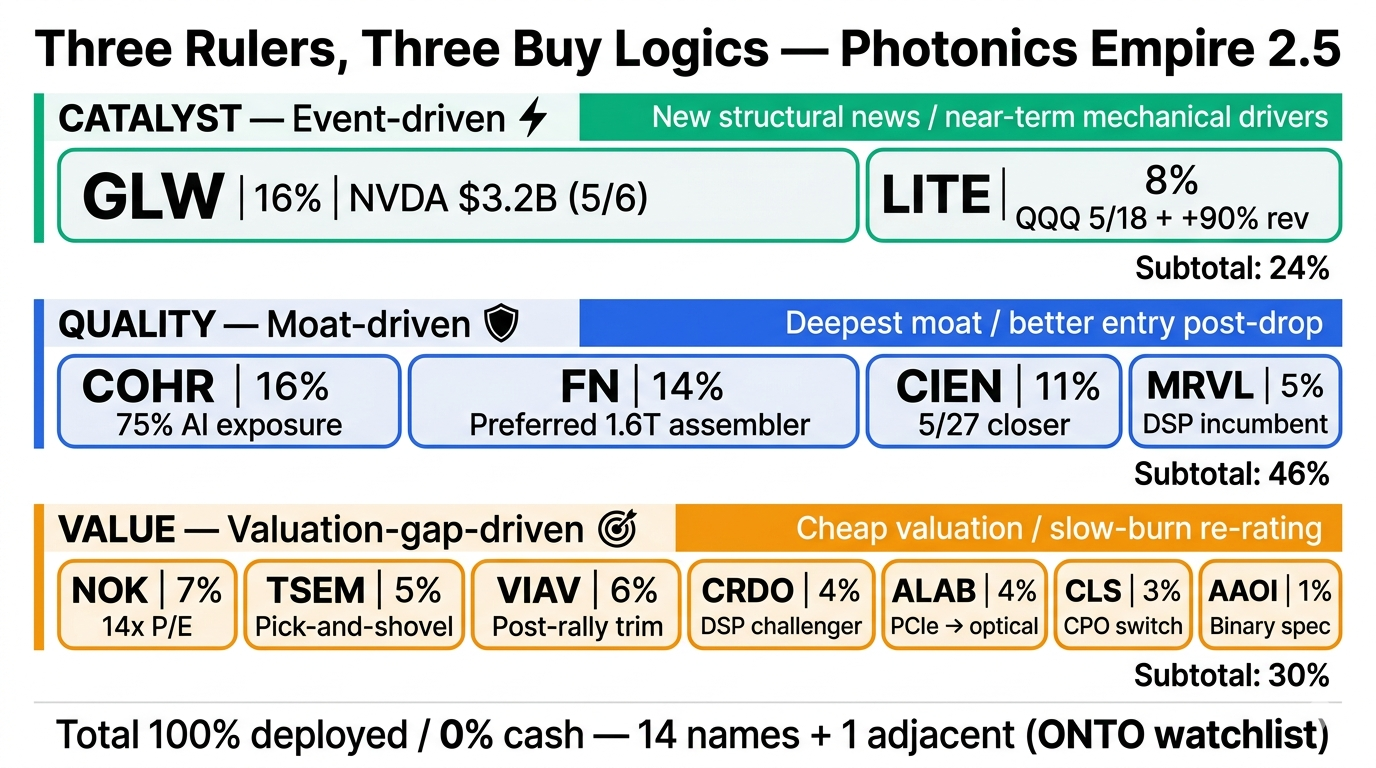
Six principles behind this rebalance:
- Rank by 5/9 catalyst-weighting, not 3/22 fundamentals. GLW gets #1 because NVDA $3.2B is new. LITE gets #2 because QQQ + +90% rev is new. COHR loses #1 because nothing fresh.
- Size LITE as a 60-day catalyst trade. 8% is meaningful but not dominant. The QQQ pop is technical — once forced buying ends, drift can be flat. Trim into strength after 5/18 if it overshoots.
- Don’t double down on “AI capex is real.” COHR/FN/CIEN trims aren’t bearish — they’re funding the catalyst-weighted upgrades.
- Add the missing tiers. TSEM + MRVL + CRDO + ALAB (DSP/foundry combined 18%) + CLS (3%) = 21% to tiers the original ranking didn’t have.
- Don’t overlap the three DSP names. Three different risk structures — incumbent (MRVL), challenger (CRDO), early-pivot (ALAB).
- AAOI to 1%, not 0%. Revenue +51% with widening loss is a profitability break, not demand break. Binary thesis alive at minimum size.
The “Real Article 3”
Original arc: hypothesis (3/22) → upstream (4/30) → downstream (end of May).
What’s actually playing out: - Upstream confirmed (Mag-7 capex + NOK +49%) - Mid-stream confirmed (transceiver beats) — but priced in - The new alpha is structural rotation + index-driven flow — NVDA-Corning, LITE QQQ, Infinera-Nokia, foundry (TSEM), DSP layer (MRVL/CRDO/ALAB), system EMS (CLS)
Real Article 3 closes on three remaining data points: 1. CIEN backlog (5/27) — original closer 2. NVDA late-May earnings — bottleneck question 3. LITE post-QQQ behavior (after 5/18) — does the technical catalyst hold or fade?
If all three confirm, the trilogy closes with 6 tiers, 14 names + 1 adjacent, ranked by catalyst weight, not by 3/22 inertia.
Updated Skepticism
1. “GLW at #1 looks like overpaying for one announcement.”
NVDA partnerships have a track record. NVDA $4B into COHR + LITE in March moved both stocks meaningfully and was structurally validating. NVDA $3.2B into GLW is in the same template — but at a more strategic layer (substrate vs module). Verify: track GLW’s incremental hyperscaler design wins over the next 2 quarters. If only NVDA materializes, the $10B 2030 target compresses.
2. “LITE QQQ pop will fade — you’re chasing a technical catalyst.”
Acknowledged. QQQ inclusion is technical, not fundamental. The reason LITE is #2 not #5 is the combination: forced buying + +90% YoY revenue + NVDA $2B cash + S&P 500 already in the price. Verify: if LITE drifts flat or down for two weeks after 5/18, the technical alpha was the dominant driver and the position should trim. If it holds and adds, fundamentals are pulling.
3. “Why isn’t NOK #3? It’s the cheapest valuation and survived the rotation.”
Honest pushback. NOK at #4 vs #3 came down to one criterion: catalyst weighting. GLW (NVDA deal) and LITE (QQQ) are event-driven. COHR is quality-driven — even without a fresh catalyst, it’s the highest-quality core in the deck and the -10% drop made the entry better. NOK is value-driven — cheap, structural, but slow. Three different category answers, ordered by urgency. NOK at #4 isn’t a downgrade — it’s a category placement. If you have a 24-month horizon, NOK probably is your #3 (or even #2). On the article’s near-term catalyst-weighted ruler, it’s #4.
4. “Adding five new names mid-stream looks like overfitting.”
- GLW upgrade is justified by new information (NVDA deal)
- NOK corrects a framing miss
- TSEM corrects a tier miss (foundry)
- MRVL corrects a tier miss (DSP) — most embarrassing miss; MRVL is the incumbent shipping in volume
- CRDO + ALAB add depth based on recent acquisitions (DustPhotonics, aiXscale)
- CLS corrects another tier miss (system EMS)
Each is a starter; build only on Q2 confirmation.
The Next Stop
Nine days ago: a calendar with three dates and a #1 (COHR) carried over by inertia. Tonight: the ruler changed. GLW #1 (catalyst), LITE #2 (catalyst), COHR #3 (highest-quality core, post-drop entry), NOK #4 (structural value, slow-burn). Six tiers, fourteen names, one corrected phrase (“FN sole-source”), and one explicit acknowledgment that the original framework needed an honest reappraisal — not just a few additions.
Real Article 3 ships end of May, after CIEN, NVDA, and the LITE post-QQQ window.
If 5/18 LITE QQQ + 5/27 CIEN + NVDA late-May play out: - LITE holds post-QQQ + CIEN backlog +$15B + NVDA shipment guide raise → confirm GLW #1 / LITE #2 / COHR #3 / NOK #4; full structural confirmation - LITE fades post-QQQ + CIEN flat + NVDA in-line → trim LITE to 4%; technical catalyst was the dominant driver - NVDA flags optical bottleneck explicitly → GLW to 18%, COHR back up to 19% (move toward #2), CRDO to 6% - NVDA raises GPU + photonics order books don’t match → cut transceiver tier (COHR / FN / LITE) by 6pp combined, redirect to NOK + TSEM + MRVL + ALAB
The most useful update is not the one that congratulates the original thesis. It’s the one that fixes the framing.
Five weeks ago I built a list with one tier, one ruler, eight names, and COHR at #1. Tonight the list has six tiers, a different ruler, fourteen names (+1 adjacent), GLW at #1, LITE at #2, COHR at #3 (still core, just no longer the dominant single-name bet), and NOK at #4 (the structural value play that takes 18-24 months to mature, not 60 days).
Beats are necessary. They are no longer sufficient. Even #1 rankings have a half-life.
Sources
Earnings results: - Nokia Q1 2026: Nokia Newsroom | Nokia 1.6T optical solutions - Corning Q1 2026: Corning Investor Relations - Viavi Q3 FY2026: Investing.com transcript - Fabrinet Q3 FY2026: Fool.com transcript | Datacom supply concerns - Lumentum Q3 FY2026: +90% revenue growth - Coherent Q3 FY2026: Globe Newswire results | Optics trade cools 5/7 - Applied Optoelectronics Q1 2026: Investor Relations - Credo Q3 FY2026: Cardinal 1.6T DSP launch | DustPhotonics acquisition - Astera Labs Q1 2026: Q1 2026 results | aiXscale acquisition - Celestica Q1 2026: Celestica IR - Onto Innovation Q1 2026: Yahoo Finance summary
Major catalysts: - NVDA-Corning $3.2B partnership: NVIDIA Newsroom | GLW +12% reaction - LITE QQQ inclusion 5/18: Nasdaq announcement | +339% rally context - TSEM-NVDA 1.6T partnership: Tower Semiconductor | Tower-Coherent 400Gbps/lane - Marvell 1.6T DSP family: COLORZ 1600 + Electra 2nm
Market size projections: - Silicon Photonics TAM: Global Market Insights 2026-2035 | Precedence Research $28.75B by 2034 - Optical Transceiver TAM: Fortune Business Insights $46B by 2034 - Optical Interconnect & CPO: Hyperscale Interconnects 2026 analysis | SemiAnalysis: Co-Packaged Optics | LightCounting cloud DC optics
Based on public information as of May 9, 2026. Includes Q1/Q3 prints from NOK (4/23), GLW (4/28), VIAV (4/29), FN (5/4), LITE (5/5), COHR (5/6), AAOI (5/7), CRDO (Q3 FY26, March), ALAB (Q1 2026, 5/5), CLS (Q1 2026, 4/27), and ONTO (Q1 2026); plus the NVDA-GLW partnership (5/6), CRDO DustPhotonics acquisition (April), and the LITE Nasdaq-100 inclusion announcement (5/8). All judgments are independent estimates and do not constitute investment advice.
Related: Photonics Empire II (4/30) | The Photonics Power Ranking (3/22)
quantmind.ai