Mar 14, 2026
$ORCL Q3 FY2026 Deep Dive: Borrowed $134B to Bet on AI — Is Oracle Crazy or Visionary?
Oracle Q3 FY2026 earnings deep dive: OCI growing 84%, $553B RPO, but $134.6B total debt and negative $24.7B free cash flow. A leveraged bet on AI infrastructure — PASS at $164, wait for $140-145.
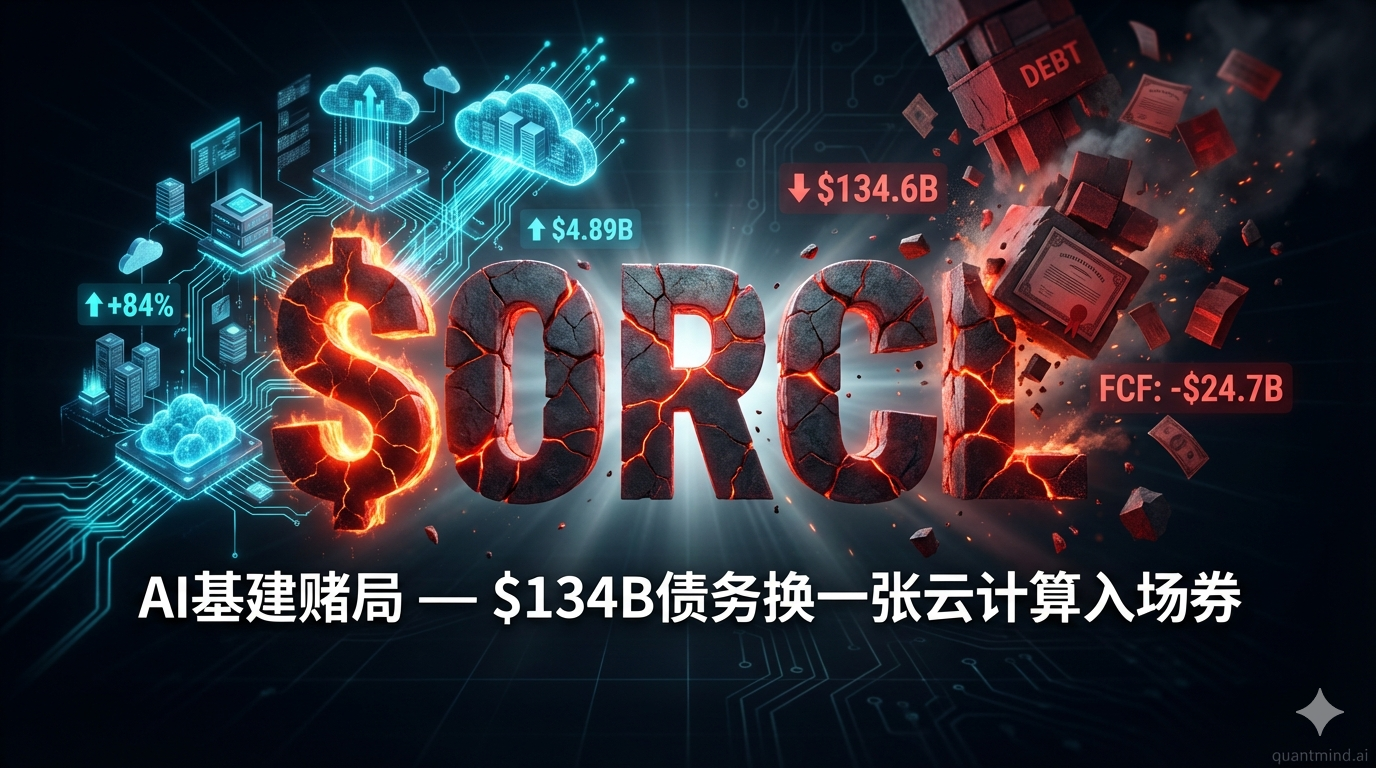
$ORCL: Borrowed $134B to Bet on AI — Is Oracle Crazy or Visionary?
Oracle reported earnings last night, and the stock jumped 10%. I looked at the numbers and my first reaction was “this is indeed impressive” — OCI cloud infrastructure growing 84%, EPS a solid beat, RPO at $553B.
Then I flipped to the balance sheet.
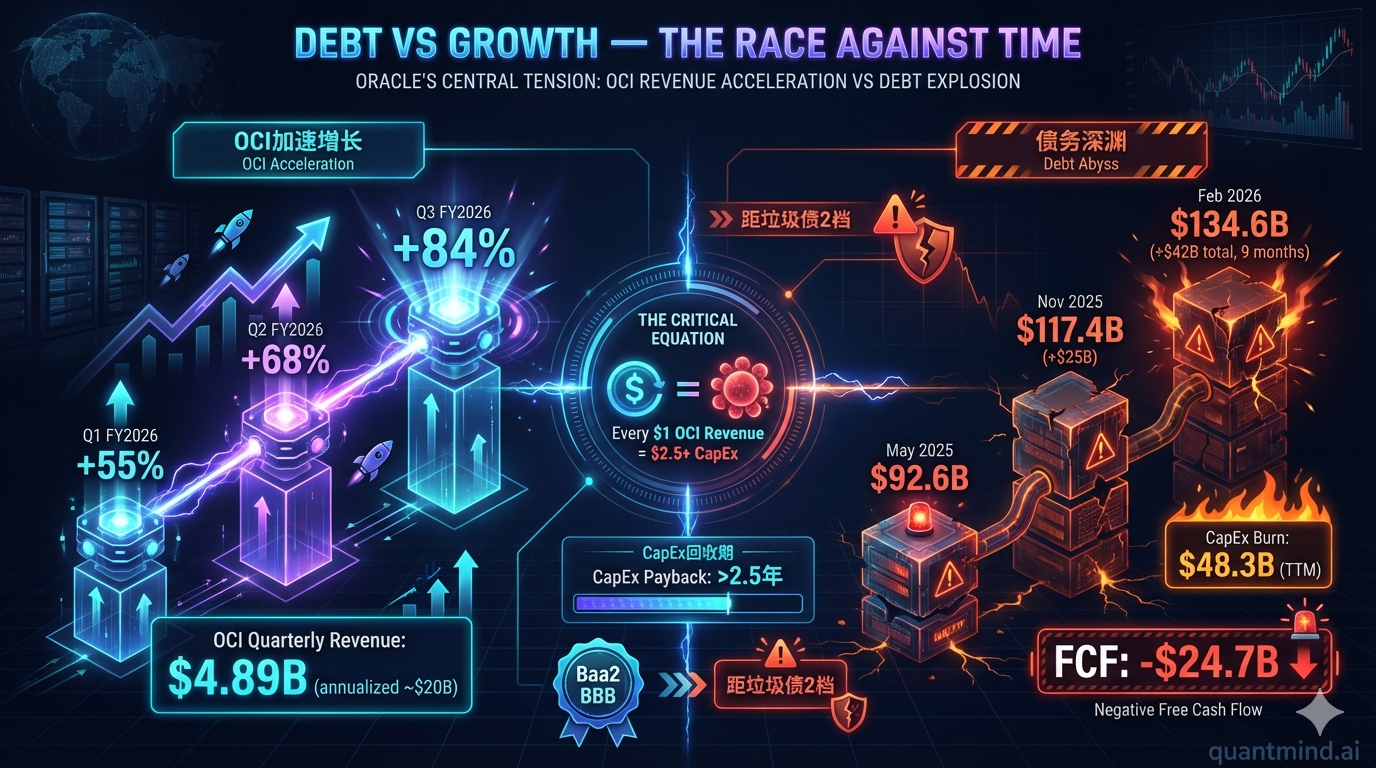
$134.6B in total debt. Just $92.6B nine months ago. A $42B surge in 9 months. Free cash flow? Negative $24.7B. Credit rating just two notches above junk.
That’s when it hit me: this isn’t a company “investing in the future.” This is a company using leverage to make an all-in bet that it can win the AI infrastructure race.
Verdict: PASS @ $164. Wait for $140-145.
The Surface Story vs. The Real Story
What Wall Street saw last night:
- Revenue $17.2B, +22% YoY
- OCI (Cloud Infrastructure) +84%, accelerating for three consecutive quarters (55%→68%→84%)
- EPS $1.79 beat consensus $1.70
- RPO $553B — $553 billion in future contracted obligations
- Next quarter EPS guidance $1.96-$2.00, 15-18% above consensus of $1.70
If that’s all you look at, you’d think: isn’t this the next AWS? 23x PE is cheaper than Microsoft’s 30x — buy!
But the Oracle I see tells a very different story.
The Real Oracle: An Arithmetic Exercise
Let’s do some simple arithmetic:
OCI annualized revenue is roughly $20B. To generate that $20B, Oracle burned through $39.2B in CapEx over the past 9 months and added $42B in net debt.
For every $1 of OCI revenue, Oracle needs to invest $2.5+ in CapEx. All funded by debt.
It’s like someone telling you “my income grew 84%!” — only for you to discover they did it by maxing out 8 credit cards.
| Metric | Figure | What It Means |
|---|---|---|
| Total Debt | $134.6B | +$42B in 9 months |
| Free Cash Flow | -$24.7B | Was +$5.8B same period last year |
| CapEx | $48.3B | +223% YoY |
| Annualized Cash Shortfall | ~$31.5B | OCF - Interest - CapEx |
| Credit Rating | Baa2/BBB | 2 notches above junk |
| Debt/OCF | 5.7x | Extremely rare among tech stocks |
Oracle just issued $30B in bonds + convertible preferred stock in a single February offering. Management knows the financing window won’t stay open forever.
What About That $553B RPO? Doesn’t It Guarantee Future Revenue?
This is where I initially got dazzled too. $553B in Remaining Performance Obligations sounds like “future revenue is locked in.”
But RPO does not equal guaranteed revenue.
The largest chunk of RPO comes from the OpenAI Stargate partnership — $300B / 5 years. This contract: - Can be renegotiated - Can be delayed - Can be scaled down
Evidence? The Stargate Abilene expansion project has already been cancelled. This isn’t hypothetical — it’s already happened.
When 60% of a company’s RPO growth comes from a single customer, that’s not pipeline diversification — that’s single-client concentration risk.
Competitive Landscape: Oracle Is Bringing a Knife to a Gunfight
This is the comparison table that concerns me the most:
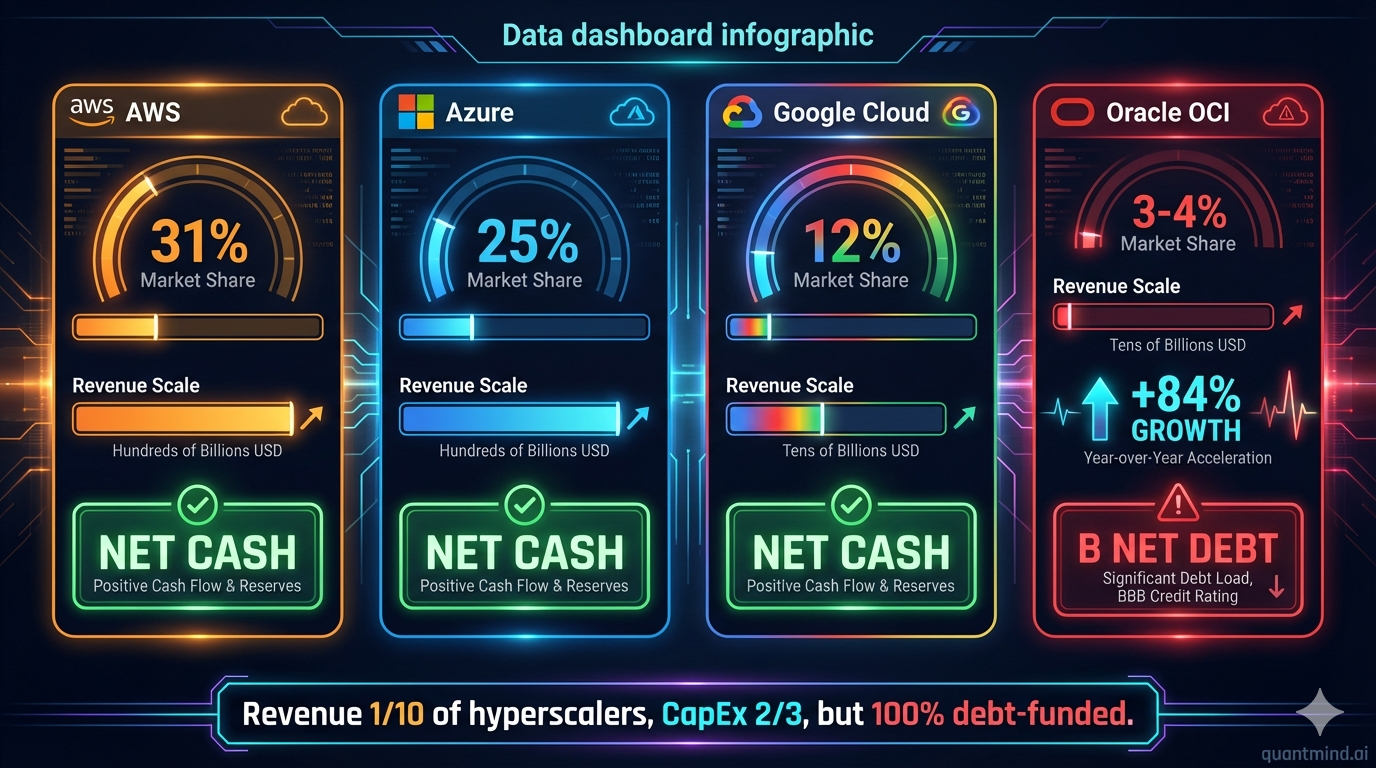
| Cloud Provider | Market Share | Growth | CapEx | Funding Source |
|---|---|---|---|---|
| AWS | ~31% | ~19% | ~$75B/yr | Self-funded from profits |
| Azure | ~25% | ~29% | ~$80B/yr | Self-funded from profits |
| Google Cloud | ~12% | ~30% | ~$75B/yr | Self-funded from profits |
| Oracle OCI | ~3-4% | +84% | ~$50B/yr | $134.6B in debt |
Oracle is spending 60-70% of the CapEx that AWS/Azure/GCP spend, but has only 1/8th to 1/10th of their revenue base.
The critical difference: those three build data centers with money they earned. Oracle builds with money it borrowed.
This means if growth slows, the Big Three can cut investment and protect margins. Oracle can’t — it must keep borrowing and keep building, because stopping means conceding defeat, and debt interest doesn’t disappear just because you slow down.
Oracle’s moat does exist (database market dominance, multi-cloud strategy, Stargate anchor-client lock-in), but the depth of that moat looks thin compared to the depth of $134.6B in debt.
Valuation: Looks Cheap, But It Isn’t
| Company | Fwd PE | Growth | Net Debt |
|---|---|---|---|
| MSFT | 30x | 16% | Net cash |
| AMZN | 28x | 11% | Net cash |
| GOOG | 20x | 14% | Net cash |
| ORCL | 23x | 22% | $96B net debt |
On the surface, ORCL’s 23x PE looks cheaper than MSFT’s 30x. But Microsoft sits on net cash, while Oracle carries $96B in net debt. Add debt back to Enterprise Value, and Oracle isn’t cheap at all.
Furthermore: negative FCF means you simply cannot value this company on free cash flow. When a company’s FCF is -$24.7B, every DCF model is a bet on the future — a bet that OCI can turn Oracle FCF-positive before 2028.
Three Scenarios
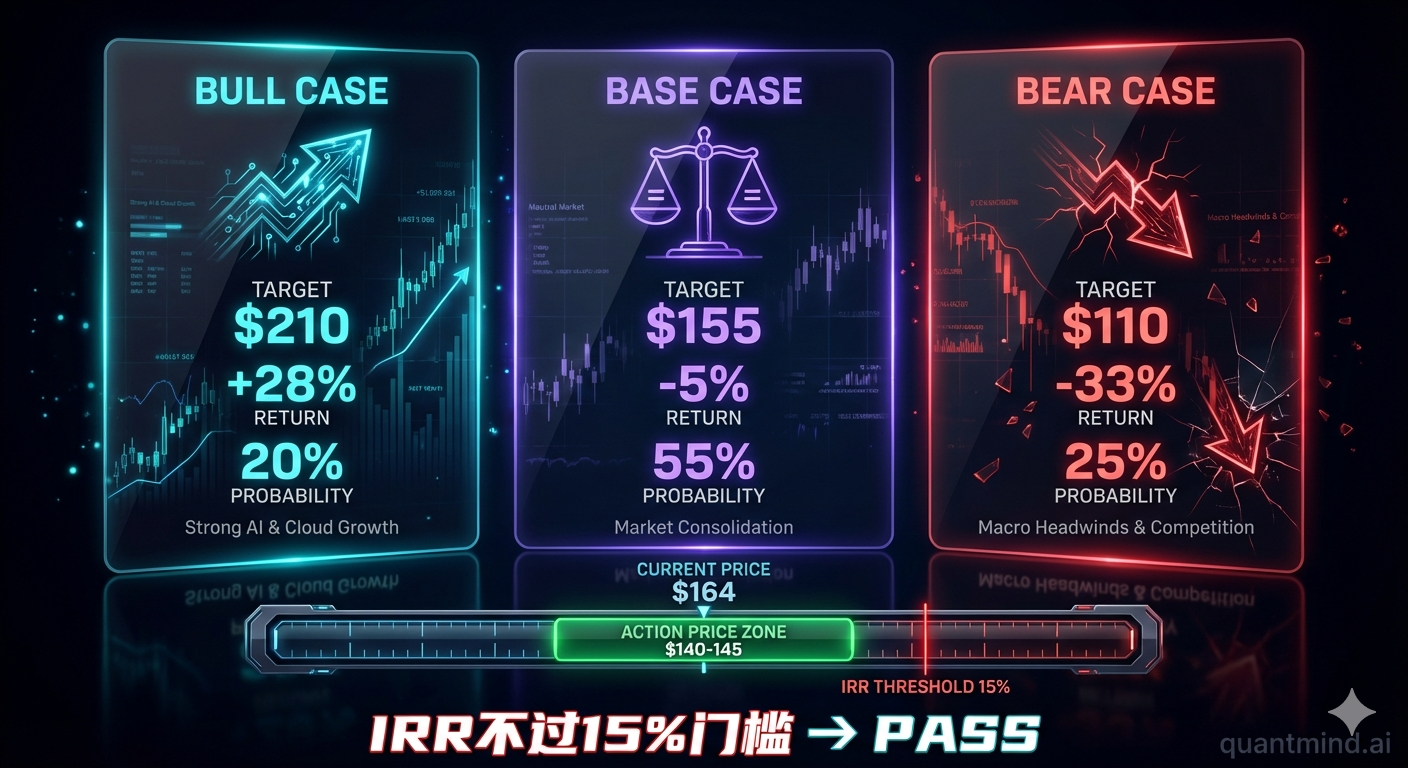
| Scenario | Probability | Target Price | Return |
|---|---|---|---|
| Bull: OCI continues accelerating, market share doubles | 20% | $210 | +28% |
| Base: Tracks guidance, debt doesn’t deteriorate | 55% | $155 | -5% |
| Bear: Growth slows, credit downgrade | 25% | $110 | -33% |
Probability-weighted return: $152 (-7%). Implied IRR well below my 15% hurdle rate.
$140-145 is where I’d start building a position. Until then, PASS.
How Six Investment Philosophies View Oracle
I stress-tested the same dataset through six different investment worldviews. The results are telling — almost every style says PASS:
| Perspective | Verdict | One-Line Rationale |
|---|---|---|
| Buffett (Quality Compounding) | PASS | Negative FCF + high leverage — not a quality business |
| ARK (Visionary Growth) | LONG | OCI +84%, complete AI narrative |
| Tiger Cubs (Fundamental L/S) | PASS | Both sides have merit, no clear variant view |
| Klarman (Deep Value) | SHORT | Negative-FCF company shouldn’t be worth $472B |
| Ackman (Catalyst-Driven) | PASS | Next catalyst too far out (Q4 earnings in June) |
| Druckenmiller (Macro-Tactical) | PASS | High-rate environment punishes high-leverage names |
The only style that says buy is ARK — but ARK’s thesis requires “everything goes right.” The problem is, Oracle’s current position leaves no room for “everything goes right.” $134.6B in debt means the margin for error is essentially zero.
What the Market Thinks vs. What I Think
Market consensus: Oracle is a beneficiary of the AI infrastructure wave. OCI growing 84% proves the transformation is working. $553B RPO locks in future revenue. 23x PE is cheap.
My view: Oracle isn’t “winning” — it’s “buying” growth with 3.4x debt-to-equity leverage. The growth numbers are real, but so is the cost of that growth. When FCF is -$24.7B, growth is being purchased with borrowed money, not earned.
What the market may be overlooking: Everyone is focused on “growth rate,” but nobody is looking at “the cost of growth.” Every $1 of OCI revenue requires $2.5+ in CapEx, 100% debt-financed. If rates don’t come down and growth decelerates below 40%, Oracle falls into a trap where “growth isn’t fast enough to cover interest expense.”
How I Could Be Wrong
To be candid, the biggest risks to this PASS call are:
-
OCI truly becomes the next AWS. If Oracle becomes the indispensable fourth hyperscaler in the AI era, $134.6B in debt will look in hindsight like a stroke of “visionary genius” — just like Amazon lost money for 20 years before proving every skeptic wrong.
-
Rate cuts bail them out. If the Fed cuts aggressively in 2026-2027, Oracle’s financing costs drop and it buys more time.
-
I’m underestimating RPO certainty. If the majority of $553B converts to revenue on schedule, Oracle’s growth curve will be steeper than I project.
But my current assessment is: at $164, the risk/reward for taking on this debt exposure is asymmetrically unfavorable.
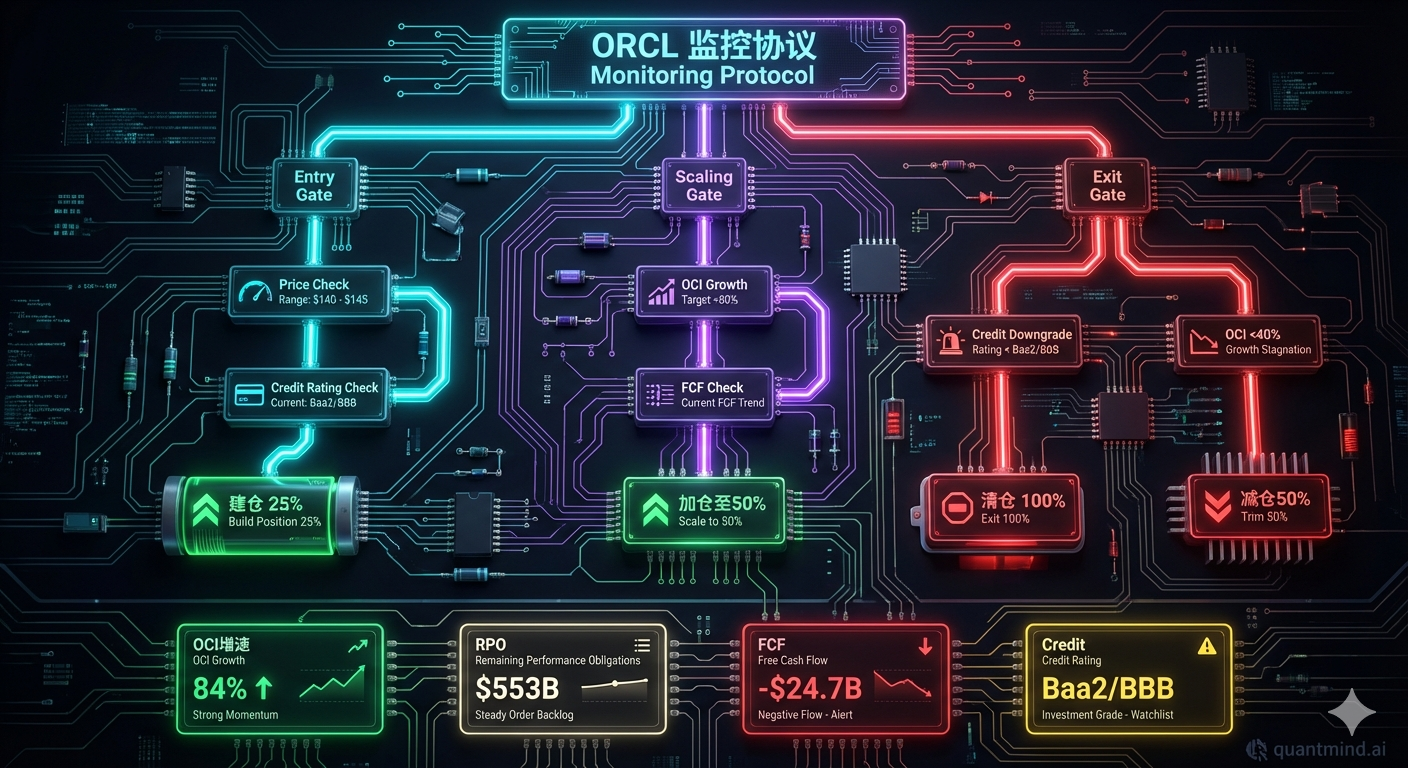
Key Monitoring Metrics
Watch these four numbers — that’s all you need:
| Metric | Current Value | Alert Threshold | Action |
|---|---|---|---|
| OCI YoY Growth | 84% | <40% | Cut position by 50% |
| TTM Free Cash Flow | -$24.7B | Trend toward positive | Signal to add |
| Credit Rating | Baa2/BBB | Downgrade to BBB-/Baa3 | Liquidate immediately |
| RPO QoQ Change | $553B | Consecutive declines | Reassess thesis |
Trading Rules
- $140-145 + stable rating → Initiate position (25% of target allocation)
- 2 consecutive quarters OCI >80% + FCF improving → Scale to 50%
- Rating downgraded to BBB- → Liquidate, no hesitation
- $200+ without fundamental support → Consider small short position
Decision Framework
| Dimension | Conclusion |
|---|---|
| Position Category | PASS — Watchlist |
| Action Price | $140-145 (15%+ IRR) |
| Current Price | $164 (IRR ~8%, below hurdle) |
| Scaling Plan | 3 tranches: 25%→25%→50% |
| Position Cap | 5% of tech allocation (high leverage limits sizing) |
| Next Review | Q4 FY2026 earnings (June 2026) |
Oracle’s story is fundamentally a bet on time: if OCI can achieve scale economics and positive FCF before debt interest consumes the company, Larry Ellison will go down as the boldest gambler of this era. If not, this will be one of the most expensive leveraged blowups in tech history.
At $164, I don’t want to be part of this gamble. But at $140-145? Maybe it’s worth putting 5% on the line, betting on the chance that the madman wins.
This analysis is based on publicly available information and model estimates. It does not constitute investment advice.