Mar 22, 2026
The Nuclear Renaissance: Energy Security Meets AI Power Demand
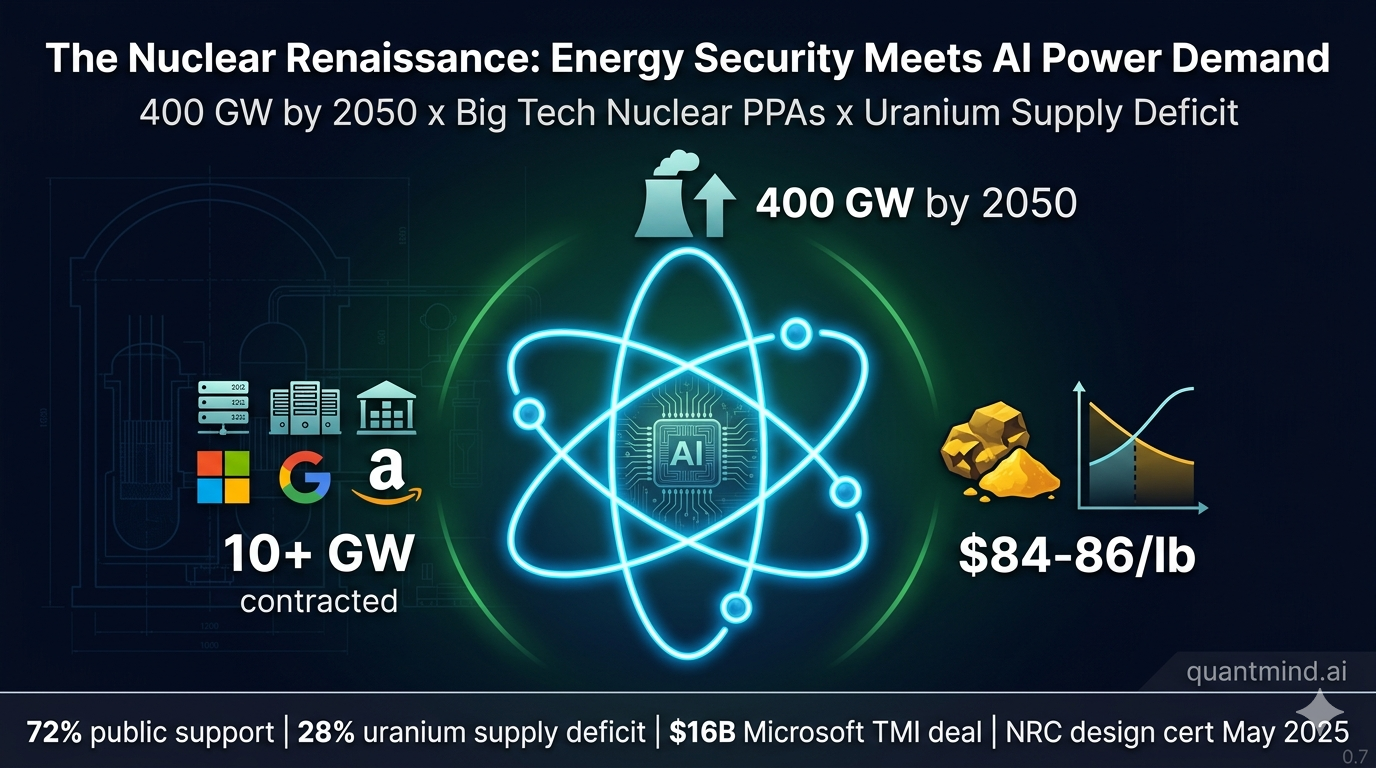
400 GW by 2050 x Big Tech Nuclear PPAs x Uranium Supply Deficit. 10 nuclear stocks analyzed from fleet operators to uranium miners to SMR developers.
Part 3 of “The Geopolitical Edge” Investment Series
One signature. 400 gigawatts. A fourfold increase in American nuclear capacity – ordered from the Oval Office.
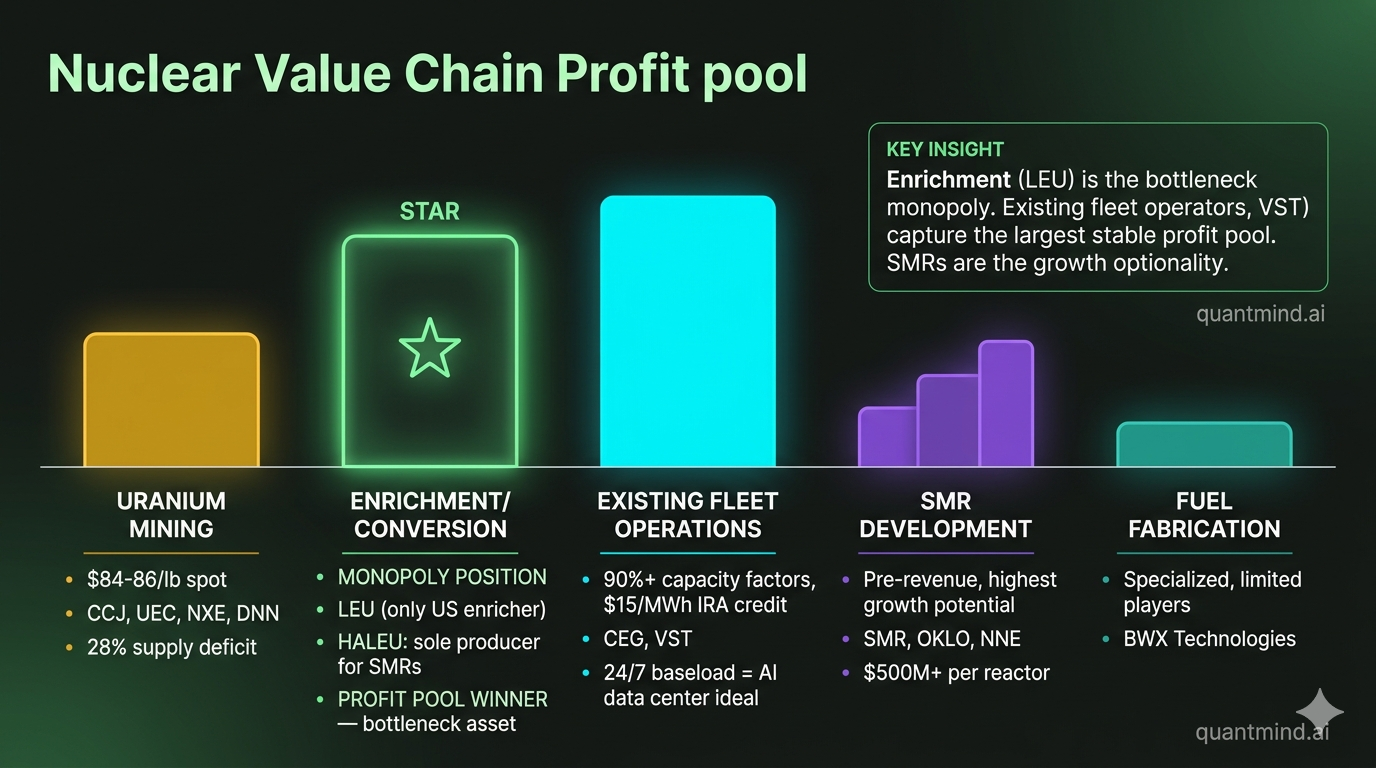
That is what President Trump’s January 2025 Executive Order demands: 400 GW of nuclear capacity by 2050, quadrupling the current 95 GW fleet. The price tag is measured in trillions. But here is the part Washington does not advertise: the world mines 140 million pounds of uranium per year and consumes 180 million pounds. That is a 28% structural supply deficit – and every new reactor makes it worse.
Meanwhile, Big Tech is not waiting for Congress. Microsoft committed $16 billion to restart Three Mile Island. Amazon signed an $18 billion deal at Susquehanna. Google contracted Kairos Power for 500 MW. In total, hyperscalers have signed over 10 GW of nuclear power purchase agreements in the last 18 months. They need power that solar and wind cannot deliver: 24/7, baseload, carbon-free electrons measured in gigawatts.
I ran full fundamental analysis on 10 nuclear stocks – fleet operators, uranium miners, enrichment monopolies, and next-gen reactor developers – across valuation, financial health, earnings quality, peer comparisons, and intrinsic value. Here is the complete breakdown.
TL;DR: - Top Conviction: CEG (Constellation Energy) – largest US nuclear fleet, Microsoft TMI PPA, forward P/E 20.5x, healthy balance sheet, $394 analyst target (+40% upside) - Best Picks-and-Shovels: CCJ (Cameco) – dominant Western uranium producer, net cash, growing FCF, 28% supply deficit tailwind - Monopoly Play: LEU (Centrus Energy) – only US enrichment facility, sole HALEU producer, $280 analyst target (+50% upside) - Highest Upside (Speculative): NNE (Nano Nuclear) – cheapest P/B among developers (1.78x), $580M cash, +121% to analyst target - Best Risk/Reward Turnaround: VST (Vistra) – forward P/E 13x (cheapest), but 4x leverage and 0% beat rate demand patience
Three Forces Driving the Nuclear Renaissance
Force 1: Energy Security – The Post-Dependence Imperative
The geopolitical logic for nuclear has never been stronger. Russia controls 40% of global uranium enrichment capacity. Kazakhstan (a Russian-aligned state) produces 43% of the world’s uranium. The 2024 Russian enrichment ban forced Western utilities to scramble for non-Russian fuel supply – and there is not enough.
Key policy catalysts: - Trump Executive Order: 400 GW nuclear by 2050 (4x current 95 GW fleet) - ADVANCE Act (2024): Bipartisan legislation streamlining NRC licensing, reducing fees for advanced reactors - Russian Enrichment Ban (2024): Redirects enrichment demand to Centrus (LEU) and European facilities - EU Taxonomy (2025): Nuclear classified as sustainable, upheld by European Court – unlocks green financing - 72% US public approval for nuclear energy – highest in polling history
This is not a partisan issue. Nuclear has unified support from the Trump administration’s energy dominance agenda and the progressive climate movement. That political durability makes the investment case structurally different from renewables, which swing with election cycles.
Force 2: AI Data Center Demand – The Gigawatt Problem
Hyperscalers have a power problem that renewables cannot solve. A single 1 GW data center campus requires the equivalent output of 3-4 million solar panels or 300+ wind turbines – and it needs that power 24/7/365 with 99.999% reliability. Nuclear delivers exactly that: >90% capacity factors, zero carbon, and decades-long operational life.
The signed deals tell the story: - Microsoft + Constellation (TMI-1): $16B, 20-year PPA to restart Three Mile Island Unit 1 (835 MW) - Amazon + Talen Energy (Susquehanna): $18B for 960 MW nuclear-adjacent data center campus - Google + Kairos Power: 500 MW advanced reactor deployment by 2030 - Combined Big Tech nuclear PPAs: 10+ GW signed or in negotiation
NuScale Power received the first-ever NRC design certification for a small modular reactor in May 2025. This regulatory milestone unlocks a new class of factory-built, scalable nuclear plants purpose-designed for data center campuses and industrial sites.
Force 3: Uranium Supply Deficit – The Commodity Squeeze
Uranium spot price: $84-86/lb. But the structural story is far more compelling than the headline number:
- Annual demand: ~180 million lbs U3O8
- Annual primary mine supply: ~140 million lbs U3O8
- Structural deficit: ~40 million lbs/year (28%)
- Secondary supply drawdown: Utility inventories, government stockpiles, and underfeeding are declining
- New mine lead times: 10-15 years from discovery to production
- Kazakh production issues: Sulfuric acid shortages constraining Kazatomprom output
Every new reactor announcement widens this deficit. The 400 GW US target alone would require roughly 800 million additional pounds of uranium over the reactor lifetimes. The math is unforgiving: there is not enough uranium being mined to fuel the reactors being planned.
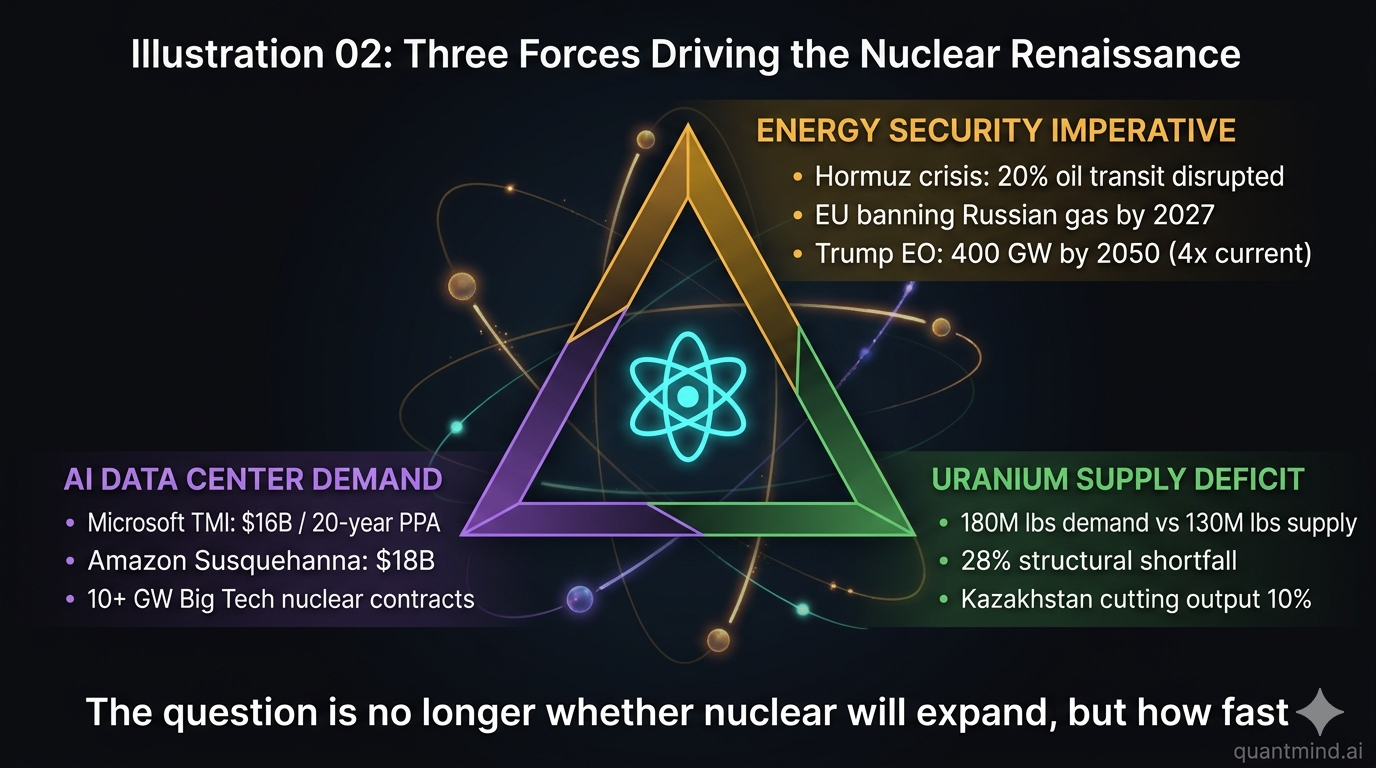
Where the Money Is: Nuclear Value Chain Profit Pool
| Segment | Margin Profile | Key Players | Growth Catalyst |
|---|---|---|---|
| Fleet Operators | Moderate margin, repricing upward | CEG (21 GW), VST (6.4 GW) | VERY HIGH – AI data center PPAs repricing legacy contracts at 2-5x |
| Uranium Mining | Cyclical, leveraged to spot price | CCJ (Tier 1), UEC, DNN, NXE | HIGH – 28% structural supply deficit, 10-15yr mine lead times |
| Enrichment/Fuel Services | Monopoly margin, constrained supply | LEU (sole US), CCJ/Westinghouse JV | VERY HIGH – Russian ban redirects 40% of global SWU demand |
| SMR Developers | Pre-revenue, option value | SMR (NRC-certified), OKLO, NNE | HIGH – factory-built reactors for data centers, but 5-10yr deployment |
| HALEU Fuel | Nascent, strategic | LEU (sole domestic) | CRITICAL – advanced reactors require HALEU; no commercial supply chain exists |
| Nuclear Services | Recurring, high-margin | CCJ/Westinghouse, BWX Technologies | MODERATE – existing fleet maintenance + life extensions |
The profit pool is migrating. Historically, nuclear operators earned regulated utility returns of 8-10%. The AI data center PPA wave is repricing nuclear electricity at $80-120/MWh – 2-5x the legacy regulated rate. This margin expansion flows directly to operators (CEG, VST) and indirectly to the entire fuel supply chain.
The Power Ranking: 10 Nuclear Stocks Analyzed
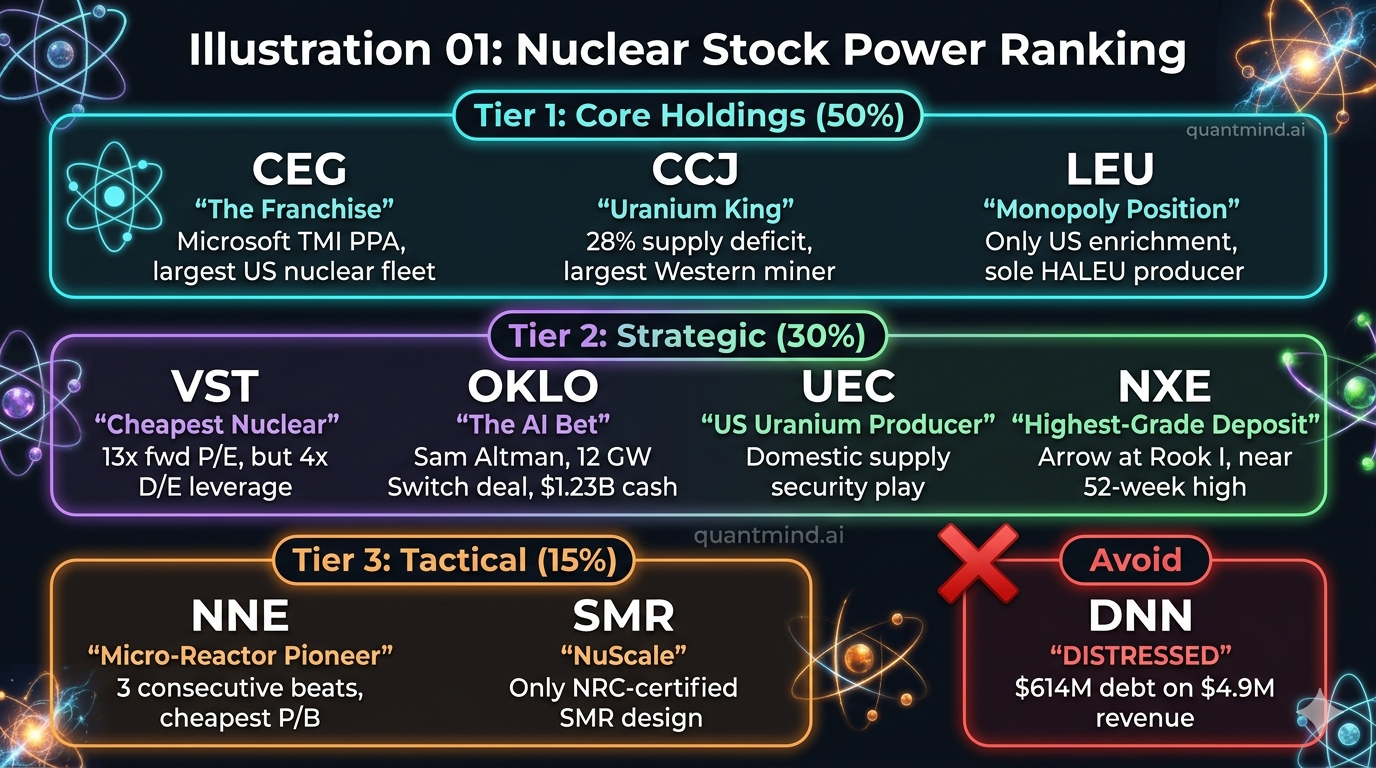
Tier 1: Core Holdings
CEG – Constellation Energy | $282.00 | Market Cap: $88.1B
The Nuclear Fleet Champion
| Metric | Value | Signal |
|---|---|---|
| P/E (TTM) | 38.2x | Premium to utility peers (~18x) |
| Forward P/E | 20.5x | Reasonable on FY26E EPS $12.11 |
| EV/EBITDA | 19.2x | Above utility avg (~12x) |
| ROE | 16.4% | Strong for utility |
| FCF (TTM) | $1.26B | Positive |
| Debt/Equity | 63.9% | Manageable |
| Current Ratio | 1.53 | Adequate |
| Beat Rate | 50% (2/4) | Mixed |
| Analyst Target | $394 | +39.7% upside |
| Altman Z-Score | ~2.5 (est.) | Grey Zone (normal for utilities) |
Bull case: Largest US commercial nuclear fleet operator (~21 GW nuclear capacity). The Microsoft Three Mile Island PPA is the highest-profile nuclear-AI deal in existence – a $16B, 20-year commitment that validates nuclear as the power source for the AI era. The $26B Calpine acquisition creates the largest clean energy company in the US. Forward P/E of 20.5x is reasonable for a growth utility with structural repricing tailwinds. Bipartisan support (ADVANCE Act) reduces regulatory risk.
Bear case: Calpine integration risk and deal financing dilution. Trailing P/E of 38x is demanding – vulnerable to multiple compression if data center demand disappoints. TMI-1 restart faces NRC relicensing uncertainty. 50% beat rate is inconsistent; do not size aggressively ahead of earnings.
Geopolitical edge: Direct beneficiary of energy security policy. Nuclear fleet provides baseload reliability that no intermittent source can match. Every hyperscaler power announcement strengthens CEG’s pricing power.
Action: BUY. Best risk/reward among profitable nuclear names. The Microsoft PPA is transformational.
CCJ – Cameco Corporation | $101.55 | Market Cap: $44.2B
The Uranium Blue Chip
| Metric | Value | Signal |
|---|---|---|
| P/E (TTM) | 102.6x | Elevated (uranium cycle pricing) |
| Forward P/E | 39.7x | FY26E EPS $1.59 |
| Gross Margin | 36.3% | Healthy, improving |
| Operating Margin | 13.6% | Growing |
| FCF (TTM) | $480M | Positive, growing |
| Debt/Equity | 14.7% | Very low |
| Current Ratio | 2.47 | Strong |
| Total Cash | $1.21B | Net cash position |
| Beat Rate | 50% (2/4) | Lumpy (delivery timing) |
| Analyst Target | $125 | +23.2% upside |
Bull case: World’s largest publicly traded uranium producer. McArthur River/Key Lake and Cigar Lake are Tier 1 assets. 49% stake in Westinghouse Electric (via Brookfield JV) adds nuclear fuel fabrication and reactor services – vertical integration across the value chain. Net cash balance sheet is the strongest among operational nuclear companies. The 28% structural uranium supply deficit is a multi-year tailwind that has barely begun to be priced in. Long-term contract portfolio provides revenue visibility even if spot prices dip.
Bear case: Trailing P/E of 102x prices in substantial uranium price appreciation. Kazatomprom production decisions could flood the market. Canadian dollar exposure. The previous uranium bust (2011-2020) lasted nearly a decade – cyclicality is real.
Geopolitical edge: Russian enrichment ban and Kazakh production constraints funnel Western utility demand toward Cameco. As the dominant non-Russian, non-Kazakh producer, CCJ is the energy security pick for uranium.
Action: BUY. The foundational uranium position. Accept the elevated P/E as the cost of owning the best asset in a supply-constrained market.
LEU – Centrus Energy | $186.76 | Market Cap: $3.5B
The Enrichment Monopoly
| Metric | Value | Signal |
|---|---|---|
| P/E (TTM) | 47.9x | Elevated |
| Forward P/E | 35.3x | FY26E EPS $3.52 |
| EV/EBITDA | 55.0x | Very high |
| Operating Margin | 6.1% | Thin |
| ROE | 16.8% | Good |
| FCF (TTM) | $38M | Modest but positive |
| Debt/Equity | 159% | Elevated (legacy USEC restructuring) |
| Current Ratio | 5.59 | Very strong |
| Total Cash | $1.96B | Net cash ($740M net) |
| Beat Rate | 50% (2/4) | Extremely volatile |
| Analyst Target | $280 | +49.7% upside |
Bull case: The ONLY licensed uranium enrichment facility in the United States. Sole domestic producer of HALEU (High-Assay Low-Enriched Uranium) – the fuel required by every advanced reactor design (OKLO, X-energy, Kairos, NuScale). This is not a competitive advantage; it is a legal monopoly backed by national security imperatives. The 2024 Russian enrichment ban redirects 40% of global enrichment demand away from Rosatom, directly benefiting LEU. DOE HALEU production contract makes LEU a strategic national asset. Institutional ownership of 91% signals smart-money conviction. Analyst consensus target of $280 implies 50% upside.
Bear case: Extremely volatile quarterly earnings driven by enrichment delivery timing (Q1 surprise of +1,469% followed by Q4 miss of -51%). Operating margin of 6.1% is thin for a monopoly. $1.22B debt is a legacy overhang. Revenue of only $449M for a $3.5B market cap. Single-facility concentration risk at Piketon, OH. Centrifuge scale-up execution risk.
Geopolitical edge: Maximum exposure to the Russia decoupling trade. Every pound of enrichment that moves away from Rosatom has exactly one domestic destination: Centrus. HALEU is the irreplaceable fuel for the advanced reactor buildout.
Action: BUY. Irreplaceable national security asset. Accept earnings volatility as structural; focus on annual trajectory.
Tier 2: Strategic Positions
VST – Vistra Corp. | $146.00 | Market Cap: $49.5B – The Contrarian Value Play
| Metric | Value | Signal |
|---|---|---|
| P/E (Forward) | 13.0x | Cheapest in nuclear universe |
| Gross Margin | 33.2% | Healthy |
| Debt/Equity | 399.6% | EXTREME |
| Current Ratio | 0.78 | Below 1.0 |
| FCF (TTM) | -$459M | Negative |
| Beat Rate | 0% (0/4) | Worst in universe |
| Analyst Target | $234 | +60.3% upside |
Forward P/E of 13x is the cheapest among nuclear-exposed utilities – a massive discount to CEG’s 20.5x. Operating cash flow of $4.1B demonstrates underlying earnings power. 6.4 GW nuclear capacity (Comanche Peak) in the ERCOT market positions for Texas data center demand. But the balance sheet is frightening: 4x debt/equity, sub-1.0 current ratio, negative FCF, and four consecutive earnings misses. The Altman Z-Score estimate of ~1.3 is in the distress zone. HOLD – wait for two consecutive earnings beats before building a position. The value is real but the execution risk is severe.
OKLO – Oklo Inc. | $54.00 | Market Cap: $9.4B – The AI-Nuclear Narrative
| Metric | Value | Signal |
|---|---|---|
| Revenue | $0 | Pre-revenue |
| Total Cash | $1.23B | 15-year runway |
| Burn Rate | $82M/year | Most efficient among developers |
| P/B | 5.87x | Premium |
| Beat Rate | 25% (1/4) | Weak |
| Analyst Target | $97 | +80.2% upside |
Sam Altman’s involvement creates the strongest perceived link between nuclear and AI among developer-stage companies. Aurora fast reactor design targets modular deployment. $1.23B cash against $82M/year burn provides ~15 years of runway – no near-term dilution risk. DOE Idaho National Lab site access for first reactor. But $9.4B market cap for zero revenue and zero operating reactors is extreme speculation. NRC denied previous license application in 2022 (reapplied). Losses accelerating from -$0.07 to -$0.27 per quarter. SPECULATIVE HOLD – position sizing must reflect binary outcome risk.
UEC – Uranium Energy Corp. | $12.09 | Market Cap: $5.9B – The US Uranium Champion
| Metric | Value | Signal |
|---|---|---|
| Revenue | $20M | Minimal (ramp phase) |
| Debt/Equity | 0.1% | Debt-free |
| Total Cash | $486M | 4+ years runway |
| Beat Rate | 0% (0/4) | Four consecutive misses |
| Analyst Target | $19.17 | +58.6% upside |
| Analyst Rating | Strong Buy (1.44/5.0) | Highest conviction |
Largest diversified uranium miner in the US with ISR operations in Texas and Wyoming plus high-grade Athabasca Basin assets from UEX/Roughrider acquisitions. Hub-and-spoke ISR model means low-cost production once ramped. Zero debt eliminates financial distress risk during the ramp-up. Analyst consensus is “Strong Buy” – the most bullish rating in this coverage universe. Physical uranium inventory on balance sheet acts as a price hedge. But $5.9B market cap on $20M revenue is extreme, and four consecutive earnings misses show the Street is still too optimistic on ramp timing. ACCUMULATE on weakness below $10. Production ramp is the catalyst.
Tier 3: Tactical / Speculative
NNE – Nano Nuclear Energy | $21.10 | Market Cap: $877M – The Cheapest Option Ticket
| Metric | Value | Signal |
|---|---|---|
| P/B | 1.78x | Cheapest among pre-revenue developers |
| Total Cash | $580M | 29 years runway at current burn |
| EV/Cash | 0.90x | Below cash value |
| Beat Rate | 75% (3/4) | Best in nuclear universe |
| Analyst Target | $46.67 | +121.2% upside |
| Employees | 5 | Micro-team |
| Beta | 7.60 | Extreme volatility |
The numbers tell a paradoxical story. NNE is the cheapest pre-revenue nuclear developer on every metric: P/B of 1.78x (vs OKLO 5.87x), EV/Cash of 0.90x (trading below cash value), and cash per share of $11.15 provides a 47% floor. Three consecutive earnings beats with narrowing losses. ZEUS and ODIN microreactor designs target remote/military/mining applications. HALEU fuel fabrication facility adds vertical integration. But 5 employees makes this a funded research project, not a company. No NRC application submitted. Beta of 7.60 means this will destroy portfolios that oversize it. SPECULATIVE BUY – tiny position. The math on cash value is compelling but the execution path is a decade long.
NXE – NexGen Energy | $11.26 | Market Cap: $7.4B – The Highest-Grade Deposit
| Metric | Value | Signal |
|---|---|---|
| Revenue | $0 | Development stage |
| Debt/Equity | 32.4% | Manageable |
| Total Cash | $1.12B | Net cash position |
| P/B | 5.57x | Premium |
| FCF (TTM) | -$216M | Construction spending |
Rook I hosts the Arrow deposit – the highest-grade undeveloped uranium deposit ever discovered (3.10% U3O8 vs industry average <1%). Saskatchewan EIS approved. Near 52-week high shows strongest price momentum in the group. $7.4B market cap makes it the largest pure-play uranium developer. But zero revenue, $310M net loss, and first production likely 2029+ mean this is a construction-phase bet. $594M debt is unusual for a pre-production company. HOLD – own for the asset quality, but size for a 3+ year holding period.
SMR – NuScale Power | $11.44 | Market Cap: $3.4B – The Regulatory Pioneer (In Crisis)
| Metric | Value | Signal |
|---|---|---|
| Revenue | $31.5M | Mostly DOE cost recovery |
| Operating Margin | -3,338% | Massive losses |
| Total Cash | $1.25B | 2.7 years runway |
| Beat Rate | 25% (1/4) | Massive H2 2025 misses |
| Analyst Target | $20.73 | +81.2% upside |
NuScale holds the only NRC-certified SMR design in the world (77 MWe VOYGR module, May 2025). That is an extraordinary regulatory moat. But the stock is near its 52-week low ($11.08) for good reason: Q3 and Q4 2025 losses of -$1.85 and -$0.80 per share (vs estimates of -$0.15) signal major cost control problems. The flagship UAMPS project was cancelled in 2023. No domestic construction contract exists. Cash burn of $460M/year against $1.25B cash gives only 2.7 years of runway – dilution is coming. MONITOR – do not buy until cost overruns are explained and a construction contract is signed. The NRC certification is valuable but the business execution is alarming.
Avoid
DNN – Denison Mines | $3.33 | Market Cap: $3.0B – Distressed Balance Sheet
Worst financial health in the coverage universe. Debt/equity of 167% is the highest among uranium developers. Altman Z-Score estimated in the distress zone. P/B of 11.18x is the most expensive. $614M debt against $4.9M revenue and a $217M net loss. Wheeler River is a world-class asset (largest undeveloped high-grade deposit in the Athabasca Basin), but the capital structure is wrong for a development-stage company. Only 2 analysts covering provides limited market scrutiny. AVOID until balance sheet is restructured or production begins. The asset is excellent; the financial structure is not.
Geopolitical Scenario Matrix
| Stock | 400 GW Build Accelerates | AI Data Center Boom | Uranium Price Spike (>$120/lb) | Russia Decoupling Deepens | Nuclear Sentiment Reversal |
|---|---|---|---|---|---|
| CEG | Very Strong – fleet expansion | Very Strong – PPA repricing | Moderate – cost pass-through | Moderate – US operator | Weak – political risk |
| VST | Strong – fleet value rises | Strong – ERCOT demand | Moderate – cost pass-through | Moderate – US operator | Weak – political risk |
| CCJ | Very Strong – more fuel demand | Strong – indirect | Very Strong – price leverage | Strong – Western supply shift | Moderate – demand floor |
| LEU | Very Strong – enrichment bottleneck | Strong – HALEU for SMRs | Strong – enrichment reprices | Very Strong – sole US enricher | Moderate – national security floor |
| UEC | Very Strong – US supply mandate | Moderate – indirect | Very Strong – production leverage | Strong – domestic supply | Moderate – demand floor |
| DNN | Strong – asset revaluation | Weak – too early | Strong – deposit value rises | Moderate | Weak – speculative |
| NXE | Strong – asset revaluation | Weak – too early | Very Strong – highest grade | Moderate | Moderate – Saskatchewan stable |
| SMR | Very Strong – SMR orders | Strong – data center reactors | Moderate – pre-revenue | Moderate | Weak – NRC dependent |
| OKLO | Strong – reactor orders | Very Strong – AI narrative | Moderate – pre-revenue | Moderate | Weak – NRC dependent |
| NNE | Moderate – early stage | Moderate – micro scale | Moderate – pre-revenue | Strong – HALEU play | Weak – speculative |
Portfolio Construction
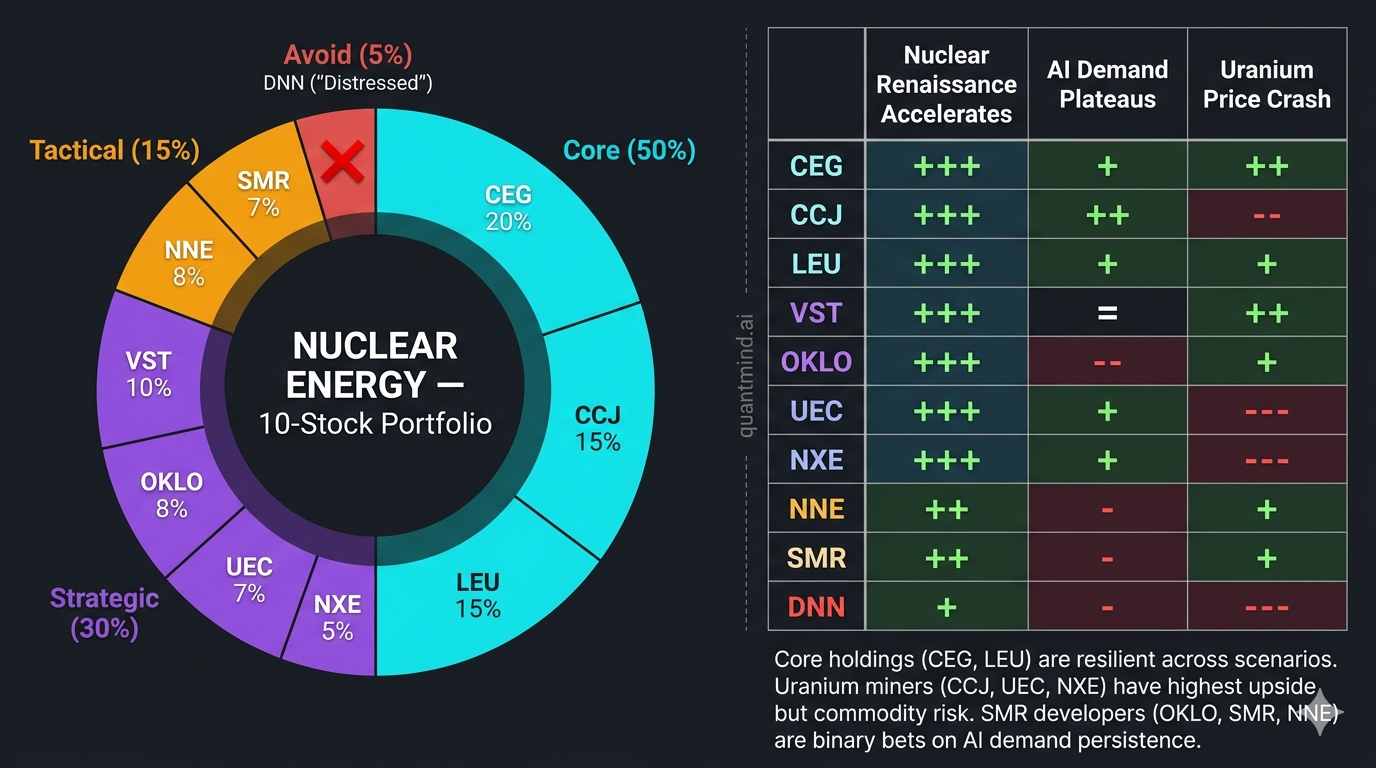
| Tier | Stock | Allocation | Rationale |
|---|---|---|---|
| Core (50%) | CEG | 20% | Largest nuclear fleet, Microsoft PPA, profitable |
| CCJ | 20% | Blue-chip uranium, net cash, supply deficit | |
| LEU | 10% | Enrichment monopoly, HALEU, national security | |
| Strategic (30%) | VST | 8% | Cheapest forward P/E, turnaround candidate |
| OKLO | 7% | Best-funded developer, AI narrative | |
| UEC | 8% | US uranium champion, Strong Buy consensus | |
| NXE | 7% | Highest-grade deposit, construction stage | |
| Tactical (15%) | NNE | 5% | Below-cash valuation, longest runway |
| SMR | 5% | NRC certification moat, monitor execution | |
| NNE/SMR rebalance | 5% | Rotate toward whichever achieves next milestone | |
| Avoid (0%) | DNN | 0% | Distressed balance sheet |
Position sizing note: Pre-revenue names (OKLO, NNE, SMR) should collectively not exceed 15% of a nuclear allocation. These are binary outcomes. The core holdings (CEG, CCJ, LEU) carry the portfolio through volatility.
6 Investment Philosophy Perspectives
| Philosophy | Verdict | Rationale | Biggest Risk |
|---|---|---|---|
| Quality Compounder (Buffett) | LONG CEG, CCJ | Durable competitive advantages, positive FCF, decades-long demand | NRC permitting delays; utility regulation |
| Imaginative Growth (Baillie Gifford) | LONG OKLO, SMR, NNE | Nuclear + AI = civilizational infrastructure; 10-year compounding | Pre-revenue companies may never commercialize |
| Fundamental L/S (Tiger Cubs) | LONG LEU / SHORT DNN | Monopoly enricher vs distressed developer; pair captures spread | LEU earnings volatility; DNN squeeze risk |
| Deep Value (Klarman) | LONG VST (contrarian) | 13x forward P/E, $4.1B operating CF; market punishing 0% beat rate | Balance sheet blowup; continued misses |
| Catalyst-Driven (Tepper) | LONG CCJ, UEC | Uranium supply deficit = near-term price catalyst; production ramp | Kazatomprom flooding market |
| Macro Tactical (Druckenmiller) | LONG nuclear broadly | Generational energy transition + AI demand + supply deficit = regime change | Public nuclear sentiment reversal |
Variant View
Market consensus: Nuclear stocks have already re-rated on the AI data center narrative. The TMI restart, the Amazon-Susquehanna deal, the uranium rally to $84/lb – it is all priced in. Nuclear is a momentum trade that has run its course.
What the market is missing: The 400 GW executive order is not a target – it is a 4x expansion of the entire US nuclear fleet over 25 years. The uranium supply deficit is not cyclical – it is structural, with 10-15 year mine lead times that cannot respond to demand signals. HALEU enrichment capacity does not exist at commercial scale anywhere outside Russia. The AI power demand curve is steepening, not flattening – each generation of GPU clusters doubles power consumption. And 72% public approval means the political tailwind is durable across administrations.
The market is treating nuclear as a theme trade. It is actually an infrastructure super-cycle. The difference is 5-10x in duration and magnitude. Consensus P/E multiples treat this as a 2-3 year narrative. The uranium supply deficit alone guarantees a 10+ year structural bid under producers.
Pre-Mortem: Three Ways This Goes Wrong
-
NRC permitting gridlock. Despite the ADVANCE Act, the NRC remains chronically understaffed and culturally risk-averse. If advanced reactor approvals take 8-10 years instead of 3-5, the SMR/OKLO/NNE cohort burns through cash without reaching commercial deployment. Pre-revenue stocks decline 50-70%. Operators (CEG, VST) are insulated but lose the growth premium. Uranium demand growth is delayed, compressing CCJ/UEC multiples by 20-30%.
-
Uranium price crash below $60/lb. Kazatomprom resolves sulfuric acid shortages and floods the market. Secondary supply (utility destocking, government sales) exceeds expectations. Spot uranium drops to $55-60/lb. CCJ and UEC operating margins compress. Development-stage miners (DNN, NXE) defer production decisions. The supply deficit thesis is delayed by 3-5 years. Portfolio drawdown of 25-40% across the sector.
-
AI data center demand plateaus. Hyperscaler capex growth decelerates as AI model efficiency improves (less compute per inference). Nuclear PPAs are renegotiated or cancelled. CEG’s premium to utility peers compresses from 20.5x to 14-16x forward P/E (-25% drawdown). The OKLO/SMR narrative collapses without anchor customers. The nuclear renaissance becomes a nuclear false start – again.
Monitoring Variables and Action Triggers
| Variable | Current State | Bull Trigger | Bear Trigger |
|---|---|---|---|
| Uranium spot price | $84-86/lb | Break above $100/lb | Drop below $65/lb |
| US nuclear capacity additions | 95 GW (static) | NRC approves first advanced reactor construction permit | NRC denies/delays multiple applications |
| Hyperscaler nuclear PPAs | 10+ GW signed | 20+ GW signed or major new entrant (Apple, Meta) | PPA cancellation or renegotiation |
| HALEU production | LEU pilot scale only | LEU commercial-scale production begins | DOE contract delays or cancellation |
| CEG TMI-1 restart | NRC review in progress | NRC grants operating license | NRC denies or multi-year delay |
| SMR first construction contract | None signed | Domestic or international contract signed | No contract by end of 2027 |
| Kazatomprom production | Constrained (acid shortage) | Production guidance cut further | Full production restored + expansion |
| Congressional nuclear funding | ADVANCE Act passed | $50B+ nuclear infrastructure bill | DOGE-style nuclear budget cuts |
| VST earnings trajectory | 0% beat rate | Two consecutive earnings beats | Fifth consecutive miss + debt downgrade |
| Public nuclear sentiment | 72% favorable | Sustained above 70% | Drop below 55% (Fukushima-style event) |
Decision Framework
| Stock | Buy | Add | Reduce | Stop |
|---|---|---|---|---|
| CEG | $240 | $260 | $380 | $200 |
| CCJ | $85 | $95 | $130 | $70 |
| LEU | $150 | $170 | $280 | $120 |
| VST | $120 | $135 | $210 | $95 |
| OKLO | $40 | $48 | $90 | $30 |
| UEC | $9 | $11 | $18 | $7 |
| NXE | $9 | $10.50 | $14 | $7.50 |
| NNE | $17 | $19 | $42 | $13 |
| SMR | $9 | $10.50 | $19 | $7 |
How to read this table: - Buy: Initial entry price where risk/reward is compelling - Add: Price to increase position on confirmed thesis - Reduce: Take partial profits at this level - Stop: Exit if price breaks below this level (thesis broken)
DNN is excluded from the decision framework due to its Avoid rating. Re-evaluate if balance sheet is restructured.
Part 3 of “The Geopolitical Edge” series. Part 1: LNG Value Chain | Part 2: Defense & Munitions available on the blog.
Disclaimer: Research and educational purposes only. Not investment advice. Data as of March 22, 2026.