May 3, 2026
The Drone Warfare Winners: When a $50K Drone Kills a $2M Target, Who Rewrites Defense Economics?
A $50K drone destroying a $2M target. The Iran conflict validated drone-centric warfare economics: unit economics flipped. Market still values KTOS, AVAV by traditional defense models, but legacy primes literally cannot build $50K systems. Full teardown of 10 drone & autonomous systems stocks.

The Drone Warfare Winners: When a $50K Drone Kills a $2M Target, Who Rewrites Defense Economics?
“Geopolitical Edge” Investment Series
A $50K kamikaze drone destroying a $2M high-value target. A $200K attack drone disabling an $8M tank. This isn’t science fiction — this is what’s happening daily on the Iran battlefield in 2026.
I was working on another defense deep-dive, organizing the loss data from the Iran conflict, when one set of numbers stopped me: Israeli military disclosures showed Iran’s Shahed-series and indigenous loitering munitions destroyed $2.5B worth of targets while consuming roughly $50M in drone costs. A 50-to-1 cost efficiency ratio.
Then it clicked: that number doesn’t just change war — it changes the entire mathematics of defense procurement.
For 30 years, the US defense budget logic was this: buy expensive exquisite platforms (F-35, Aegis, Ford-class), use quality to crush quantity. F-35: $80M each. Aegis destroyer: $2B. Ford-class carrier: $13B.
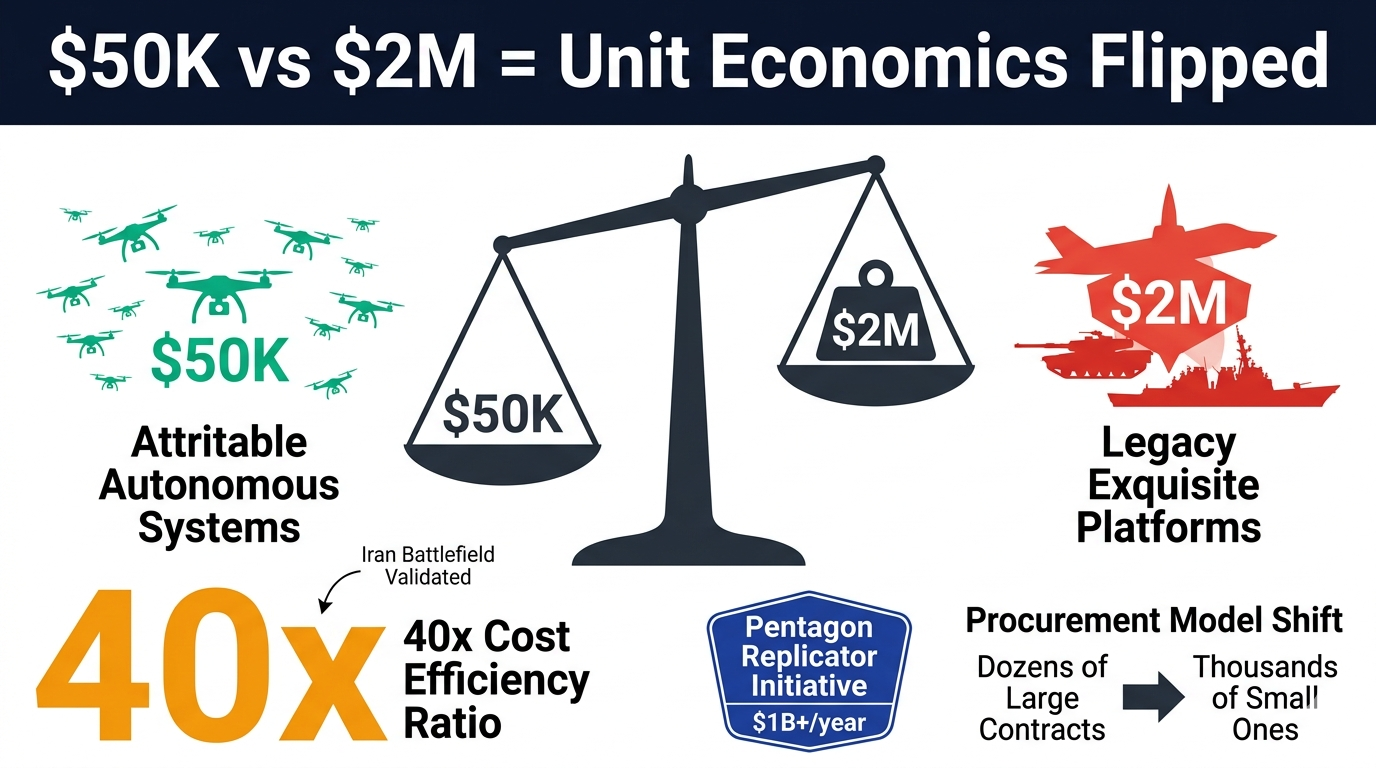
Iran proved one thing: when an adversary can threaten your $2M asset with a $50K thing, the exquisite logic breaks. Pentagon’s Replicator initiative (DepSecDef Hicks, $1B+/year) officially acknowledged this — the offense-defense economics have flipped.
The market hasn’t digested it yet. Wall Street still values KTOS, AVAV, and others using traditional defense valuation models — DOD budget cycles, multi-decade prime contracts, 15-20x P/E. That’s the wrong comp set. These companies aren’t mini-Lockheeds — they’re the defense version of consumer electronics: high-volume, fast-iteration, low-unit-price, thousands-of-orders.
A bigger asymmetry: legacy primes literally cannot build $50K systems. LMT, RTX, NOC have cost structures optimized for nine-figure platforms — overhead, compliance, staffing make profitable production of a $50K Switchblade impossible. So they must acquire. That puts a strategic-acquisition floor under all the disruptors (KTOS, AVAV, AXON, RKLB).
I ran the full fundamental workup on 10 drone + autonomous systems stocks. The conclusion:
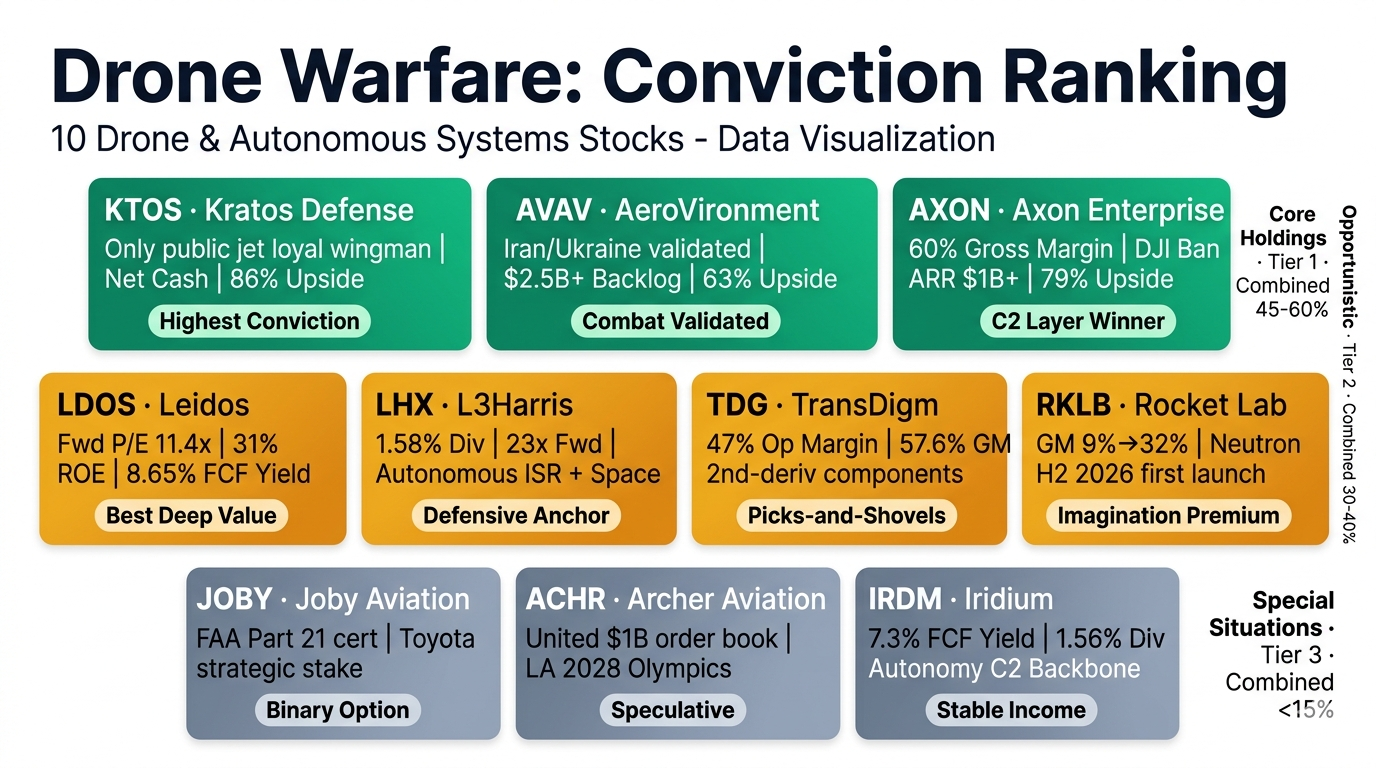
TL;DR: - Highest Conviction: Kratos (KTOS) — Only public US pure-play jet-powered loyal wingman, XQ-58 Valkyrie, analyst target 86% upside - Strongest Combat Validation: AeroVironment (AVAV) — Switchblade is the most thoroughly Iran/Ukraine-validated Western system, $418→$185 BlueHalo integration discount - C2 + Counter-Drone Layer: Axon (AXON) — DJI ban beneficiary + Dedrone counter-UAS + SaaS, 60% gross margin (best in group) - Best Deep Value: Leidos (LDOS) — Forward P/E 11.4x (cheapest in group) + 8.65% FCF yield + 31% ROE, autonomy software prime - Highest Imagination Premium: Rocket Lab (RKLB) — Gross margin 9% → 32% (consumer electronics curve), Neutron H2 2026 first launch
Three Forces Driving the Drone War
Force 1: Iran Validation — Unit Economics Flipped
Everyone sees “drones change war.” But what the market is missing is that the procurement model has been permanently changed:
- $50K vs $2M = 40x cost efficiency ratio — Iran and Ukraine battlefields repeat this math daily
- Pentagon Replicator officially codifies this — DepSecDef Hicks’s $1B+/year explicitly funds attritable autonomous systems
- Procurement shape shifts from “dozens of large contracts” to “thousands of small ones” — structurally favors KTOS/AVAV-style mass manufacturers, structurally disfavors exquisite primes
- Key insight: this is not budget growth — it’s budget reallocation within defense. The reallocation is the trade. Even if total defense spend is flat, attritable/autonomous share keeps rising
Historical analogue: in the 2010s, the US spent $10B+ on Small Diameter Bomb programs, driving unit cost from $30K to $15K. But once an SDB destroyed a $200K target, returns inverted. Iran compressed that same logic into months in 2026.
Force 2: FAA Regulatory Inflection — Commercial Drones Get Real
Beyond the defense story, the civilian dimension also hits inflection in 2026-2027:
- BVLOS rules finalized — the unified “beyond visual line of sight” framework finally lands, unlocking drone delivery, infrastructure inspection, agricultural spraying
- eVTOL Part 21 type certification path clearing — JOBY leading, ACHR 6-12 months behind, commercial flights within 2026 H2
- DJI ban + domestic-drone mandates — create an enforced US market for AVAV, AXON
- LA 2028 Olympics — forced public eVTOL demonstration timeline, gives ACHR a concrete catalyst
The civilian inflection matters because JOBY, ACHR, IRDM don’t depend on defense budgets rising — they have independent commercial catalysts.
Force 3: M&A Frenzy — Primes Can’t Build, So They Must Buy
The most-overlooked structural support:
- Legacy primes’ cost structures preclude profitable $50K-system production — LMT averages 35% project overhead vs KTOS at 8-10%. Not a culture issue, a structural one
- Only viable response: acquire — autonomy startups (Anduril, public KTOS/AVAV/RKLB) are all targets
- Defense PE funds (Cerberus, Bain, Apollo Defense) actively bidding — pushing valuations up
- KTOS at $11.6B, AVAV at $9.2B, RKLB at $45B — all within EV-accretion range for LMT ($170B), NOC ($90B), RTX ($170B)
The 54-56% drawdowns (KTOS, AVAV, AXON all down half from 52-week highs) actually increase strategic acquisition probability — primes can buy IP and capacity at compressed multiples.
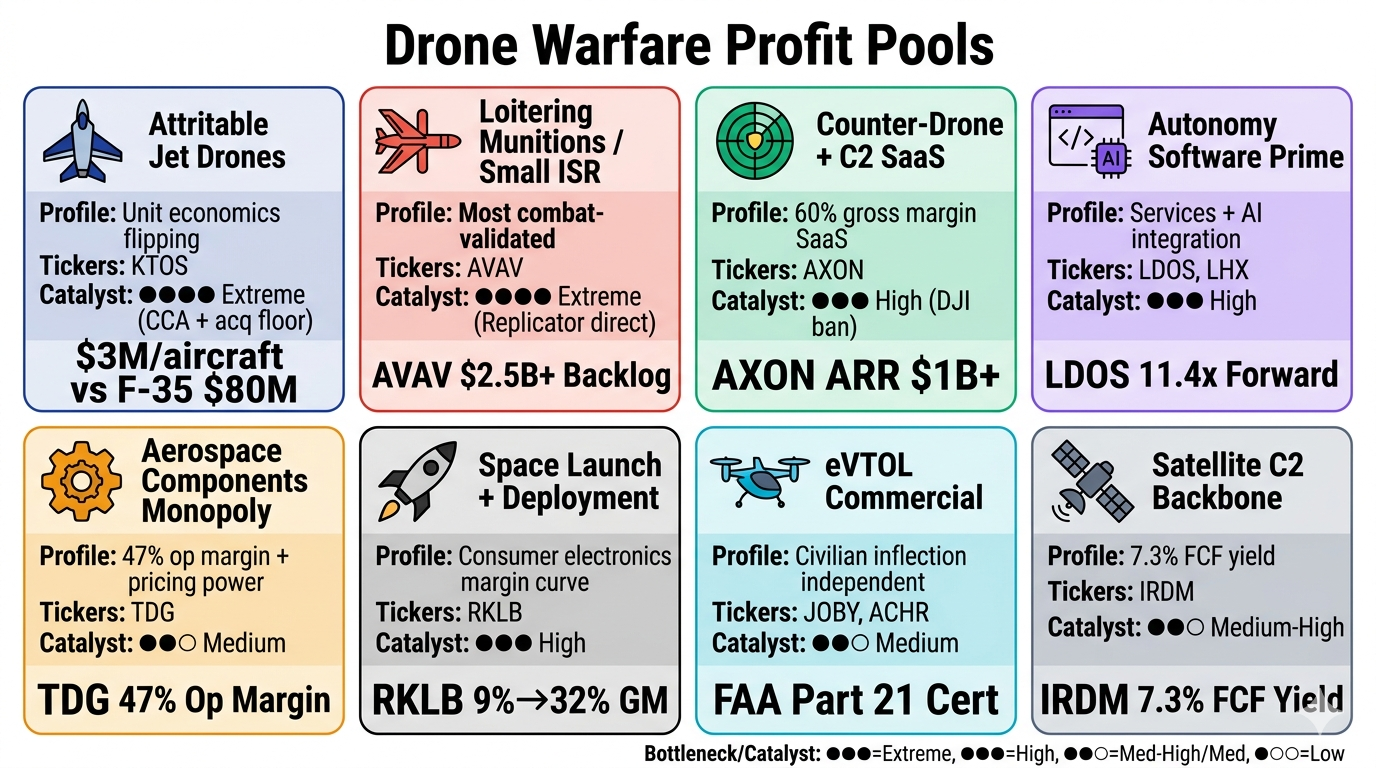
Where the Money Is: Drone Warfare Profit Pools
| Subsector | Profit Profile | Key Tickers | Battle/M&A Catalyst |
|---|---|---|---|
| Attritable Jet Drones | Unit economics flipping, pre-scale | KTOS | Extreme — CCA program + strategic acquisition floor |
| Loitering Munitions / Small ISR | Iran/Ukraine most-validated | AVAV | Extreme — direct Replicator beneficiary |
| Counter-Drone + C2 SaaS | High margin (60%), DJI ban beneficiary | AXON | High — Dedrone + domestic mandate |
| Autonomy Software Prime | Services margin + AI integration | LDOS, LHX | High — CCA software layer + ISR fusion |
| Aerospace Component Monopoly | 47% operating margin + pricing power | TDG | Medium — second-derivative parts beneficiary |
| Space Launch + Deployment | Consumer electronics margin curve | RKLB | High — constellation deployment + DoD launches |
| eVTOL Commercial | Civilian inflection independent catalyst | JOBY, ACHR | Medium — Agility Prime dual-use |
| Satellite C2 Backbone | 7.3% FCF yield + stable base | IRDM | Medium-High — every autonomous platform needs comms backbone |
Power Rankings: Full Analysis of 10 Drone & Autonomous Systems Stocks
Tier 1: Core Holdings
Kratos Defense — KTOS | $62.05 | Market Cap: $11.63B
Only Public Pure-Play Jet-Powered Loyal Wingman
| Metric | Value | Signal |
|---|---|---|
| P/E (TTM) | 471.5x | Extreme (TTM EPS only $0.13) |
| Forward P/E | 58.8x | Big compression — TDS scaling |
| EV/EBITDA | 128.9x | Distorted by depressed EBITDA, normalizes ~30x by 2027 |
| Gross Margin | 22.1% | Critical — needs to scale to 28-30% |
| Operating Margin | 2.06% | Thin — unit economics still proving |
| ROE | 1.31% | Below cost of capital (bear evidence) |
| Cash | $560M | Strong — post $1.17B raise |
| D/E Ratio | 0.07 | Net cash balance sheet |
| Current Ratio | 4.06 | Excellent |
| Analyst Consensus | Strong Buy, $115.71 | 86% upside |
Bull Case: Kratos is the only public US company with a fielded, in-production, jet-powered, autonomous loyal wingman platform — XQ-58A Valkyrie selected for the USAF CCA (Collaborative Combat Aircraft) program demonstrators alongside Anduril (private). A ~$3M-per-aircraft cost vs F-35’s ~$80M makes the Valkyrie the canonical “mass-attritable” platform the Iran war narrative requires. Three commercial vectors stack: (1) Tactical Drone Systems (BQM-167 target drone, MQM-178 Firejet, Apollo) — high-volume attritable units with rapidly improving unit economics; (2) Defense Rocket Support — hypersonics test infrastructure with limited competition; (3) Microwave Electronics (KGS) — RF/EW components used across primes’ platforms. Recent $1.17B equity raise (at $84/share, well above current price) provides capital to triple Valkyrie production capacity by 2027. Strategic acquisition value is real: every prime that wants CCA exposure must either build (5+ year R&D) or buy. KTOS at $11.6B is digestible for LMT, NOC, RTX. The 54% drawdown from $134 is the buyable distress.
Bear Case: Operating margin of 2.06% on $1.35B of revenue is the brutal truth. Kratos has been “about to inflect” for five years; XQ-58 was first flown in 2019 and is still not in mass production. The capital raise dilutes existing holders ~9%, and the market reaction (-30% from raise price to current $62) tells you the Street is skeptical of the deployment timeline. Management’s target margin profile (low-double-digit operating margin “long term”) is conditional on production volumes that remain unconfirmed by DoD POM funding. Technology risk: peer programs (Anduril Fury, GA ASI Gambit, Boeing MQ-28) compete for the same CCA dollars.
Verdict: Highest Conviction. Iran war narrative + CCA program + strategic acquisition floor + net cash balance sheet = strongest risk-adjusted exposure in group. The issue is entry price — $50-55 is a safer add zone.
KTOS is the loyal-wingman strategic option. But what if you want not optionality but a product already validated on the battlefield? The next stock’s Switchblade has killed more high-value targets in Iran and Ukraine than any other Western system.
AeroVironment — AVAV | $184.97 | Market Cap: $9.24B
Loitering Munitions Pure-Play — Most Combat-Validated System in the West
| Metric | Value | Signal |
|---|---|---|
| P/E (TTM) | n/a | Negative TTM EPS (BlueHalo integration charges) |
| Forward P/E | 45.8x | On normalized 2027 EPS |
| EV/EBITDA | 59.0x | Distorted by integration accounting |
| Gross Margin | 18.9% | Compressed from 38% pre-BlueHalo — the issue |
| Operating Margin | -3.49% | Negative on integration |
| ROE | -8.74% | TTM noise |
| Cash | $590M | Strong |
| D/E Ratio | 0.19 | Very low |
| Current Ratio | 5.51 | Outstanding |
| Analyst Consensus | Strong Buy, $300.94 | 63% upside |
Bull Case: AeroVironment is the cleanest publicly-traded play on loitering munitions — exactly the category the Iran/Israel/Ukraine wars proved is the dominant cost-effective kill vector. Switchblade 300 ($60K) and Switchblade 600 ($120K) have killed more high-value targets per dollar spent than any other Western system in active conflict. The DoD has committed to 60,000+ Switchblade units across multiple program cycles, and Replicator initiative ($1B/year) explicitly funds attritable systems where AVAV is a primary supplier. BlueHalo expansion into directed-energy (Locust laser counter-UAS), space domain awareness, and electronic warfare creates a vertically-integrated autonomy/CUAS stack that makes AVAV harder to disrupt — and more strategically valuable to a prime acquirer. Backlog reportedly $2.5B+, growing. Puma 3 AE and Jump 20 expand ISR side. The 56% drawdown from $418 is the pre-thesis-validation buyable level.
Bear Case: Gross margin compression from 38% → 19% in two quarters tells you BlueHalo is a less-profitable business that AVAV bought at a premium with stock issuance. Switchblade has true competition: AeroVironment is no longer the only DoD-approved loitering munition (Anduril Altius, Skydio X10D, Teledyne FLIR Black Hornet 4, Raytheon Coyote LE all have program slots). The BlueHalo deal could face integration challenges that delay margin recovery to FY28+. Inventory write-downs and contract restructuring charges could continue another 2-3 quarters.
Verdict: Strongest Combat Validation. Switchblade’s combat record cannot be replicated in 3-5 years by any competitor. 56% drawdown + Strong Buy 63% upside = asymmetric opportunity. $170 below is more ideal entry.
AVAV is the platform-layer winner. But what if it’s not DoD but the civilian market that needs drone capability?
Axon Enterprise — AXON | $402.31 | Market Cap: $32.41B
Counter-Drone + Public Safety SaaS — The Non-DoD Autonomy C2 Layer
| Metric | Value | Signal |
|---|---|---|
| P/E (TTM) | 263.8x | High (depressed TTM) |
| Forward P/E | 38.2x | Reasonable (SaaS-heavy mix) |
| P/S | 11.66x | SaaS premium |
| Gross Margin | 59.7% | Highest in mass-market drone basket (SaaS mix) |
| FCF | $390M | Strong (despite GAAP noise) |
| FCF Yield | 1.20% | Modest |
| Cash | $1.74B | Substantial |
| Current Ratio | 2.53 | Strong |
| Revenue Growth | YoY +33% sustained 16+ quarters | Hyper-growth |
| Analyst Consensus | Strong Buy, $718.94 | 79% upside |
Bull Case: Axon is the autonomy/C2 layer for everyone who isn’t the DoD — police, fire, federal, local, corrections, courts, retail security. The Dedrone acquisition (closed late 2024) added counter-drone radar/RF detection that became enormously more valuable after (1) the FAA confirmed DJI Part 89 ban, and (2) drones were used in homeland-security incidents during Iran tensions (NJ/PA sightings late 2024). Axon’s three-layer thesis: (1) Hardware (TASER 10, Axon Body 4) + Counter-UAS (Dedrone) — high-margin enterprise hardware; (2) SaaS (Evidence.com, Axon Records, Axon Justice) — 90%+ gross margin recurring revenue at >100% net retention; (3) AI tools (Draft One report writing) — generative-AI features compounding the SaaS attach rate. ARR crossed $1B in 2025; trajectory toward $2B by 2027. The DJI ban + Iran-era counter-drone urgency creates massive Dedrone tailwind for the next 24 months. Federal contract wins (DEA, FBI, BOP, ICE) prove the franchise is broadening past municipal police.
Bear Case: 38x forward P/E on a stock that just round-tripped 55% is not cheap. SBC dilution remains heavy — Q4 2025 GAAP loss of $50M on $797M revenue. Counter-UAS is a competitive market (DroneShield, Anduril Pulsar, IronNet, Fortem). ROE 4.5% is well below what the multiple implies.
Verdict: C2 Layer Winner. 60% gross margin + 33% revenue growth 16 quarters + DJI ban + Dedrone tailwind = high-quality SaaS-style autonomy exposure. Biggest risk is valuation — $350 below is more ideal.
Tier 2: Opportunistic Positions
The three above are close-your-eyes-and-hold cores. The next four are different — each is a bet on something specific happening.
Leidos — LDOS | $149.23 | Market Cap: $18.79B
Cheapest Defense Stock + 30% ROE + 8.65% FCF Yield
| Metric | Value | Signal |
|---|---|---|
| P/E (TTM) | 13.4x | Cheapest in group |
| Forward P/E | 11.4x | Significant value |
| EV/EBITDA | 9.61x | Cheap |
| Operating Margin | 12.3% | Above LMT/RTX/NOC |
| ROE | 31.05% | Highest among profitable names |
| FCF | $1.6B | Strong |
| FCF Yield | 8.65% | Highest in group |
| Dividend Yield | 1.17% | Meaningful income |
| Beta | 0.57 | Lowest in group |
| Analyst Consensus | Buy, $196.69 | 32% upside |
Bull Case: Leidos is the autonomy software prime — when DoD, DHS, IC needs AI/ML to fuse sensor data, target-recognize, command-and-control attritable swarms, the prime contract sits with Leidos, Booz, or SAIC, not LMT/NOC. Their classified portfolio (estimated 60%+ of revenue) makes them the first beneficiary of any autonomy-stack RFP that pulls software dollars away from hardware platforms. The Dynetics subsidiary builds counter-UAS systems (Enduring Shield) competing directly in the Iran-war-validated counter-drone vertical. 11.4x forward / 8.6% FCF yield / 31% ROE / 1.17% div yield — this is the classic “left for dead” defense services name where the autonomy thesis re-rates it to 15-17x. Even no-multiple-expansion gives you 12-15% earnings growth + 1.2% dividend = ~14-16% annual return.
Bear Case: Defense services businesses are perennially out-of-favor versus hardware names because services growth tracks budget growth. Continuing resolution (CR) risk in any year compresses near-term revenue. Cybersecurity (60-70% of National Security business) faces commoditization pressure. Beta 0.57 is a warning: the market doesn’t price LDOS as a growth name.
Verdict: Best Deep Value. 11.4x forward + 31% ROE + 8.65% FCF yield + 0.57 beta = strongest risk-adjusted fundamentals. Stable anchor in volatile markets.
L3Harris — LHX | $313.37 | Market Cap: $58.53B
Autonomous ISR + Space Sensing Prime + 1.58% Dividend
| Metric | Value | Signal |
|---|---|---|
| P/E (TTM) | 34.0x | Slightly above historical |
| Forward P/E | 23.1x | Aerojet synergies |
| EV/EBITDA | 18.9x | Mid-pack |
| Operating Margin | 11.0% | Improving |
| FCF | $2.6B | Strong |
| FCF Yield | 4.42% | Solid |
| Dividend Yield | 1.58% | Highest in defense cohort |
| Beta | 0.51 | Defensive |
| Analyst Consensus | Buy, $390.21 | 24% upside |
Bull Case: L3Harris is the second-derivative beneficiary of the autonomy thesis — they don’t make the drones, they make the radios, sensors, electronic warfare, and space-based payloads the drones need. Aerojet integration adds hypersonic propulsion and solid rocket motors that constraint the entire cruise-missile and counter-cruise-missile economy. Recent contract wins: USAF EW-37 next-gen jammer, Space Force resilient PNT, MQ-25 Stingray sensors, Replicator small-UAS contracts. Wescam EO/IR business autonomous unmanned surface vessel (USV) capability is now a $200M+ revenue line. 1.58% dividend at 56% payout is sustainable.
Bear Case: Mid-tier prime conversion to autonomy thesis takes 5+ years — legacy revenue base (Communications, Mission Avionics) is GDP-growth-correlated. Heavy debt from Aerojet absorbed buyback runway. Contract margin volatility (Q4 2025 EPS $1.61 vs run-rate $2.50) is recurring.
Verdict: Dividend + Steady Growth. Not the sexiest story but provides downside protection. 25-30% allocation as defensive ballast makes sense.
TransDigm — TDG | $1,154.45 | Market Cap: $65.20B
Aerospace Component Monopolist — 47% Operating Margin
| Metric | Value | Signal |
|---|---|---|
| P/E (TTM) | 37.1x | Monopoly economics premium |
| Forward P/E | 25.4x | Reasonable compression |
| EV/EBITDA | 19.9x | Reasonable for 50%+ EBITDA margin |
| Gross Margin | 57.6% | Top tier |
| Operating Margin | 47.0% | Best in group |
| Net Margin | 19.9% | Excellent |
| FCF | $2.2B | Strong |
| FCF Yield | 3.35% | Modest (priced as compounder) |
| Analyst Consensus | Buy, $1,536.84 | 33% upside |
Bull Case: TransDigm is the proven M&A operator in aerospace components — buy a niche monopoly, raise prices 5-10% per year, integrate operations, refinance into more debt, return capital. The drone-component vector is genuinely additive: TDG’s pumps, valves, sensors, actuators, and fasteners are used in attritable autonomy platforms (Switchblade, Valkyrie, RKLB Electron stages, Anduril platforms) where small-volume sole-source contracts command extreme pricing power. The Iran-war-driven step-change in attritable order volume rises TDG’s drone-component exposure from ~5% of revenue to potentially 10-15% by 2027. Unlike a prime, TDG benefits regardless of which platform wins — it’s the “picks and shovels” play. 47% operating margin is the moat.
Bear Case: TDG’s PE-style balance sheet means leverage is high and the company is sensitive to financing conditions. In a higher-for-longer rate environment, the special-dividend-funded-by-debt model gets more expensive. Defense exposure is modest (~30% of revenue). The drone-component thesis is real but slow-contributing.
Verdict: Picks-and-shovels Premium. 47% operating margin is a real moat. Opportunistic add — entry at $1,050 below.
Rocket Lab — RKLB | $78.81 | Market Cap: $45.38B
Gross Margin 9% → 32% — The Consumer Electronics Curve
| Metric | Value | Signal |
|---|---|---|
| Forward P/E | 1882x | Effectively meaningless — 2026 EPS $0.04 |
| P/S | 75.4x | Most aggressive sales multiple in group |
| Gross Margin | 31.7% | From 9% in 2022 — consumer electronics curve |
| Operating Margin | -38.0% | Heavy reinvestment |
| Cash | $800M | Runway through 2027 |
| Current Ratio | 4.08 | Excellent |
| Beta | 2.31 | Highest in group |
| Analyst Consensus | Strong Buy, $86.85 | 10% upside |
Bull Case: Rocket Lab is the pure-play small-sat constellation deployer — Electron has launched 60+ missions with 90%+ success and is the price leader in dedicated small-sat launch. Space Systems segment (~70% of revenue) builds spacecraft buses for DoD, NRO, NASA, and commercial constellations including Globalstar (Apple iPhone partner) — this is the autonomy-relevant growth vector because every autonomous platform needs space-based PNT, comms, and ISR support. Neutron, the medium-class reusable rocket, targets first launch H2 2026 — successfully fielding Neutron creates the second US-listed alternative to SpaceX for medium-lift, and DoD’s Replicator and Golden Dome missile-defense satellite layer create captive demand. 31.7% gross margin in 2025 vs 9% in 2022 demonstrates unit economics flipping from one-off services into repeatable products. M&A optionality: RKLB at $45B is small enough to be acquired by Boeing/Lockheed for missile-defense vertical integration.
Bear Case: 75x trailing sales for a company that loses $200M+ per year is the most aggressive multiple in the basket. Neutron development risk is enormous — first launches of new vehicles slip ~12 months on average. Beta 2.31 means the stock will decline 20-30% in any market drawdown.
Verdict: High Imagination Premium. Consumer electronics margin curve is the thesis core. Beta 2.31 volatility must be accepted. <10% position cap.
Tier 3: Special Situations
The last three each have a unique asymmetric angle but don’t belong as core positions.
| Name | Price / Mkt Cap | Core Bet | Key Metrics | Biggest Risk | Verdict |
|---|---|---|---|---|---|
| JOBY $9.25 | $9.09B | 2026 FAA Part 21 type cert + Dubai commercial launch | Cash $1.3B, net cash, Toyota strategic stake | FAA cert slipped 3 times; dilution risk if not commercial by 2027 | <3% position. Binary option — massive upside if cert lands |
| ACHR $5.87 | $4.45B | LA 2028 Olympics + United $1B order book + Stellantis manufacturing | Cash $2B (3-4 year runway), Beta 3.13 | 60% drawdown; FAA cert delayed multiple times | <2% position. Speculative, wait for 2027 cert clarity |
| IRDM $39.44 | $4.17B | Autonomous platform C2 backbone + IoT growth + post-constellation-depreciation FCF | FCF Yield 7.3%, dividend 1.56% | Subscriber growth slowing; Globalstar/Skylo competition | Stable income position. Not high-explosion but solid |
JOBY and ACHR are pure eVTOL options weakly correlated with the Iran-validated mass-attritable economics. Their narrative is civilian air mobility, not the drone-war thesis. IRDM is the autonomy-stack “backbone” — every platform needs satellite comms, civilian + military both grow, the steadiest in this group.
Variant View
Market consensus: These are defense contractors — value them on DOD budget cycles, multi-decade prime contracts, 15-20x P/E. Iran is a one-quarter news event.
Our view: Wrong frame entirely. The unit economics have flipped. A $50K drone destroying a $2M target 40x changes everything about how defense procurement works: - Thousands of small contracts replace dozens of large ones (KTOS, AVAV business model) - Legacy primes (LMT, RTX, NOC) literally cannot produce $50K systems profitably — their cost structures don’t allow it - DOD Replicator initiative officially codifies the shift toward attritable platforms - The defense budget doesn’t need to grow. The mix shift within the existing budget is the trade.
The market is mispricing two things: 1. Volume scaling — KTOS/AVAV are mass manufacturers now, not artisans. Their margin curves should look like consumer electronics, not defense. RKLB went from 9% to 32% gross margin in three years — that’s the consumer electronics curve made real 2. M&A floor — Primes can’t build, so they must buy. There’s a strategic acquisition floor under these names that doesn’t exist for traditional defense names. The 54-56% drawdowns (KTOS, AVAV, AXON) actually increase acquisition probability
6 Investment Philosophy Perspectives
| Perspective | Conclusion | Core Rationale | Biggest Risk |
|---|---|---|---|
| 🏦 Quality Compounding (Buffett/Munger) | LONG LDOS + IRDM | LDOS’s 31% ROE + 8.65% FCF yield + 0.57 beta. IRDM’s 47% gross margin + 7.3% FCF yield + post-constellation-depreciation | LDOS’s services nature + CR risk; IRDM’s subscriber growth slowing |
| 🚀 Imaginative Growth (Baillie Gifford) | LONG RKLB + KTOS | RKLB’s consumer electronics margin curve + Neutron binary catalyst. KTOS’s XQ-58 + CCA program + strategic acquisition floor | RKLB Neutron delays; KTOS “about to inflect” for 5 years already |
| 📈 Fundamental L/S (Tiger Cubs) | LONG AVAV | Most thoroughly Iran/Ukraine-validated pure-play. 56% drawdown + Strong Buy 63% upside = largest asymmetry | BlueHalo integration extending into FY28+ |
| 💎 Deep Value (Klarman) | LONG LDOS + AVAV | LDOS’s 11.4x forward + 31% ROE + 8.65% FCF yield. AVAV’s 5.7x sales vs 3-3.5x forward sales for mass-attritable franchise | LDOS Beta 0.57 won’t re-rate; AVAV integration prolonged |
| ⚡ Catalyst-Driven (Tepper/Ackman) | LONG KTOS + AXON | KTOS’s CCA contract decision + strategic acquisition speculation. AXON’s DJI ban + Dedrone tailwind | CCA delay; DJI ban reversal |
| 🌍 Macro Tactical (Druckenmiller) | LONG entire sector (heavy KTOS+AVAV+AXON) | Iran war + FAA rules + DoD Replicator + M&A frenzy = three forces stacking simultaneously | Iran de-escalation; CR budget risk |
6/6 perspectives are LONG — each framework points to different preferred names, but the direction is unanimous: long the drone war thesis.
Pre-Mortem: If We Lose Money in 2 Years
Failure Path A (~25% probability): Iran De-Escalation - Iran tensions ease, drone procurement urgency drops - Replicator program budget cut or redirected - KTOS/AVAV order peak fades - Warning signals: Pentagon Replicator FY28 budget request <$500M; Iran-Israel ceasefire achieved
Failure Path B (~15% probability): M&A Premium Reverses - Primes stop bidding for autonomy assets (DoJ antitrust resistance increases; valuations too high to attract buyers) - Strategic acquisition floor disappears, KTOS/AVAV valuations move down - Warning signals: DoJ blocks any major defense M&A; KTOS/AVAV no acquisition rumors for 2+ consecutive quarters
Failure Path C (~10% probability): FAA BVLOS Delayed - BVLOS rule finalization pushed to H2 2027 or later - JOBY/ACHR 2026 commercial launch impossible - Warning signals: FAA Part 108 final rule not published in Q3 2026
Action Triggers
| Signal | Action | Ticker |
|---|---|---|
| KTOS pulls back to $50-55 | Add | KTOS |
| AVAV drops below $170 | Deep value add | AVAV |
| AXON drops below $350 | Initiate | AXON |
| Any prime acquisition of drone company announced | Trim acquired, add untaken peer | Across KTOS/AVAV |
| FAA Part 108 final rule published | Add commercial eVTOL | JOBY, ACHR |
| RKLB Neutron first launch successful | Major add | RKLB |
| Replicator budget YoY drop >20% | Trim all attritable platforms | KTOS, AVAV |
| LDOS drops below $130 | Deep value add | LDOS |
Portfolio Construction Guide
Core (45-60%): KTOS 15-20% | AVAV 15-20% | AXON 10-15% Opportunistic (30-40%): LDOS 15-20% | LHX 5-10% | TDG 5-10% | RKLB 5-10% Satellite (<15%): IRDM 5-8% | JOBY 2-3% | ACHR 1-2%
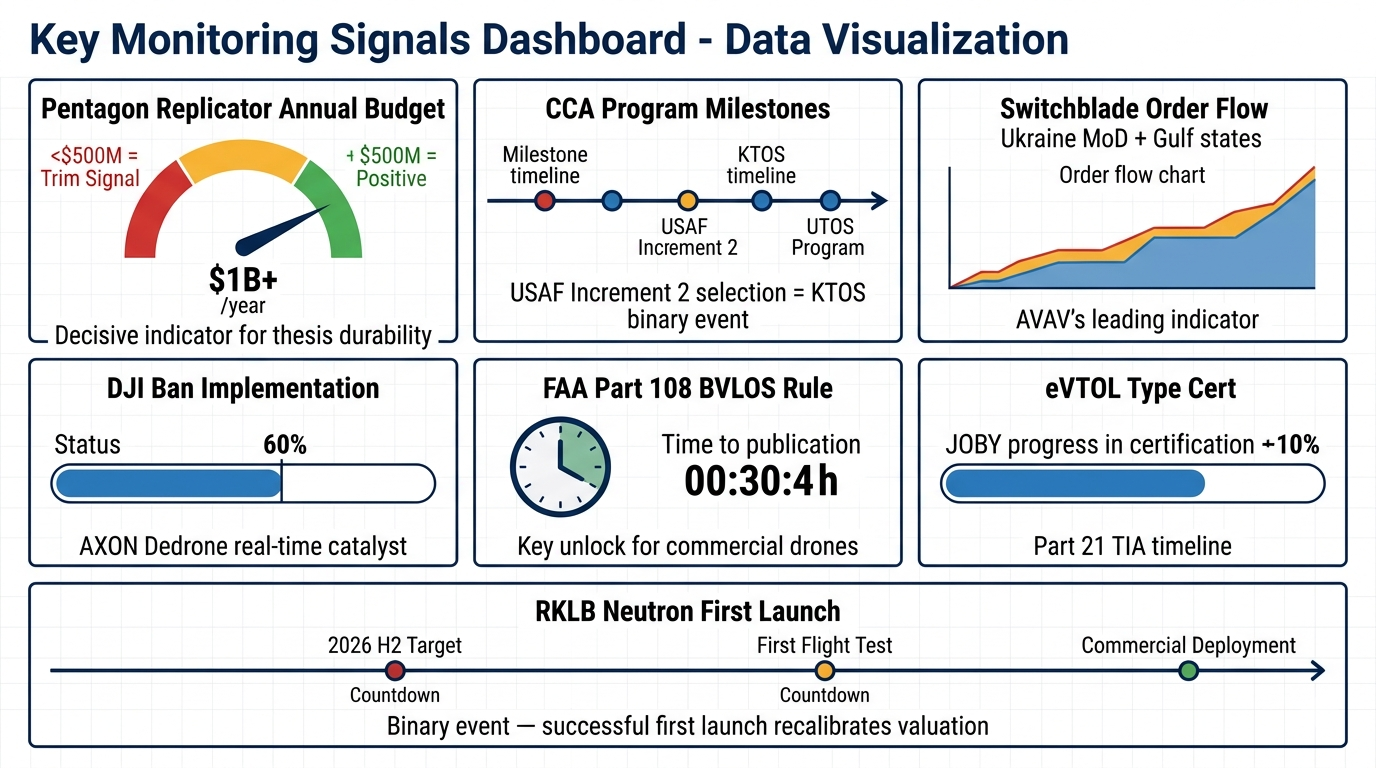
Key Signals to Monitor
- Pentagon Replicator annual budget — sustained $1B+ YoY = thesis intact; cut to <$500M = trim
- CCA program milestones — which suppliers USAF selects for Increment 2 = KTOS binary event
- Switchblade order flow — new orders from Ukraine MoD and Gulf states are AVAV’s leading indicator
- DJI Part 89 ban implementation — DJI ban enforcement = real-time AXON Dedrone catalyst
- FAA Part 108 BVLOS rule — final rule publication is the commercial drone unlock
- eVTOL type certifications — JOBY’s Part 21 TIA timeline
- RKLB Neutron first launch date — any 2026 H2 progress update
Data as of: April 18, 2026. All valuations based on closing prices that day. Fundamental data sourced from Finviz / StockAnalysis.com / Yahoo Finance.
Disclaimer: This article is for educational and research purposes only, and does not constitute investment advice. The author may hold positions in some of the securities mentioned.