Mar 22, 2026
Digital Warfare Goes Kinetic: Cybersecurity Investment Deep Dive
State-sponsored cyber escalation x $102B M&A wave x Platform consolidation. Full analysis of 9 cybersecurity stocks amid Iran cyber retaliation and Volt Typhoon.
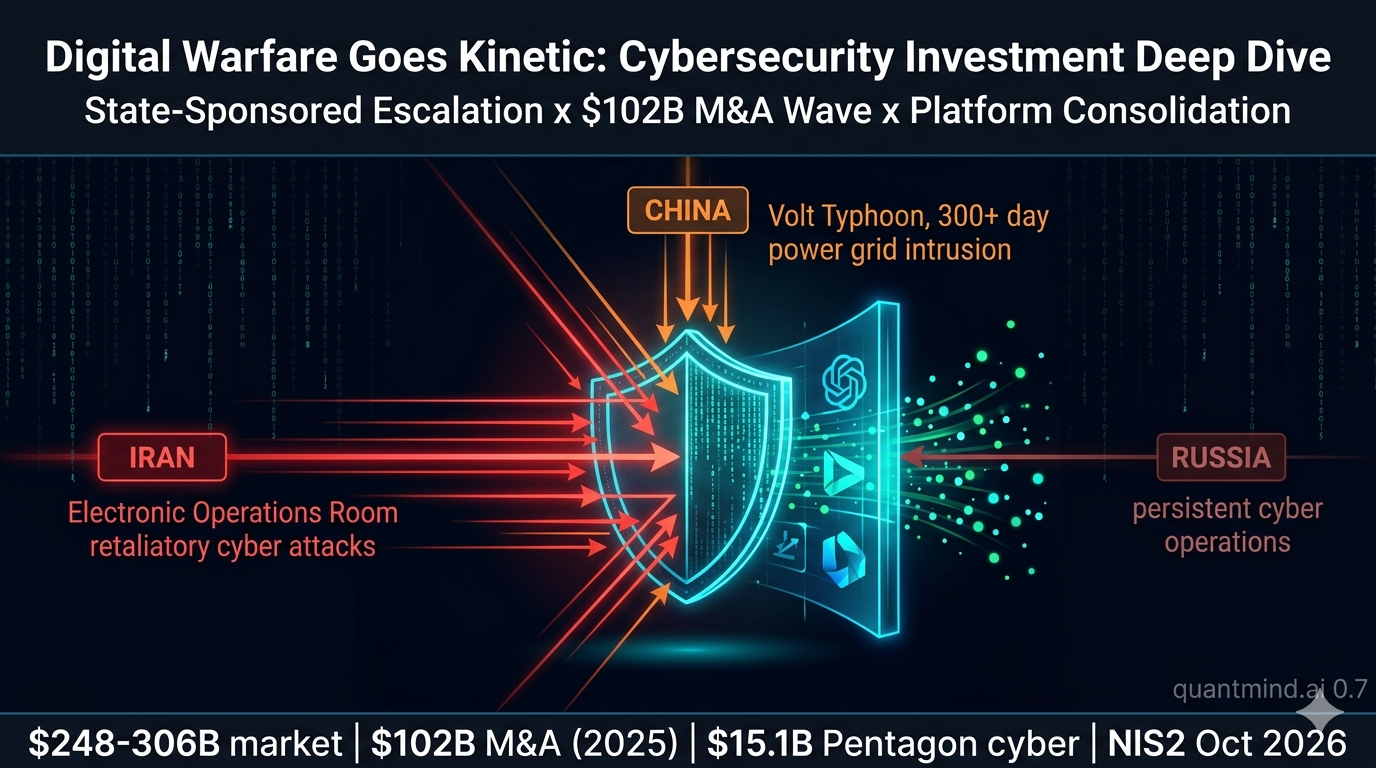
Part 4 of “The Geopolitical Edge” Investment Series
300 days. That’s how long China’s Volt Typhoon sat inside the US power grid before anyone noticed.
Not a smash-and-grab. Not ransomware. A state-sponsored advanced persistent threat burrowed into American critical infrastructure for nearly a year, pre-positioning for potential wartime sabotage. Meanwhile, Iran’s newly established “Electronic Operations Room” is coordinating cyber retaliation across proxy networks. Pentagon cyber spending just hit $15.1 billion. And the M&A frenzy? $102 billion in 2025 – a 300% increase – punctuated by Google’s $32 billion acquisition of Wiz.
This isn’t a growth sector. It’s a wartime sector priced like peacetime software.
I ran full fundamental analysis on 9 cybersecurity stocks – platform leaders, zero-trust pioneers, and deep-value vulnerability plays – across the complete toolkit: valuation, financial health, earnings quality, peer comparisons, intrinsic value. Here’s the complete breakdown.
TL;DR: - Top Conviction: FTNT (Fortinet) – cheapest profitable name, best-in-class 33-36% operating margins, record $2.21B FCF, 27.9x forward P/E - Best Platform Play: PANW – $3.75B FCF (38% margin), CyberArk acquisition creates identity moat, DCF implies +92% upside - Highest Growth: CRWD – $5.25B ARR, +51% Q4 earnings surprise, but 93.5x forward P/E prices perfection - Best Risk/Reward: ZS (Zscaler) – 77% analyst upside, pure zero-trust aligned with federal mandates, +94% Q2 earnings surprise - Deep Value Contrarian: TENB – 11.4x forward P/E, 2.4x EV/Revenue (cheapest in sector), 76% analyst upside
Three Forces Driving Cybersecurity Spending
Force 1: The Nation-State Cyber Escalation – From Espionage to Pre-Positioned Warfare
The ODNI 2026 Annual Threat Assessment names China as the most active and persistent cyber adversary. This is no longer theoretical:
- Iran’s Electronic Operations Room: Newly established coordination center directing cyber retaliation across proxy networks in response to Operation Epic Fury
- Russia: Continued targeting of NATO logistics, energy grids, and defense supply chains
- North Korea: Sustained crypto theft and ransomware funding ballistic missile program
- Google Threat Intelligence links coordinated defense-sector cyber operations across all four nation-states simultaneously
This creates mandatory, non-discretionary spending. When a foreign adversary is inside your power grid, you don’t wait for budget approval.
Force 2: The Regulatory Ratchet – Compliance as a Revenue Engine
Governments worldwide are weaponizing regulation to force cybersecurity adoption:
- EU NIS2 Directive: October 2026 deadline – every essential and important entity across 18 sectors in 27 EU member states must comply or face penalties up to 2% of global revenue
- US Federal Zero-Trust Mandate: CISA directives requiring agencies to adopt zero-trust architecture by end of FY2027
- Pentagon Cyber Budget: $15.1B in FY2026 NDAA (+$1.1B YoY) – dedicated military cyber spending separate from civilian IT
- CMMC 2.0: Defense contractor compliance requirement gates $400B+ in DoD contract eligibility
- SEC Cyber Disclosure Rules: Public companies must report material incidents within 4 business days
CISOs expect cybersecurity budgets to grow 50% faster than overall software spending (Morgan Stanley survey). Gartner projects global cybersecurity spending at $240B in 2026, up 12.5% from $213B in 2025, within a total addressable market of $248-306B growing 12-15% annually.
Force 3: Platform Consolidation – The Winner-Take-Most Dynamic
The cybersecurity industry is undergoing radical consolidation:
- $102B in M&A in 2025 – a 300% increase over prior years
- Google acquired Wiz for $32B – the largest cybersecurity acquisition in history
- PANW acquired CyberArk for $25B (closed Feb 2026) and Chronosphere for $3.35B – building the broadest security platform
- Platform vendors are eating point solutions: PANW, CRWD, and FTNT are consolidating 10+ security categories onto single platforms
- Customers consolidating vendors from 40-80 down to 3-5 platforms to reduce complexity
The winners are companies that can offer a unified platform spanning network, endpoint, cloud, identity, and data security. Point solutions face existential pressure.
Where the Money Is: Cybersecurity Profit Pool
| Segment | Margin Profile | Key Players | Geopolitical Catalyst |
|---|---|---|---|
| Network Security / SASE | High margin, large TAM | PANW, FTNT, ZS | VERY HIGH – nation-state perimeter breaches drive urgency |
| Endpoint / XDR | High margin, recurring | CRWD, S | HIGH – APT detection is existential for government/enterprise |
| Identity Security | Highest growth, strategic | PANW (via CyberArk) | VERY HIGH – identity is the new perimeter |
| Vulnerability Management | Moderate margin, compliance-driven | QLYS, TENB | HIGH – BOD 22-01 mandates CVE patching |
| Data Security | Emerging, underpenetrated | VRNS | MODERATE – data exfiltration by nation-states drives adoption |
| Zero Trust / Cloud Security | High growth, federal mandate | ZS, PANW, CRWD | VERY HIGH – federal zero-trust architecture is policy |
| Edge / Infrastructure Security | Moderate, network effects | NET | MODERATE – DDoS protection for critical infrastructure |
The Power Ranking: 9 Cybersecurity Stocks Analyzed
Tier 1: Core Holdings
FTNT – Fortinet | $81.40 | Market Cap: $60.5B
The Margin Machine at a Discount
| Metric | Value | Signal |
|---|---|---|
| P/E (Forward) | 27.9x | Cheapest profitable name |
| EV/Revenue | 8.4x | Below peer median |
| Operating Margin | 33-36% | Best-in-class |
| FCF | $2.21B (record) | 33% FCF margin |
| Revenue Growth | +15% | Solid |
| Beat Rate | >85% (6+ consecutive) | Consistent |
| Gross Margin | 79-81% | Strong |
| Rule of 40 | 48 | Strong pass |
Bull case: Cheapest profitable cybersecurity name by forward P/E. Record FCF at $2.21B. 33-36% operating margins are best-in-class among companies with meaningful revenue scale. 600,000+ customer installed base – largest firewall footprint globally. Vertically integrated ASIC design creates hardware cost advantage competitors cannot replicate. Firewall refresh cycle approaching as 3-5 year product lifecycles expire. Down 28% YTD creates entry point.
Bear case: Revenue growth decelerating to mid-teens. Market questions whether hardware-centric model is durable in a cloud-first world. SASE and cloud-native competitors (ZS, CRWD) eroding network security TAM.
Geopolitical edge: Primary perimeter defense vendor for critical infrastructure. Nation-state threat escalation directly drives firewall refresh cycles. FedRAMP authorized with strong DoD firewall presence.
Action: BUY. Best risk/reward in cybersecurity. Value + quality + execution.
PANW – Palo Alto Networks | $162.95 | Market Cap: $111.1B
The Platform Consolidator
| Metric | Value | Signal |
|---|---|---|
| P/E (Forward) | 45.7x | Premium but justified by FCF |
| EV/Revenue | 11.2x | Premium |
| FCF | $3.75B | 38% FCF margin – exceptional |
| Revenue Growth | +16% | Solid |
| Beat Rate | >90% (8+ consecutive) | Strong execution |
| Altman Z-Score | 5.71 | SAFE |
| Net Cash | $4.1B | Fortress balance sheet |
| Rule of 40 | 54 | Elite |
Bull case: Largest cybersecurity company globally by revenue. FCF machine generating $3.75B at 38% margins. CyberArk acquisition ($25B, closed Feb 2026) creates the only integrated network + endpoint + identity + cloud security platform. DCF models imply $313-395 fair value – 92-142% upside. Aggressive platformization strategy driving $33M+ single government deals. Debt/equity at 0.05x – near zero leverage.
Bear case: CyberArk and Chronosphere integration execution risk. Revenue growth decelerating from 20%+ to mid-teens. Guidance sensitivity high – shares fell 9% after Q2 FY2026 despite EPS beat. 45.7x forward P/E leaves limited room for error.
Geopolitical edge: Sells to government entities worldwide. FedRAMP authorized. Large US cabinet agency signed $33M SASE deal. Core network security vendor for critical infrastructure – directly benefits from nation-state escalation.
Action: BUY. FCF generation justifies premium. CyberArk integration is the catalyst.
QLYS – Qualys | $96.44 | Market Cap: $3.5B
The Cash Cow Fortress
| Metric | Value | Signal |
|---|---|---|
| P/E (Forward) | 21.4x | Attractive |
| EV/FCF | 18.2x | Deep value |
| Operating Margin | ~42% | #1 in sector |
| Net Margin | 29.0% | Exceptional |
| FCF Margin | 44% | #1 in sector |
| Debt | ZERO | Debt-free for 5+ years |
| ROE | 37.4% | Excellent |
| Rule of 40 | 54 | Elite |
| Cash | $696.8M | Strong |
Bull case: Most profitable cybersecurity company in the public markets. Zero debt. 44% FCF margin. 29% GAAP net margin. Trading at 18x FCF – a rarity in cybersecurity. $200M buyback expansion. 51 beats out of 59 quarters (86% all-time beat rate). At 21.4x forward P/E, this is a cash-generating fortress priced like a value stock.
Bear case: Revenue growth decelerating to 7-8%. NDR declining – customers not expanding spend. Stock fell 18% after Q4 2025 despite beating estimates, on soft 2026 guidance. Insider selling activity. Risk of becoming a value trap if growth stalls.
Geopolitical edge: Vulnerability scanning is a compliance requirement under BOD 22-01 and NIS2. Government mandates require agencies to patch known exploited vulnerabilities – Qualys is the compliance tool of choice.
Action: BUY for income-oriented / value investors. Best financial quality in cybersecurity.
Tier 2: Strategic Positions
CRWD – CrowdStrike | $409.00 | Market Cap: $103.7B – The Growth King
$5.25B ending ARR. Only company to exceed $1B net new ARR in a single year. Q4 FY2026 earnings surprise of +51.4%. Falcon Flex driving stickier deals (ARR up 200% YoY). 81% gross margins. But 93.5x forward P/E is the most expensive in the group. HOLD – magnificent company, fully valued. Accumulate on 15%+ pullbacks below $350.
ZS – Zscaler | $151.47 | Market Cap: $24.4B – The Zero-Trust Pure Play
Largest analyst upside in sector (+77-118%). Pure cloud-native zero-trust platform – no hardware legacy. ARR $3.36B growing 25%. Q2 FY2026 EPS surprise of +94.2%. Federal zero-trust mandates are a structural tailwind. Stock down 55% from 52-week high. But GAAP losses persist and CEO ownership concentration creates governance questions. SPECULATIVE BUY – the federal zero-trust mandate is a multi-year catalyst.
TENB – Tenable | $19.84 | Market Cap: $2.4B – The Deep Value Play
Cheapest stock in cybersecurity by every metric: 11.4x forward P/E, 2.4x EV/Revenue. 76% analyst upside. 82.7% gross margins. Crossing $1B revenue in FY2026. Columbia, MD headquarters near NSA/Cyber Command with strong government presence. But revenue growth decelerating to 7-11%, GAAP losses, and CEO transition risk. SPECULATIVE BUY – deep value with government cyber tailwind.
Tier 3: Growth / Tactical
S – SentinelOne | $14.17 | Market Cap: $4.7B – The AI-Native Challenger
Cheapest EV/Revenue among growth names (4.7x). Just crossed $1B revenue. Non-GAAP margins expanding 600bps YoY. AI-native endpoint detection competing directly with CRWD. But smallest company fighting PANW and CRWD behemoths. NDR at 109% is lowest among peers. Rule of 40 fails at 30. SPECULATIVE HOLD – growth trajectory improving, but scale disadvantage is real.
NET – Cloudflare | $215.27 | Market Cap: $75.8B – The Edge Infrastructure Bet
30% revenue growth at $2.17B scale. 269 customers spending $1M+ (up 55% YoY). Largest ACV deal ever at $42.5M/year. Edge computing + AI inference positioning. But 180.4x forward P/E is extreme. Only 8% analyst upside. Not a pure-play cybersecurity company. AVOID at current levels – risk/reward is asymmetrically negative at 180x forward P/E with 8% upside.
Avoid / Monitor
VRNS – Varonis | $23.72 | Market Cap: $2.8B – High-Risk Turnaround
94% analyst upside – most beaten-down name. SaaS ARR growing 26-32%. Data security is an underpenetrated TAM. But DISTRESSED health rating: D/E 2.17x, net debt/EBITDA 18.2x, -17.4% GAAP net margin. Three red flags. Q3 2025 revenue miss and guidance cut. Class action lawsuit filed. FY2026 EPS guidance missed consensus by 76.6%. MONITOR – wait for SaaS transition to stabilize financials. Only for deep contrarians at very small size.
Geopolitical Scenario Matrix
| Stock | Cyber War Escalation | Regulatory Ratchet (NIS2/Zero Trust) | M&A Consolidation Wave | Budget Austerity / DOGE Cuts |
|---|---|---|---|---|
| FTNT | Very Strong – firewall refresh | Strong – NIS2 compliance driver | Moderate – acquirer or target | Moderate – commercial offsets |
| PANW | Very Strong – platform demand | Very Strong – federal zero-trust deals | Very Strong – consolidation leader | Moderate – diversified revenue |
| QLYS | Strong – vuln scanning demand | Very Strong – compliance is their business | Strong – acquisition target | Moderate – lean cost structure |
| CRWD | Very Strong – endpoint detection | Strong – federal presence | Strong – platform consolidator | Moderate – diversified |
| ZS | Strong – zero-trust adoption | Very Strong – architecture aligned | Moderate – could be acquired | Weak – government exposure risk |
| TENB | Strong – CVE patching urgency | Very Strong – BOD 22-01 tailwind | Very Strong – likely target | Weak – government-heavy revenue |
| S | Strong – AI endpoint | Moderate – growing federal | Strong – acquisition target | Weak – small scale |
| NET | Moderate – DDoS defense | Moderate – not pure-play | Moderate – too large to acquire | Moderate – enterprise-heavy |
| VRNS | Moderate – data exfiltration | Moderate – data governance | Strong – likely target | Weak – distressed financials |
Portfolio Construction
| Tier | Stock | Allocation | Rationale |
|---|---|---|---|
| Core (55%) | FTNT | 20% | Best value+quality combination. Record FCF, cheapest profitable name |
| PANW | 20% | Platform consolidation winner. 38% FCF margin, CyberArk moat | |
| QLYS | 15% | Cash cow fortress. Zero debt, 44% FCF margin, 21.4x P/E | |
| Strategic (30%) | CRWD | 10% | Growth king – accumulate on pullbacks only |
| ZS | 10% | Zero-trust pure play. 77% analyst upside, federal mandate tailwind | |
| TENB | 10% | Deep value. 11.4x P/E, government cyber tailwind | |
| Tactical (10%) | S | 5% | AI-native endpoint. Improving margins, M&A optionality |
| VRNS | 5% | Turnaround speculative. 94% analyst upside, high risk | |
| Avoid (0%) | NET | 0% | 180x forward P/E, 8% analyst upside, not pure-play |
6 Investment Philosophy Perspectives
| Philosophy | Verdict | Rationale | Biggest Risk |
|---|---|---|---|
| Quality Compounder (Buffett) | LONG FTNT, QLYS | Fortress balance sheets + durable demand + best margins in sector | Growth deceleration becomes permanent |
| Imaginative Growth (Baillie Gifford) | LONG CRWD, ZS | Cloud-native platforms redefining enterprise security = paradigm shift | Extreme valuations compress on any miss |
| Fundamental L/S (Tiger Cubs) | LONG FTNT / SHORT NET | Cheapest profitable name vs most expensive with 8% upside | NET re-rates on AI infrastructure narrative |
| Deep Value (Klarman) | LONG TENB, VRNS (small) | 2.4x EV/Revenue and 94% analyst upside – discount may be overdone | Growth stalls, value trap confirmed |
| Catalyst-Driven (Tepper) | LONG PANW, ZS | CyberArk integration + NIS2 deadline Oct 2026 = near-term catalysts | Integration stumbles, NIS2 delayed |
| Macro Tactical (Druckenmiller) | LONG cybersecurity broadly | Nation-state cyber escalation is a generational secular trend | Budget fatigue / civilian CISA cuts |
Variant View
Market consensus: Cybersecurity stocks have re-rated on AI hype and geopolitical noise. Growth is decelerating across the sector. The best names (PANW, CRWD) are expensive. The cheap names (QLYS, TENB) are cheap for a reason – slowing growth.
What the market is missing: This isn’t a growth story – it’s a mandate story. When China sits inside your power grid for 300 days, cybersecurity spending becomes as non-discretionary as munitions replenishment. EU NIS2 creates a hard October 2026 compliance deadline across 27 countries and 18 sectors. The US federal zero-trust mandate is policy, not aspiration. Pentagon cyber spending is $15.1B and rising. And the $102B M&A wave in 2025 (300% increase) signals that strategic acquirers – Google, Palo Alto, Cisco – believe current public market valuations are too low. The consensus treats cybersecurity as a mature software sector with decelerating growth. It’s actually a wartime necessity with regulatory tailwinds, mandatory government spending, and aggressive consolidation creating winners at every tier. FTNT at 27.9x forward P/E with 33-36% operating margins is mispriced. PANW’s DCF implies 92% upside. TENB at 2.4x EV/Revenue is priced for irrelevance while sitting next to NSA headquarters with 65% Fortune 500 penetration.
Pre-Mortem: Three Ways This Goes Wrong
-
DOGE cuts civilian cyber budgets + NIS2 delayed. OMB has already proposed a 7% civilian agency cyber cut ($852M reduction) and CISA funding slashed. If NIS2 enforcement is pushed to 2028 and US federal spending flattens, the regulatory catalyst evaporates. Government-heavy names (TENB, ZS) give back 20-30%.
-
Platform consolidation kills the mid-cap ecosystem. PANW and CRWD absorb so much market share that QLYS, TENB, S, and VRNS face structural TAM compression. Point solutions become features, not products. Mid-cap valuations de-rate 30-40%.
-
Cyber detente or attribution failure. A diplomatic breakthrough on cyber norms – or simply an extended quiet period without major public breaches – removes the urgency premium. The sector trades down to normal software multiples. CRWD at 93x and NET at 180x have the most to lose.
Monitoring Dashboard
| Signal | Watch For | Bullish Trigger | Bearish Trigger |
|---|---|---|---|
| Nation-State Attacks | CISA advisories, ODNI reports | New critical infrastructure breach disclosed | 6+ months without major incident |
| NIS2 Enforcement | EU Commission updates | On track for Oct 2026 deadline | Delay announced beyond 2027 |
| Pentagon Cyber Budget | FY2027 NDAA markups | $16B+ cyber allocation | Flat or declining allocation |
| CISA Funding | Congressional appropriations | Funding restored to FY2025 levels | Further cuts beyond 7% |
| M&A Activity | Deal announcements | Another $10B+ acquisition | M&A freeze / antitrust blocks |
| PANW Integration | Quarterly earnings commentary | CyberArk cross-sell metrics positive | Integration charges, customer churn |
| CRWD ARR Growth | Quarterly earnings | Net new ARR accelerating | Net new ARR decelerating below $200M/Q |
| FTNT Billings | Quarterly earnings | Billings growth re-accelerating above 15% | Billings growth below 10% |
Decision Framework
| Stock | Buy | Add | Reduce | Stop |
|---|---|---|---|---|
| FTNT | $72 | $78 | $100 | $62 |
| PANW | $140 | $155 | $200 | $120 |
| QLYS | $85 | $92 | $120 | $72 |
| CRWD | $330 | $370 | $500 | $280 |
| ZS | $130 | $145 | $200 | $110 |
| TENB | $17 | $19 | $30 | $14 |
| S | $12 | $13.50 | $20 | $10 |
Part 4 of “The Geopolitical Edge” series. Part 2: Defense & Munitions Super-Cycle | Part 3: Photonics & Optical Interconnects available on the blog.
Note: CyberArk (CYBR) was acquired by Palo Alto Networks in February 2026 and is no longer independently tradeable. CYBR’s identity security business is now accessed through PANW. The original 10-stock universe has been reduced to 9 active names.
Disclaimer: Research and educational purposes only. Not investment advice. Data as of March 22, 2026.